

Hello! This is your Daily Hangul Editor.
Welcome back to Daily Hangul. As a tutor who has spent years correcting papers and chatting with students over coffee in Hongdae, I know exactly where you hit the wall. You’ve mastered the basic ~요 and ~습니다. You feel confident.
But then, you go to a hair salon or a clinic, and suddenly the grammar seems to break the laws of physics. Why are they showing respect to your hair? Why is the nurse honoring your headache?
Today, we are tackling the boss level of B2 Korean: Indirect Honorifics (간접 높임) and the common mistakes even Koreans make known as Service Industry Honorifics (사물 존칭).
This is the moment you transition from “Student Korean” to “Native-like Korean.”
Phase 1: The ‘Wait, What?’ Moment
Imagine you are at a nice dermatologist clinic in Gangnam. The receptionist smiles and says:
“환자분, 이름이 나오셨어요.”
(Patient, your name has come out [honorably].)
Wait. My name came out? And my name is honorable?
This is where B2 learners get confused. In English, you are polite to people. In Korean, to show extreme politeness to the person, we sometimes honor things related to them (like their name, body parts, or opinion). But often, service workers take this too far.
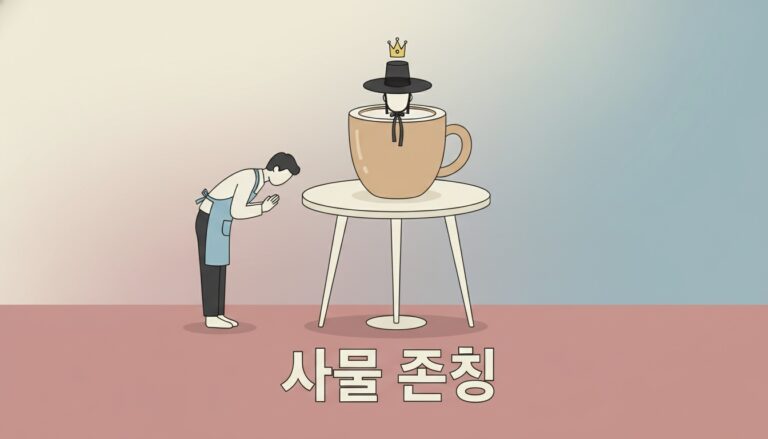
If you don’t understand this, you might giggle when a barista “bows” to your latte. If you do understand it, you can navigate these situations with confidence.
Phase 2: Deep Dive into Indirect Honorifics
Here are the 3 concepts that trip up intermediate learners.
1. 눈이 예쁘시네요 (Your eyes are beautiful)
This is Correct Indirect Honorifics. You aren’t honoring the eyes themselves; you are honoring the listener’s eyes.
- Pronunciation: Nun-i ye-ppeu-shi-ne-yo [Sounds like: ‘New-knee’ + ‘Yeah-pneu’ + ‘She-neigh-yo’]
- Meaning: “(Since you are respected), your eyes are beautiful.”
- Grammar Logic: Noun (part of you) + Adjective +
-(으)시-(Honorific marker). - Editor’s Insight: Use this for body parts, family members, or thoughts. It feels sophisticated and very polite.
2. 품절이십니다 (It is sold out)
This is the controversial “Service Industry Honorific.” Grammatically, it is often considered incorrect by the National Institute of Korean Language, but it is rampant in real life.
- Pronunciation: Poom-jeol-i-shim-ni-da
- Literal Meaning: “The product is honorable and sold out.”
- Real Nuance: The clerk is so anxious to be polite that they accidentally honor the product.
- Situation Check: You will hear this everywhere in shops. You don’t need to say it, but you must understand it.
3. 말씀이 있으시겠습니다 (He has words to say)
This is using special vocabulary for Indirect Honorifics.
- Pronunciation: Mal-sseum-i it-sseu-shi-get-sseum-ni-da
- Meaning: “The CEO (or respected person) will speak now.”
- Editor’s Insight: Notice we use
있으시다(to exist/have – honorific) instead of just있다.
Phase 3: Textbook vs. Real Life (Street Smarts)
Let’s compare what the grammar books say versus what you’ll hear in a bustling café in Seoul.
| Situation | Textbook (Grammatically Perfect) | Real Life (Service Industry/Over-polite) |
|---|---|---|
| Coffee is ready | 커피 나왔습니다. (Coffee came out.) | 커피 나오셨습니다. (Mr. Coffee has graciously appeared.) |
| Paying the bill | 5만 원입니다. (That will be 50,000 won.) | 5만 원이십니다. (The 50,000 won is honorable.) |
| Describing a boss | 사장님은 딸이 있어요. (The boss has a daughter.) | 사장님은 따님이 있으세요. (The boss [honorably] has a [honorable] daughter.) |
Editor’s Note: As a B2 learner, you should aim for the Textbook/Correct column when you speak. However, do not correct a service worker using the Real Life column. They are just trying to be kind!
Phase 4: Cultural Context (Nunchi Factor)
Why does this happen?
It’s about “Face” (Chemyon, 체면) and Service Mindset.
In Korea, the customer is King (literally called Wang). Employees feel uncomfortable using a “flat” sentence like “The coffee is here” to a King. They feel it sounds too abrupt.
So, they add the magic sauce -(으)시- to everything to soften the blow.
Non-verbal Tip: When you hear these indirect honorifics, simply nod slightly. You don’t need to bow back to the coffee. A gentle nod acknowledges their effort to be polite.
Phase 5: Roleplay – At the Hair Salon (미용실)
Setting: You (B2 Learner) are getting a haircut. The stylist is very polite.
Stylist: 고객님, 머리카락이 많이 상하셨네요.
(Go-gaek-nim, meo-ri-ka-rak-i ma-ni sang-ha-shyun-ne-yo.)
(Customer, your hair is quite damaged [honored].)
You: 아, 정말요? 염색을 자주 해서 그런가 봐요.
(Ah, jeong-mal-yo? Yeom-saek-eul ja-ju hae-seo geu-reon-ga bwa-yo.)
(Oh, really? I guess it’s because I dye it often.)
Stylist: 네, 두피도 좀 건조하세요. 트리트먼트 해드릴까요?
(Ne, du-pi-do jom geon-jo-ha-se-yo. Treatment hae-deu-ril-kka-yo?)
(Yes, your scalp is also a bit dry [honored]. Shall I do a treatment for you?)
You: 네, 부탁드릴게요.
(Ne, bu-tak-deu-ril-ke-yo.)
(Yes, please [I give a request].)
Acting Tip: Notice the stylist honors your hair (
상하셨네요) and scalp (건조하세요). This is correct Indirect Honorifics because these are parts of your body!
Phase 6: 10-Second Shadowing Drill
Practice the rhythm. Emphasize the bold part to master the “Honorific Insert.”
Sentence: “Teacher, your voice is really nice.”
선생님, 목소리가 / 정말 / 좋으시네요.
(Seon-saeng-nim, mok-so-ri-ga / jeong-mal / jo-eu-shi-ne-yo.)
- Start with a flat tone.
- Pause slightly after
목소리가. - Rise in pitch gently at
으시(eu-shi) to show respect.
Phase 7: FAQ & Troubleshooting
Q: Can I use -(으)시- for my own body parts? Like “제 눈이 아프십니다”?
A: ABSOLUTELY NOT. Never honor yourself.
* Wrong: 제 다리가 아프세요. (My leg is honorable and hurts.)
* Right: 제 다리가 아파요. (My leg hurts.)
Q: Is it rude if I don’t use Indirect Honorifics for someone older?
A: At the B2 level, yes. If you say to your boss “눈이 예뻐요” (Eyes are pretty), it sounds like you are flirting or talking to a child. You must say “눈이 예쁘세요.”
Phase 8: Wrap-up
One-Liner Summary: Indirect Honorifics honor the attributes of a person (hands, ideas, family), but avoid honoring inanimate objects (coffee, bills) unless you are a stressed service worker.
Action Mission: Next time you watch a K-Drama, listen for when a character talks about a boss or elder. Try to catch one instance where they honor a body part or possession (e.g., “말씀이 지나치십니다” – Your words are excessive).
Tell me in the comments: What is the funniest “Service Honorific” mistake you’ve heard in Korea? Did someone bow to your credit card?
Phase 9: Pop Quiz
Which sentence is historically/grammatically INCORRECT (even if common)?
- 선생님, 따님이 예쁘시네요. (Teacher, your daughter is pretty.)
- 주문하신 커피 나오셨습니다. (The coffee you ordered has [honorably] come out.)
- 할머니는 귀가 밝으세요. (Grandmother has good hearing [Ears are bright].)
Click to see the answer
Answer: 2. Coffee is an object and cannot be honored. The correct phrase is “커피 나왔습니다.” But don’t be surprised if you hear #2 at Starbucks!







