

👋 Hello! This is your Editor at Daily Hangul.
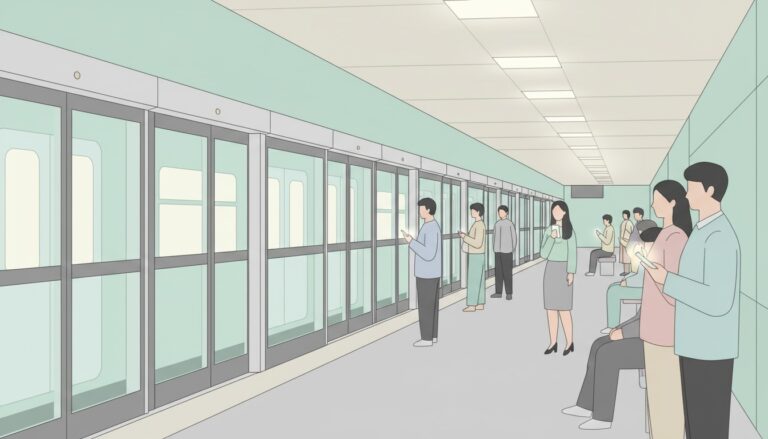
Imagine this: It’s 8:00 AM in Seoul. You are rushing to catch the subway. A Korean acquaintance sees you running and asks, “Where are you going?” You freeze. Do you say “Work go?” or “Go company?”
Don’t worry. This is a classic panic moment for every beginner.
Today, we are going to master the Morning Commute. By the end of this post, you won’t just know how to say “I’m going to work”; you’ll understand the subtle difference between going to school and going to work, so you don’t sound like a student when you’re actually a CEO.
This guide is built on real questions from students who successfully survived their first month in Korea. Let’s dive in!
Phase 1: Deep Dive into Key Expressions
Here are the top 3 expressions you need to survive the morning rush. We are keeping it A1 (Absolute Beginner) friendly.
1. 회사에 가요 [Hoe-sa-e ga-yo]
- Pronunciation: Hoe-sa (sounds like “Hway-sa”) + e (eh) + ga-yo.
- Meaning: “I am going to work (the company).”
- Editor’s Insight: This is the most standard, safe way to say you are off to work. “Hoe-sa” means company.
- Situation Check: 🔸 Polite/Standard. Good for neighbors or acquaintances.
2. 학교에 가요 [Hak-gyo-e ga-yo]
- Pronunciation: Hak-gyo (sounds like “Hahk-gyo”) + e + ga-yo.
- Meaning: “I am going to school.”
- Editor’s Insight: If you are a student, this is your phrase. Don’t mix this up with Hoe-sa!
- Situation Check: 🔸 Polite/Standard.
3. 출근해요 [Chul-geun-hae-yo]
- Pronunciation: Chul-geun (sounds a bit like “Chewing gum” without the ‘ing’) + hae-yo.
- Meaning: “I am commuting to work.”
- Editor’s Insight: This is a bit more advanced but very natural. It specifically means the act of clocking in or starting the work day. It sounds much more professional than just “going.”
- Situation Check: 💼 Professional/Formal.
Phase 2: Textbook vs. Real Life
Textbooks make you sound like a robot. Let’s make you sound like a local.
| Textbook (Correct but Stiff) | Real Life (Natural & Cool) | Usage Note |
|---|---|---|
| 버스에 탑니다. (I board the bus.) | 버스 타요. (I’m taking the bus.) | Drop the particle ‘e’ and end with soft ‘yo’. |
| 지금 회사에 갑니다. (I go to the company now.) | 지금 가는 중이에요. (I’m on my way now.) | Used when someone calls you while you are moving. |
| 안녕히 다녀오세요. (Go and come back safely.) | 다녀올게요! (I’ll be back!) | Said to family/roommates when leaving the house. |
Note: As an A1 learner, sticking to “[Place] + ga-yo” (going to [Place]) is perfectly fine and understood by everyone!
Phase 3: Cultural Context (The “Nunchi” Game)
🚇 The Silence of the “Jiok-cheol”
Korean mornings are intense. We call the rush hour subway 지옥철 (Jiok-cheol), which literally means “Hell Subway.”
- Non-verbal Rule: If you are on the subway or bus during rush hour, silence is golden. Talking loudly on the phone is considered rude.
- Eye Contact: Don’t stare at people. Most Koreans will be looking at their smartphones. If you make eye contact, just lightly nod or look away.
Phase 4: Real Scenario Roleplay
Setting: You are leaving your share-house. You meet your Korean neighbor, Min-su, at the door.
Characters:
* You: An enthusiastic expat.
* Min-su: A friendly Korean neighbor.
(You open the door and bow slightly)
Min-su: 안녕하세요! 어디 가요?
(An-nyeong-ha-se-yo! Eo-di ga-yo?)
Hello! Where are you going?
You: 안녕하세요! 회사에 가요.
(An-nyeong-ha-se-yo! Hoe-sa-e ga-yo.)
Hello! I’m going to work.
Min-su: 아, 버스 타요?
(Ah, Bus ta-yo?)
Ah, do you take the bus?
You: 아니요, 지하철 타요.
(A-ni-yo, Ji-ha-cheol ta-yo.)
No, I take the subway.
Min-su: 네, 잘 다녀오세요!
(Ne, jal da-nyeo-o-se-yo!)
Okay, have a safe trip!
Phase 5: 10-Second Shadowing Drill
Don’t just read it, say it! Focus on the rhythm.
Sentence: I am going to the company now.
Korean: 지금 / 회사에 / 가요.
Pronunciation: Ji-geum / Hoe-sa-e / Ga-yo.
(Repeat 3 times: Slow -> Normal -> Fast)
Phase 6: FAQ & Troubleshooting
Q: Can I say “School-e Chul-geun-hae-yo”?
A: NO! 🙅♂️ Chul-geun is only for work (earning money). For school, we use 등교 (Deung-gyo), but that’s a hard word. Just stick to “Hak-gyo-e ga-yo” (Going to school). It works perfectly.
Q: Do I always have to say “-yo” at the end?
A: YES. Until you become very close friends (“besties”), always add “yo” at the end. It ensures you are polite and respectful.
Phase 7: Wrap-up
- One-Liner: To say you are commuting, just use “[Place] + e + ga-yo”.
- Your Mission: Tomorrow morning, when you leave your house, say “Da-nyeo-ol-ge-yo!” (I’ll be back!) to your room, your pet, or your roommate.
💬 Question: How do you commute in your country? Bus? Subway? Or walking? Tell me in the comments!
Phase 8: Pop Quiz
1. How do you say “I go to work”?
A) Hak-gyo-e ga-yo
B) Hoe-sa-e ga-yo
C) Ji-be ga-yo
2. What is the “Hell Subway” called in Korean?
A) KTX
B) Jiok-cheol
C) Taxi
3. Which particle is dropped often in real life conversation? (e.g., Bus-___ ta-yo)
A) Eul/Reul
B) Ga
C) Eun
(Answers: 1-B, 2-B, 3-A)
Frequently Asked Questions (FAQ)
Q: What does "회사에 가요 [Hoe-sa-e ga-yo]" mean in Korean and how do you pronounce it?
A: In Korean, "회사에 가요 [Hoe-sa-e ga-yo]" is pronounced [Hoe-sa (sounds like "Hway-sa"] and means: "I am going to work (the company)."
Q: What does "학교에 가요 [Hak-gyo-e ga-yo]" mean in Korean and how do you pronounce it?
A: In Korean, "학교에 가요 [Hak-gyo-e ga-yo]" is pronounced [Hak-gyo (sounds like "Hahk-gyo"] and means: "I am going to school."
Q: What does "출근해요 [Chul-geun-hae-yo]" mean in Korean and how do you pronounce it?
A: In Korean, "출근해요 [Chul-geun-hae-yo]" is pronounced [Chul-geun (sounds a bit like "Chewing gum" without the 'ing'] and means: "I am commuting to work."







