

Phase 1: Introduction
Hello! It’s your editor from Daily Hangul.
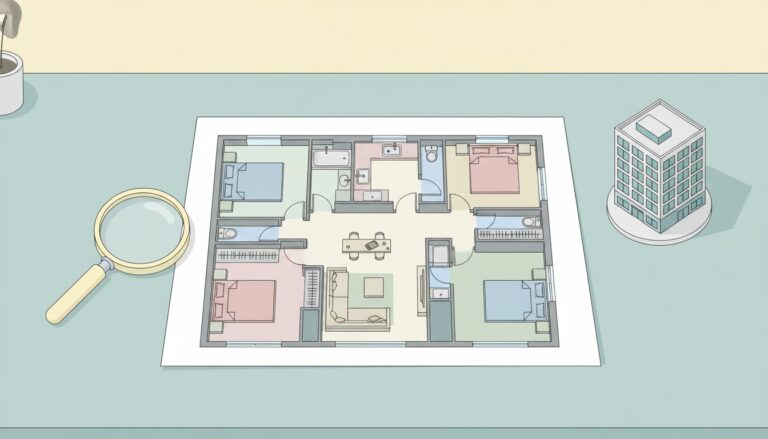
Have you ever walked past a building in Korea with huge banners, loud music, and a long line of people waiting to get in? Chances are, you’ve stumbled upon a Model House (모델 하우스), or a “Show Home” for a new apartment complex.
For a foreigner, entering one can feel like stepping onto a sci-fi movie set. It’s chaotic, exciting, and full of rapid-fire Korean numbers. You might just want to look at the pretty interior design, but an agent approaches you and asks, “Cheong-yak tong-jang iss-eu-seyo?” (Do you have a housing subscription account?)
Panic mode on, right? 😅
Don’t worry. Today, we aren’t buying a million-dollar apartment. We are learning how to navigate the viewing experience with confidence. Knowing just a few key phrases will turn you from a confused tourist into a savvy potential resident (or at least, someone who looks like one!).
Transparency Note: This guide is based on real struggles my intermediate students faced when trying to find housing in Seoul.
Phase 2: Deep Dive into Key Expressions
Here are the top 3 expressions you need to survive a Model House visit without looking lost.
1. 이거 기본 옵션인가요?
(I-geo gi-bon op-syeon-in-ga-yo?)
- Pronunciation: E-guh gee-bon op-shun-in-ga-yo? (Think of ‘Op-shun’ as the English word ‘Option’ with a Korean accent.)
- Meaning: “Is this a standard option?” (Is this included in the base price?)
- Editor’s Insight: This is the most critical question. Korean model houses are decorated with luxury fridges, ovens, and fancy lights. But 90% of them might be “paid upgrades” (유상 옵션). Use this to avoid falling in love with a kitchen that costs extra!
- Situation Check: Perfect for asking the staff standing in the room. Formal and polite.
2. 실평수가 어떻게 돼요?
(Sil-pyeong-su-ga eo-tteo-ke dwae-yo?)
- Pronunciation: Sil-pyung-soo-ga uh-tuh-keh dwe-yo? (‘Sil’ sounds like ‘Seal’ but shorter.)
- Meaning: “What is the actual usage area?”
- Editor’s Insight: In Korea, we use “Pyeong” (평) as a unit of size (1 Pyeong ≈ 3.3 m²). However, the “contract size” includes public spaces like hallways. Asking for “Sil-pyeong-su” (Actual/Net size) shows you know the game. You are asking, “Okay, but how much space is ACTUALLY mine?”
- Situation Check: Use this with the consulting agent. It makes you sound very pro.
3. 입주는 언제부터예요?
(Ip-ju-neun eon-je-bu-teo-ye-yo?)
- Pronunciation: Ip-ju-neun un-jay-boo-tuh-yay-yo? (‘Ip’ sounds like ‘Eep’ in ‘Jeep’.)
- Meaning: “When does the move-in start?”
- Editor’s Insight: Unlike renting, new apartments are often sold before they are built. You need to know when the construction finishes. This phrase confirms the timeline.
- Situation Check: Standard question for any housing inquiry.
Phase 3: Textbook vs. Real Life
Textbooks are great, but they don’t teach you the “Real Estate Agent” vibe. Let’s look at the difference.
| Textbook Korean (Standard) | Real Life Korean (Natural/Smart) |
|---|---|
| 이 아파트는 얼마나 넓습니까? (How wide is this apartment?) |
이거 전용 84(팔사)형 맞나요? (Is this the exclusive 84-type?) Editor’s Note: Koreans refer to size by ‘Type number’ these days. |
| 가구는 포함되어 있습니까? (Is furniture included?) |
이거 다 풀옵션이에요? (Is this all ‘Full-option’?/Fully furnished?) |
| 방을 구경하고 싶습니다. (I want to see the room.) |
유닛 좀 둘러봐도 될까요? (Can I look around the ‘Unit’?) |
Bottom Note: At a B1 level, try using the word “풀옵션” (Pul-op-syeon). It’s Konglish (Korean+English), but every Korean understands it instantly as “fully furnished.”
Phase 4: Cultural Context & Manners
Language is only 50% of communication. Here is the Non-verbal etiquette (Nunchi) you need.
1. Shoes Off, Slippers On!
Almost every model house requires you to take off your shoes at the entrance and change into slippers provided by them.
* ⚠️ Caution: Do not wear socks with holes in them! You will be walking around in slippers among hundreds of people.
2. Don’t Touch Everything
While you can open closets, some high-end items or decorative props (like fake wine bottles or laptops) are glued down or marked “Do Not Touch” (눈으로만 봐주세요). If you see a sign, keep your hands to yourself.
3. The “Freebie” Culture
Leaving a model house often involves getting free gifts—usually boxes of tissue, wet wipes, or sometimes ramen. Don’t be shy; take it! It’s part of the marketing culture.
Phase 5: Roleplay Script
Setting: A busy Sunday afternoon at a model house for a new apartment complex in Gyeonggi-do.
- Characters:
- Alex (Foreigner): Looking for a clean, new place to live.
- Agent (Korean): A busy real estate consultant.
(Alex puts on slippers and walks into the living room sample unit. He taps the shoulder of an agent.)
Alex: 저기요, 질문 좀 할게요. 이 거실 확장은 기본 옵션인가요?
(Excuse me, I have a question. Is this living room expansion a standard option?)
[Jeo-gi-yo, jil-mun jom hal-ge-yo. I geo-sil hwak-jang-eun gi-bon op-syeon-in-ga-yo?]
Agent: 아, 아니요. 확장은 별도예요. 유상 옵션입니다.
(Ah, no. Expansion is separate. It’s a paid option.)
[A, a-ni-yo. Hwak-jang-eun byeol-do-ye-yo. Yu-sang op-syeon-im-ni-da.]
Alex: 아, 그렇군요. 그럼 여기 실평수가 어떻게 되죠?
(Ah, I see. Then what is the actual size (real usage area) here?)
[A, geu-reo-kun-yo. Geu-reom yeo-gi sil-pyeong-su-ga eo-tteo-ke dwae-jo?]
Agent: 전용 59제곱미터라서, 실평수는 약 18평 정도 나와요.
(It’s exclusive 59sqm, so the actual size comes out to about 18 pyeong.)
[Jeon-yong o-sip-gu je-gom-mi-teo-ra-seo, sil-pyeong-su-neun yak sip-pal-pyeong jeong-do na-wa-yo.]
Alex: (Looking around) 구조가 되게 넓어 보이네요!
((Looking around) The structure looks really spacious!)
[Gu-jo-ga doe-ge neol-beo bo-i-ne-yo!]
Phase 6: 10-Second Shadowing Drill
Let’s practice the rhythm. Read this aloud. Pause at the slashes (/).
“Is the balcony extension / included in the price / or is it extra?”
베란다 확장은 / 분양가 포함인가요, / 아니면 별도인가요?
(Be-ran-da hwak-jang-eun / bun-yang-ga po-ham-in-ga-yo, / a-ni-myeon byeol-do-in-ga-yo?)
- Intonation Tip: Raise your pitch slightly at “포함인가요?” (Included?) and drop it at “별도인가요?” (Separate?).
Phase 7: FAQ & Troubleshooting
Q: Can I take photos inside?
A: Usually, NO. Most model houses forbid photography to protect their interior design copyright. If you try to snap a pic, staff might run over saying “Sajin jjigeusimyeon andwaeyo!” (No photos!). Always ask first: “Sajin jjigeodo dwaeyo?”
Q: Is it rude to ask about the price directly?
A: No! In a model house context, money is the main topic. You can ask “Bun-yang-ga-ga eol-ma-ye-yo?” (What is the sale price?) without hesitation.
Phase 8: Wrap-up
One-Liner Summary:
When visiting a Korean model house, check if the fancy furniture is a “Gi-bon Op-syeon” (Standard Option) and always ask for the “Sil-pyeong-su” (Actual Size).
Action Mission:
Next time you pass a local real estate agent (Budongsan) window, look for the number written next to “㎡”. Try to divide that by 3.3 in your head to guess the “Pyeong”!
💬 Let’s Chat:
Have you ever seen those huge apartment complexes in K-Dramas? Would you prefer living in a high-rise apartment or a small house? Tell me in the comments!
Phase 9: Pop Quiz
1. You see a beautiful oven in the model house kitchen. What should you ask to see if it’s free?
A) 이거 얼마예요? (How much is this?)
B) 이거 기본 옵션인가요? (Is this a standard option?)
C) 이거 맛있나요? (Is this delicious?)
2. What does “Sil-pyeong-su” (실평수) mean?
A) The price of the room.
B) The address of the building.
C) The actual/net size of the living space.
3. Which behavior is generally NOT allowed in a model house?
A) Wearing slippers provided by them.
B) Taking photos without permission.
C) Asking about the move-in date.
Click to see answers
1. B
2. C
3. B
Frequently Asked Questions (FAQ)
Q: What does ""풀옵션"" mean in Korean and how do you pronounce it?
A: In Korean, ""풀옵션"" is pronounced [Pul-op-syeon] and means: . It's Konglish (Korean+English), but every Korean understands it instantly as "fully furnished."







