

Introduction: Suddenly, Everyone is Family?
Hello, Daily Hangul family! It’s your senior editor here.
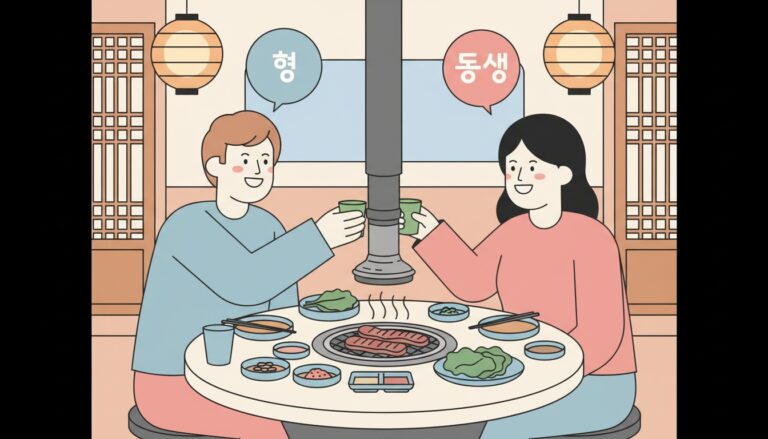
Imagine this: You are at a Korean BBQ place with a new Korean acquaintance. The atmosphere is good, the soju is flowing. Suddenly, he asks you, “How old are you?”
In the West, this might be rude. But in Korea, he is just trying to figure out if he should be your Hyung (Big Brother) or your Dongsaeng (Little Sibling).
Korean society is built on a ‘Social Family’ concept. Even if you don’t share a drop of blood, you can become brothers and sisters. But here is the tricky part: If you use these titles too early, you seem clingy. If you use them too late, you seem distant.
Today, let’s master the art of the ‘Social Family’ transition. Ready to become an insider?
Phase 2: Deep Dive into Core Expressions
At the B1 level, you likely know these words. But do you know the weight they carry?
1. 형 / 오빠 (Hyung / Oppa)
- Pronunciation:
- 형 [Hyeong]: Like ‘Hyoung’. Think of the ‘yung’ in ‘young’ but with an H.
- 오빠 [Oppa]: Oh-ppa. (Stress the ‘pp’ strongly, not soft ‘b’).
- Meaning: Older brother (used by males) / Older brother (used by females).
- Editor’s Insight:
- Hyung: This is the ultimate ‘Bro’ word. Once you call a Korean guy ‘Hyung’, you are signaling loyalty. He is now expected to buy you dinner occasionally!
- Oppa: Be careful. While it means older brother, it carries a romantic nuance in dating contexts. If you use this with a guy you just met, he might think you are flirting.
2. 누나 / 언니 (Noona / Unnie)
- Pronunciation:
- 누나 [Nuna]: Noo-nah.
- 언니 [Eonni]: Un-nee. (The ‘Un’ sounds like ‘Un’ in ‘Under’).
- Meaning: Older sister (used by males) / Older sister (used by females).
- Editor’s Insight:
- Unnie: This is a magic word. You can even use it in a cosmetic store or restaurant to call female staff (if they look slightly older or similar age). It sounds much friendlier than ‘Excuse me’.
3. ~씨 (-ssi) vs. Titles
- Meaning: Mr./Ms. (Polite suffix)
- Situation Check: Until you agree to drop formalities, keep using [Name]-ssi. Switching to Oppa/Unnie without permission is like walking into someone’s house without knocking.
Phase 3: Textbook vs. Real Life
How do you sound less like a robot and more like a friend?
| Textbook (Polite & Safe) | Real Life (B1 Level – Closer) |
|---|---|
| 민수 씨, 밥 먹었어요? (Minsu-ssi, did you eat?) |
민수 형, 밥 먹었어? (Minsu Hyung, did you eat?) |
| 저기요! (식당에서) (Excuse me!) |
언니! / 이모님! (Sister! / Auntie! – much friendlier) |
| 같이 가요. (Let’s go together.) |
형, 같이 가! (Bro, wait for me!) |
Note: Notice that when you switch to titles (Hyung/Unnie), you often drop the polite sentence ending ‘-yo’ (Banmal). But always ask first!
Phase 4: Cultural Context (The “Wallet” Rule)
In Korea, titles come with responsibilities. This is the ‘Naeri-sarang’ (Descalating Love) culture.
- The Wallet Rule: If you call him Hyung, he is culturally pressured to pay for the meal or drinks. If you insist on paying, you are being polite, but letting him pay establishes his ‘authority’ as the older one.
- The Nunchi Game: Don’t call someone Unnie or Noona if they look clearly younger than you. It can be offensive. If unsure, stick to “Jeogiyo” (Excuse me) until you know their age.
Phase 5: Roleplay Script
Setting: A casual pub (Pocha). Mark (foreigner) wants to get closer to Min-ho (older Korean coworker).
Mark: (Filling Min-ho’s glass) 민호 씨, 저 질문 하나 있어요.
(Min-ho-ssi, I have a question.)
Min-ho: 응? 뭔데요?
(Huh? What is it?)
Mark: (Smiling shyly) 우리 이제 편하게 지내면 안 될까요?
(Can we be comfortable with each other now?)
Min-ho: 아, 말 놓자고요? 당연하죠!
(Ah, speak casually? Of course!)
Mark: 그럼… 형이라고 불러도 돼요?
(Then… can I call you Hyung?)
Min-ho: (Laughing and clinking glasses) 당연하지! 마셔, 마크야!
(Of course! Drink up, Mark!)
Phase 6: 10-Second Shadowing
Let’s practice the ‘Golden Sentence’ to unlock the relationship. Read this with a slightly shy but hopeful tone.
“저도 / 형이라고 / 불러도 돼요?”
[Jeo-do / hyeong-i-ra-go / bul-leo-do dwae-yo?]
(Can I / also call you / Hyung?)
- Intonation: Raise your pitch slightly at the end (dwae-yo?) to sound polite.
Phase 7: FAQ & Troubleshooting
- Q: Can I call my boss “Hyung” at work?
- A: NO. Inside the office, hierarchy rules. Use their Job Title (e.g., Manager-nim). Hyung is only for after-work drinks or if you are extremely close and no one else is listening.
- Q: I am a guy. Can I call an older woman “Unnie”?
- A: No! Men call older women Noona. If a man says “Unnie”, it sounds like he is jokingly acting feminine or confused.
Phase 8: Wrap-up
Today’s Summary: Switching from Name-ssi to Hyung/Unnie/Oppa/Noona is the sign that you have moved from “Acquaintance” to “My Person” (내 사람).
Your Mission: Next time you are with a Korean friend who is older than you, wait for a good mood and ask: “Can I call you [Title]?” Watch their face light up!
Talk to me: Have you ever accidentally called someone the wrong title? Tell me your embarrassment in the comments!
Phase 9: Quick Quiz
1. You are a female. You met an older guy. What do you call him?
A) Hyung
B) Noona
C) Oppa
2. You are at a company meeting. Your boss is older than you. How should you address him?
A) Name-ssi
B) Job Title + nim (e.g., Bujang-nim)
C) Hyung
3. What does it usually imply if the older person agrees to be called Hyung/Unnie?
A) They want to borrow money.
B) You are now closer, and they might buy you dinner.
C) They are angry.
(Answers: 1. C, 2. B, 3. B)
Frequently Asked Questions (FAQ)
Q: What does "형 / 오빠 (Hyung / Oppa)" mean in Korean and how do you pronounce it?
A: In Korean, "형 / 오빠 (Hyung / Oppa)" is pronounced [형 [Hyeong] and means: a key conversational Korean expression covered in this lesson.
Q: What does "누나 / 언니 (Noona / Unnie)" mean in Korean and how do you pronounce it?
A: In Korean, "누나 / 언니 (Noona / Unnie)" is pronounced [누나 [Nuna] and means: a key conversational Korean expression covered in this lesson.
Q: What does "~씨 (-ssi) vs. Titles" mean in Korean and how do you pronounce it?
A: In Korean, "~씨 (-ssi) vs. Titles" is pronounced [see lesson guide] and means: Mr./Ms. (Polite suffix)







