

Hello! It’s your Daily Hangul Editor.
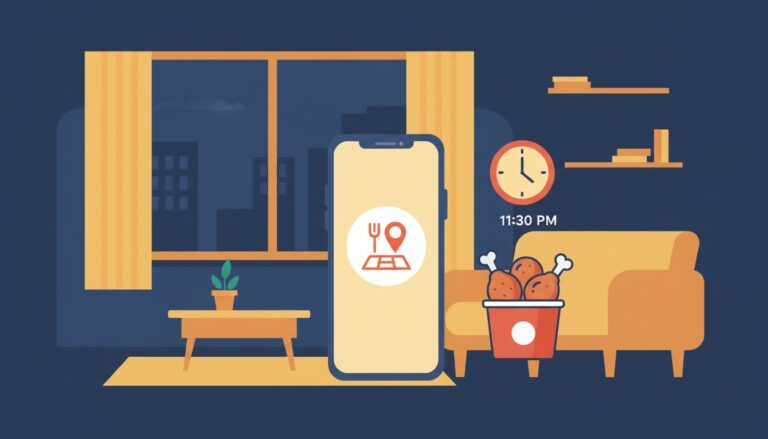
Imagine this: You are in your Airbnb in Seoul. It is 11:30 PM. You had dinner at 6 PM, but now, your stomach is growling like a tiger. You look out the window and see motorbikes zooming by with delivery boxes. This is the Golden Hour of Yasik (야식 – Late Night Snacks) in Korea.
But wait—your Korean roommate is sitting on the sofa. You want to suggest ordering some famous Korean Fried Chicken, but all you remember from your textbook is the formal “Do you want to eat dinner?”
If you say that at midnight, they might think you are time-traveling! Don’t worry. Today, I will teach you exactly how to express that late-night hunger and how to initiate the sacred ritual of Yasik like a true local. These are questions I get asked all the time by my students who want to experience Korea’s delivery culture properly.
1. The Classics & The Hidden Gems
Here are the three most important expressions you need for tonight.
1. 배고파요 (Baegopayo)
- Pronunciation:
Bae-go-pa-yo- Bae sounds like ‘be’ in bed.
- Go sounds like ‘go’.
- Pa sounds like ‘Pa’ in Papa.
- Meaning: I am hungry.
- Editor’s Insight: This is the standard, straight-to-the-point phrase. It literally means “The stomach is empty/painful.” You can use this with anyone if you keep the ‘Yo’ at the end.
- Situation Check: Universal (Friends, Polite company).
2. 출출해요 (Chulchulhaeyo)
- Pronunciation:
Chul-chul-hae-yo- Chul sounds like ‘chew’ but with an ‘L’ at the end.
- Meaning: I’m a bit peckish / I’m snacky.
- Editor’s Insight: 🌟 Star this one! This is the magic word for late nights. You aren’t starving to death, but your mouth is bored. Using this instead of Baegopayo at 11 PM makes you sound very native. It perfectly hints: “I don’t need a full meal, but maybe some Ramyeon?”
- Situation Check: Casual to Semi-formal.
3. 뭐 좀 시킬까요? (Mwo jom sikilkkayo?)
- Pronunciation:
Mwo jom si-kil-kka-yo? - Meaning: Shall we order something?
- Editor’s Insight: Korea is the Kingdom of Delivery. ‘Sikida’ (to order) is essential vocabulary. This is a gentle suggestion to open a delivery app.
- Situation Check: When you want to be the hero of the night.
2. Textbook vs. Real Life
Textbooks teach you to be polite, but sometimes they make you sound like a robot. Here is how to sound natural at night.
| Textbook (Safe but Stiff) | Real Life (Natural & Cool) | Meaning |
|---|---|---|
| 저녁 식사 하셨습니까? (Did you have dinner?) |
밥 먹었어? (Did you eat? – Casual) |
Checking hunger status |
| 배가 고픕니다. (My stomach is hungry.) |
배 안 고파? (Aren’t you hungry?) |
Suggesting food indirectly |
| 음식을 주문합시다. (Let’s order food.) |
야식 콜? (Night snack, call/deal? – Slang) |
Suggesting Yasik |
Note: Use the Real Life expressions with close friends or people younger than you. If you are unsure, stick to the Deep Dive expressions with ‘Yo’ attached!
3. Cultural Context: The ‘Nunchi’ of Yasik
In Korea, eating alone at night is fine, but Yasik is often a communal bonding activity.
- The Delivery Apps: If you see someone scrolling through an app with mint-colored branding (Baedal Minjok) or a pink one (Yogiyo) late at night, that is your signal. They are hunting for food.
- Manners: If you say “I’m hungry” (배고파요) to a Korean friend late at night, they will almost instinctively ask, “Do you want to order something?” It is part of Korean Jeong (affection) to not let friends go hungry.
4. Real Scenario: The Roommate Talk
Setting: A dorm room in Seoul. 11:45 PM.
Characters:
* Alex (You): Hungry foreigner.
* Minji (Korean): Roommate watching YouTube.
Alex: (Rubbing stomach) 아, 배고파요.
(Ah, baegopayo.)
[Ah, I’m hungry.]
Minji: 진짜요? 저도 좀 출출해요.
(Jinjja-yo? Jeo-do jom chulchulhaeyo.)
[Really? I’m a bit peckish too.]
Alex: 그럼 우리 치킨 시킬까요?
(Geureom uri chikin sikilkkayo?)
[Then shall we order chicken?]
Minji: 좋아요! 양념 반 후라이드 반?
(Joayo! Yangnyeom-ban huraideu-ban?)
[Good! Half seasoned, half fried?]
5. 10-Second Shadowing
Practice this sentence to convince your friends to eat. Read it slowly, then faster.
“Shall we order some late-night snacks?”
야식 / 좀 / 시킬까요?
(Ya-sik / jom / si-kil-kka-yo?)
- Focus Point: Raise your pitch at the end (
yo?) to make it a soft suggestion, not a demand.
6. FAQ: Troubleshooting
Q: Can I use “Chulchulhae” to my boss or teacher?
A: No! Even with ‘Yo’ attached, “Chulchulhada” can sound a bit too casual because it refers to a physical sensation of the stomach. To a superior, it is better to wait for them to suggest food, or simply use “Baegopayo” which is more neutral.
Q: What is the #1 Late Night Snack in Korea?
A: It is a battle between Chimaek (Chicken + Beer) and Ramyeon. If you want something lighter (well, slightly), Jokbal (Braised Pig’s Trotters) is also a king of Yasik.
7. Wrap-up
One-Liner Summary: Use “Baegopayo” when you are empty, use “Chulchulhaeyo” when you just want a snack, and always ask “Sikilkkayo?” to start a delivery party.
🔥 Today’s Mission: Tonight, turn to your friend, family member, or even your pet, and practice saying: “Ah… Chulchulhada!” (Ah… I’m peckish!)
What is your favorite late-night snack in your country? Let me know in the comments!
8. Pop Quiz
1. Which phrase is best used when you are just “a little bit” hungry at night?
a) Baegopayo
b) Chulchulhaeyo
c) Saranghaeyo
2. What does “Sikilkkayo?” mean?
a) Shall we sleep?
b) Shall we order?
c) Shall we run?
3. In the roleplay, what specific food did Alex suggest?
a) Pizza
b) Kimchi Stew
c) Chicken
Click to see answers
1. b) Chulchulhaeyo
2. b) Shall we order?
3. c) Chicken







