

Phase 1: Introduction
안녕하세요! This is your Head Editor at Daily Hangul.
If you’ve watched K-dramas like Descendants of the Sun or the more gritty D.P., you probably imagine the Korean military as a place of absolute isolation—a high-walled fortress cut off from the rest of the world.
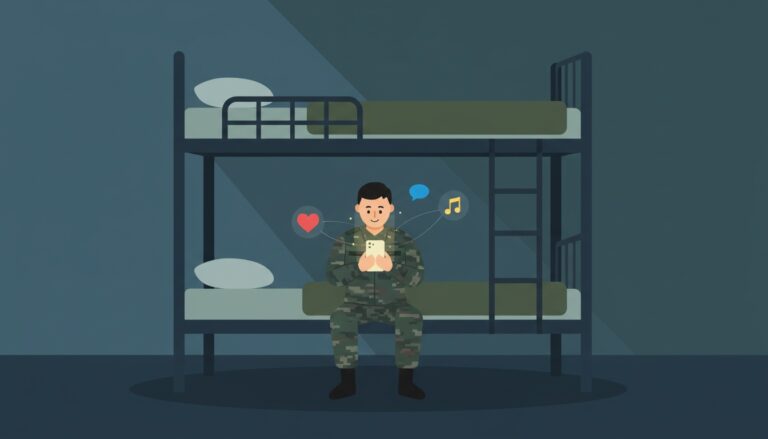
But here is the plot twist: If you visit a Korean army base today after 6 PM, you won’t just see soldiers polishing boots. You’ll see them scrolling through Instagram, watching YouTube, and even video chatting with their girlfriends.
Since 2020, the South Korean military has officially allowed soldiers to use mobile phones after duty hours. For a C2 learner like you, understanding this shift is crucial. It’s not just about “using a phone”; it’s about ‘social reconnection’ (사회적 단절 해소) and the massive cultural shift in ‘garrison life’ (병영 생활).
Today, we are going deep into the vocabulary of the modern Korean soldier. Let’s bridge the gap between the ‘Latte’ generation (older vets) and the ‘MZ’ soldiers.
Phase 2: Deep Dive into Core Expressions
These terms are essential for discussing the modern military environment at an advanced level.
1. 개인 정비 시간 (Gaein Jeongbi Sigan)
- Pronunciation: [Gae-in Jeong-bi Si-gan]
- Meaning: Personal Maintenance Time / Free Time
- Editor’s Insight: Literally, ‘maintenance’ usually applies to machines or equipment. However, in the military, humans are resources too. This term refers to the off-duty hours (usually 17:30 ~ 21:00) when soldiers can rest, exercise, or use their phones.
- Nuance: It sounds rigid, but nowadays, it equals “Freedom.” If you disturb a soldier during this time, you are violating their sacred right to rest.
- Situation Check: Very Formal (Military/Official) $\rightarrow$ Can be used sarcastically in civilian office life (e.g., “I’m taking some personal maintenance time” = coffee break).
2. 자기 계발 (Jagi Gyebal)
- Pronunciation: [Ja-gi Gye-bal]
- Meaning: Self-development / Self-improvement
- Editor’s Insight: This is the justification for allowing phones. The government argues that soldiers use phones for jagi gyebal (taking online classes, coding, learning languages). While many do, most just use it for YouTube algorithm surfing.
- Situation Check: Formal & Casual. You will hear this in corporate settings too.
3. 불출하다 (Bulchul-hada)
- Pronunciation: [Bul-chul-ha-da]
- Meaning: To dispense / To issue (supplies)
- Editor’s Insight: You won’t hear this on the streets of Seoul often. It’s a bureaucratic/military term. Phones are not “given”; they are “dispensed” (불출) from the secure locker and must be “returned” (반납) at night.
- Example: “휴대폰 불출 시간이다!” (It’s time to get our phones dispensed!)
Phase 3: Textbook vs. Real Life
At a C2 level, you need to distinguish between ‘Standard Korean’ and ‘Barracks Lingo’.
| Situation | Textbook / Civilan Korean | Modern Military Real Life (The Vibe) |
|---|---|---|
| Getting the phone | 핸드폰을 받으러 갑니다. (I am going to receive my phone.) | 폰 불출하러 갑니다. (Going for phone dispensing.) |
| Video Calling | 영상 통화를 하고 싶어요. (I want to make a video call.) | 페메 할 거야? (Gonna do a Facebook Message/Call?) Soldiers heavily use FB Messenger. |
| Using the Camera | 카메라를 켜세요. (Please turn on the camera.) | 보안 앱 켜져 있어? (Is the security app on?) Cameras are physically disabled by apps. |
| Emotional State | 사회와 소통해서 좋아요. (It’s good to communicate with society.) | 사회 물 좀 먹으니 살 것 같다. (I feel alive tasting the ‘water of society’.) |
Editor’s Note: “사회 물” (Water of society) is a metaphor for the trends, news, and vibe of the outside world, contrasting with the stagnant air of the base.
Phase 4: Cultural Context & Manners
The “Security App” Paradox
Even though phones are allowed, security (보안) is still the #1 priority.
* The Rule: Before entering the base, soldiers must install a “National Defense Mobile Security” app that disables the camera, GPS, and recording functions.
* The Culture: Taking a selfie in uniform inside the barracks is strictly prohibited. If a soldier posts a photo of the base interior on Instagram, it’s a serious offense (security leak).
The Generational Gap (Latte is Horse)
When you talk to Korean men in their 30s or 40s about this, you might hear a sigh.
* “When I was in the army, we lined up for 30 minutes to use a payphone for 3 minutes!”
* Tip: When discussing this with older Korean men, show empathy for their hardship. Say, “선배님들 덕분에 군대가 좋아진 거죠” (The army improved thanks to you seniors/veterans). This makes you an instant favorite.
Phase 5: Roleplay Script
Setting: Inside the barracks (생활관) at 6:00 PM. Two soldiers, Sergeant Kim (Senior) and Private Park (Newbie), receive their phones.
Characters:
* Sergeant Kim: Experienced, cynical, C2 level speaker.
* Private Park: Nervous, just finished training.
Dialogue:
Sergeant Kim: (Stretching arms) 아, 드디어 개인 정비 시간이다. 야, 폰 불출해 왔냐?
(Ah, finally, personal maintenance time. Hey, did you bring the dispensed phones?)
Private Park: (Handing over a phone with two hands) 네, 여기 있습니다! 보안 앱 작동 확인했습니다.
(Yes, here it is! I confirmed the security app is running.)
Sergeant Kim: 그래. 너도 얼른 여친한테 연락해. 안 그러면 고무신 거꾸로 신는다.
(Right. You should contact your girlfriend quickly. Otherwise, she might ‘wear her rubber shoes backward’ [cheat/leave you].)
Private Park: 아… 벌써 부재중 전화가 와 있습니다. 사회 물이 그립습니다, 김 병장님.
(Ah… there is already a missed call. I miss the ‘taste of society’, Sergeant Kim.)
Sergeant Kim: (Laughs) 폰이라도 있으니 버티는 거야. 예전 선배들은 어떻게 살았나 몰라.
(We survive because we at least have phones. I don’t know how the seniors survived in the past.)
Phase 6: 10-Second Shadowing Drill
Practice this sentence to sound like a sophisticated social commentator. Pay attention to the pauses.
“스마트폰 허용은 / 단순한 편의 제공을 넘어, / 병사들의 고립감을 해소하는 / 중요한 소통의 창구입니다.”
- Romanization: Smartphone heoyong-eun / dan-sun-han pyeon-ui je-gong-eul neom-eo, / byeong-sa-deul-ui go-rip-gam-eul hae-so-ha-neun / jung-yo-han so-tong-ui chang-gu-im-ni-da.
- Translation: Allowing smartphones goes beyond providing simple convenience; it is a crucial channel of communication that resolves the soldiers’ sense of isolation.
Phase 7: FAQ & Troubleshooting
Q: Can I text a soldier friend anytime?
A: No. If you text them during duty hours (08:00 – 17:30), they cannot reply. It might even get them in trouble if the vibration goes off during training. Stick to 18:00 – 21:00 KST.
Q: Can they use apps like Tinder?
A: Technically… yes. The internet isn’t blocked. But using location-based dating apps inside a military base is risky and frowned upon due to security protocols (revealing unit location).
Q: Is it rude to ask a soldier “Are you playing on your phone again?”
A: Yes. Their phone time is their only escape. Instead, ask: “오늘 개인 정비 때는 뭐 했어?” (What did you do during personal maintenance time today?)
Phase 8: Wrap-up
One-Liner Summary:
The Korean army has evolved from a disconnected island to a ‘partially connected’ society through ‘Gaein Jeongbi’ (Personal Maintenance) and smartphones.
Action Mission:
If you have a Korean male friend who finished his service recently, ask him: “군대에서 폰 쓸 때 뭐가 제일 좋았어요?” (What was the best thing about using a phone in the army?) You will hear some very honest stories.
Tell us in the comments:
If you were drafted into the army for 18 months, what is the one app you couldn’t live without?
Phase 9: Quiz
1. What is the sophisticated term for “free time” or “off-duty time” in the Korean military?
A) 낮잠 시간 (Nap time)
B) 개인 정비 시간 (Personal Maintenance Time)
C) 파티 타임 (Party Time)
2. Why do soldiers have to install a specific app before entering the base?
A) To get free discounts at the PX (store).
B) To track their calorie intake.
C) To disable the camera and microphone for security (보안).
3. What does the idiom “고무신을 거꾸로 신다” (wearing rubber shoes backward) mean in a military dating context?
A) The soldier ran away.
B) The girlfriend broke up with the soldier (often for someone else).
C) They decided to get married.
(Answers: 1. B, 2. C, 3. B)
Frequently Asked Questions (FAQ)
Q: What does "개인 정비 시간 (Gaein Jeongbi Sigan)" mean in Korean and how do you pronounce it?
A: In Korean, "개인 정비 시간 (Gaein Jeongbi Sigan)" is pronounced [Gae-in Jeong-bi Si-gan] and means: Personal Maintenance Time / Free Time
Q: What does "자기 계발 (Jagi Gyebal)" mean in Korean and how do you pronounce it?
A: In Korean, "자기 계발 (Jagi Gyebal)" is pronounced [Ja-gi Gye-bal] and means: Self-development / Self-improvement
Q: What does "불출하다 (Bulchul-hada)" mean in Korean and how do you pronounce it?
A: In Korean, "불출하다 (Bulchul-hada)" is pronounced [Bul-chul-ha-da] and means: To dispense / To issue (supplies)







