

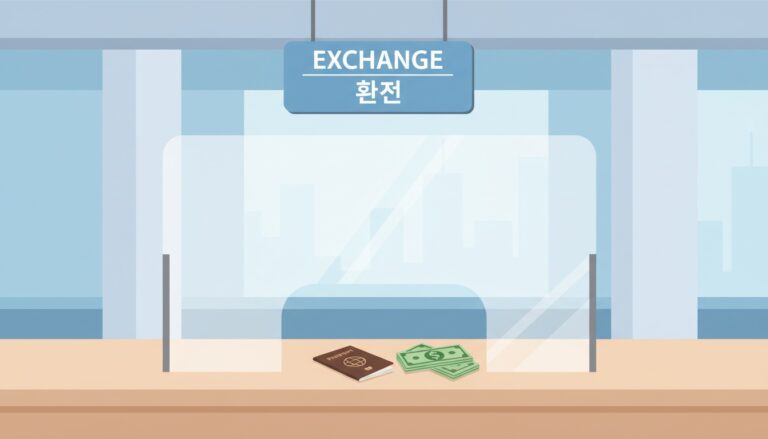
Phase 1: Introduction
Hello! This is your editor from Daily Hangul. 👋
Walking into a bank in a foreign country can feel like walking into a final exam you didn’t study for. It’s quiet, serious, and everyone seems to know exactly what they are doing except you. You just want some Korean Won (KRW) to buy delicious street food, but staring at the bank teller behind the glass makes your mind go blank.
Don’t worry. I’ve seen many of my students freeze in this exact spot. But here’s a secret: You only need one magic sentence to get the process started. Once you say this, the teller will take the lead.
Today, we are going to learn how to confidently walk up to that counter and say, “I came to exchange money.” No complex grammar, just pure survival Korean.
Phase 2: Deep Dive (Core Expressions)
Here are the 3 essential phrases you need to survive a bank visit.
1. 환전하러 왔어요 (I came to exchange money)
- Pronunciation: [Hwan-jeon-ha-reo wa-sseo-yo]
- Sound Analogy:
- Hwan sounds like ‘Juan’.
- Jeon sounds like ‘John’.
- Wa-sseo-yo sounds like ‘Wah-saw-yo’.
- Meaning: “I came to do money exchange.”
- Editor’s Insight: This is the Golden Key. As soon as you say “Hwan-jeon” (Exchange), the teller understands everything. You don’t need to explain why or how much yet.
- Situation Check: Politeness level is standard polite (ending in ‘yo’). Perfect for talking to bank staff.
2. 달러를 원화로 바꿔 주세요 (Please change Dollars to Won)
- Pronunciation: [Dal-leo-reul won-hwa-ro ba-kkwo-ju-se-yo]
- Meaning: “Please change Dollars to Won.”
- Editor’s Insight: If that is too long, just say “Won-hwa-ro (to Won) please.” The verb
바꿔 주세요(Ba-kkwo-ju-se-yo) is super useful. You can use it later when you want to exchange a defective product at a store too!
3. 여권 여기 있어요 (Here is my passport)
- Pronunciation: [Yeo-gwon yeo-gi i-sseo-yo]
- Meaning: “Here is my passport.”
- Editor’s Insight: 99% of the time, the teller will ask for your ID immediately after you say you want to exchange money. Being ready with this phrase (and your passport in hand) makes you look like a pro.
Phase 3: Textbook vs. Real Life
Textbooks often teach you the “perfect” sentence, but in Korea, we like to keep it short and efficient.
| Textbook Korean 📚 | Real Korean (Daily Hangul Style) 😎 |
|---|---|
| 환전을 하고 싶습니다. (I would like to do a currency exchange.) |
환전 좀 하려고요. (Just came to do some exchange.) |
| 이 돈을 한국 돈으로 바꿔 주십시오. (Please change this money to Korean money.) |
이거 바꿔 주세요. (Change this, please.) |
Editor’s Note for Beginners: If you panic, just smile, show your dollars, and say “Hwan-jeon Please!” It works every time. 😉
Phase 4: Cultural Context (Manners & Nunchi)
🏦 The “Number Ticket” Rule
In Korean banks, you never walk straight to the counter. You must find a machine near the entrance called the 순번대기표 (Sun-beon-dae-gi-pyo) or simply a ticket machine.
There is often a security guard (looks like a police officer) standing there. Don’t be scared! They are the friendliest people in the bank.
1. Walk in.
2. Look at the guard.
3. Say “Hwan-jeon”.
4. The guard will press the button and hand you a ticket.
Wait for your number to ding on the screen, then go to the counter.
Phase 5: Roleplay Script
Setting: A quiet branch of KB Bank in Seoul.
Characters: Alex (You, holding US Dollars) vs. Teller (Korean bank staff).
(Alex approaches the window after hearing his number ding.)
Alex: 안녕하세요. 환전하러 왔어요.
(An-nyeong-ha-se-yo. Hwan-jeon-ha-reo wa-sseo-yo.)
(Hello. I came to exchange money.)
Teller: 네, 얼마나 바꿔 드릴까요?
(Ne, eol-ma-na ba-kkwo deu-ril-kka-yo?)
(Okay, how much would you like to exchange?)
Alex: (Handing over $100) 100달러요. 원화로 바꿔 주세요.
(Baek-dal-leo-yo. Won-hwa-ro ba-kkwo-ju-se-yo.)
($100. Please change it to Won.)
Teller: 신분증 주시겠어요?
(Sin-bun-jeung ju-si-ge-sseo-yo?)
(Can I have your ID?)
Alex: 아! 여권 여기 있어요.
(Ah! Yeo-gwon yeo-gi i-sseo-yo.)
(Ah! Here is my passport.)
Phase 6: 10-Second Shadowing
Let’s practice the most important sentence. Read it aloud with the rhythm marked below.
Jeo (Me) / Hwan-jeon (Exchange) / Ha-reo (to do) / Wa-sseo-yo (came).
Try it in one breath:
🗣️ “Jeo / Hwan-jeon / Ha-reo / Wa-sseo-yo.”
Tip: Put a little stress on ‘Hwan-jeon’. That is the keyword! 🎵
Phase 7: FAQ & Troubleshooting
- Q: Can I use these phrases at the airport currency exchange booth?
- A: Absolutely. It works exactly the same way.
- Q: Do I really need my passport? Can I use my Driver’s License?
- A: No. As a foreigner, you strictly need your Passport or an Alien Registration Card (ARC). A US/UK driver’s license will not be accepted.
Phase 8: Wrap-up & Action Item
Today’s Summary:
To get Korean money, just remember: “Hwan-jeon-ha-reo wa-sseo-yo” (I came to exchange).
🚀 Your Mission:
Next time you pass by a bank or a money exchange booth in Korea, look for the sign that says 외화 환전 (Foreign Exchange). Just spotting the word ‘Hwan-jeon’ (환전) counts as a win today!
Have you ever struggled at a bank abroad? Tell me your story in the comments! 👇
Phase 9: Pop Quiz
1. What is the Korean word for “Passport”?
A) Hwan-jeon
B) Yeo-gwon
C) Dal-leo
2. What should you do FIRST when entering a Korean bank?
A) Run to the counter screaming.
B) Sit on the sofa and sleep.
C) Get a number ticket (or ask the guard).
3. Fill in the blank: “_______ ha-reo wa-sseo-yo.” (I came to exchange.)
A) Shopping
B) Hwan-jeon
C) Kimchi
(Answers: 1-B, 2-C, 3-B)
Frequently Asked Questions (FAQ)
Q: What does "환전하러 왔어요 (I came to exchange money)" mean in Korean and how do you pronounce it?
A: In Korean, "환전하러 왔어요 (I came to exchange money)" is pronounced [Hwan-jeon-ha-reo wa-sseo-yo] and means: a key conversational Korean expression covered in this lesson.
Q: What does "달러를 원화로 바꿔 주세요 (Please change Dollars to Won)" mean in Korean and how do you pronounce it?
A: In Korean, "달러를 원화로 바꿔 주세요 (Please change Dollars to Won)" is pronounced [Dal-leo-reul won-hwa-ro ba-kkwo-ju-se-yo] and means: "Please change Dollars to Won."
Q: What does "여권 여기 있어요 (Here is my passport)" mean in Korean and how do you pronounce it?
A: In Korean, "여권 여기 있어요 (Here is my passport)" is pronounced [Yeo-gwon yeo-gi i-sseo-yo] and means: "Here is my passport."







