

Phase 1: Introduction (공감)
Hello! It’s your Head Editor from Daily Hangul. 👋
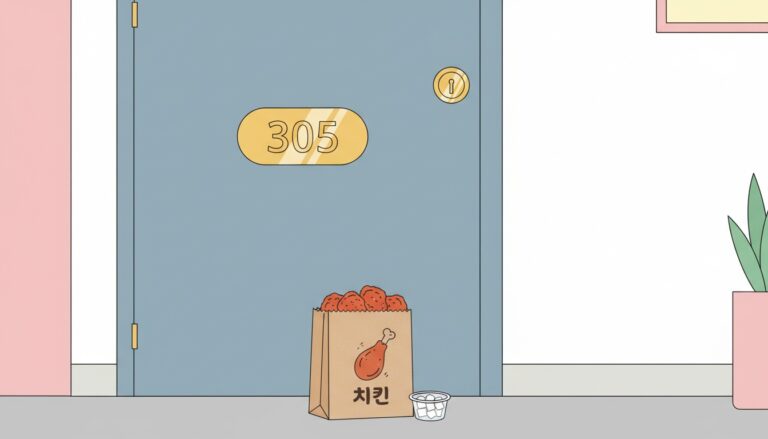
Imagine this: You’ve just arrived at your hotel in Seoul. You’re exhausted, but you finally ordered that famous Korean fried chicken to your room using a delivery app. Suddenly, your phone rings. It’s the delivery driver. He asks, “Myeot ho-eyo?” (What room number is it?)
Panic sets in. You know the number is 305, but… how do you say that? Do you say “Set-gong-daseot”? Or “Sam-baek-o”?
If you freeze here, your chicken might go back to the kitchen! 😱 Knowing how to say your room number is crucial not just for hotels, but for visiting friends’ apartments or finding offices. Don’t worry—I’ve taught this to hundreds of students, and today, I’ll make you an expert in Sino-Korean Numbers specifically for room numbers.
Let’s make sure you get that chicken delivered hot!
Phase 2: Deep Dive (핵심 표현 심층 분석)
To master room numbers, you only need one magic suffix and the “Sino-Korean” number system (the numbers derived from Chinese characters).
1. 호 (Ho)
- Pronunciation:
Ho[Sounds like Ho-ho-ho Santa Claus, but softer] - Meaning: Room / Number (suffix)
- Editor’s Insight: Think of this as the label that turns a random number into a location. Without 호, you are just shouting math at someone. With 호, you are telling them where to go.
- Situation Check: Essential for everyone—from the receptionist to the delivery driver.
2. The Sino-Korean Numbers (The Essentials)
Unlike counting apples (hana, dul, set), we use Sino-Korean numbers for addresses, money, and dates. Here is your cheat sheet for rooms:
- 1: 일 (Il)
- 2: 이 (I)
- 3: 삼 (Sam)
- 4: 사 (Sa)
- 5: 오 (O)
- 100: 백 (Baek)
3. Putting it together: 201호 (Room 201)
- Korean: 이백일호
- Pronunciation:
I-baek-il-ho[Ee-baek-il-ho] - Meaning: 201 Room
- Editor’s Insight: In English, we often say “Two-Oh-One.” In Korean, for 3-digit rooms, we usually say the full math number: “Two Hundred One.”
- 200 (I-baek) + 1 (Il) + Ho = I-baek-il-ho.
Phase 3: Textbook vs. Real Life (교과서 vs 진짜 한국어)
In a textbook, you speak like a robot. In Seoul, you want to sound efficient.
| Textbook (Grammatically Perfect) 🤖 | Real Life (How we actually speak) 😎 |
|---|---|
| 제 방 번호는 305호입니다. (Jeo-ui bang beon-ho-neun 305-ho-imnida.) _”My room number is 305.”: Too long!_ |
305호요. (Sam-baek-o-ho-yo.) _”It’s 305.”: Perfect & Natural._ |
| 똑똑, 계십니까? (Ttok-ttok, gye-sim-ni-kka?) _”Knock knock, are you there?”_ |
(Bell rings) 배달이요~ (Bae-dal-i-yo~) _”Delivery~”_ |
Editor’s Note for A1: Just adding “-yo” (요) at the end makes it polite enough for strangers! You don’t need the full sentence.
Phase 4: Cultural Context (문화와 예절)
🤫 The “Nunchi” of Apartment Complexes
In Korea, apartment complexes are huge. If you are inviting a friend over or ordering food, the Building Number (동 – Dong) is just as important as the Room Number (호 – Ho).
- Example: 101동 202호 (Building 101, Room 202).
Also, delivery culture etiquette: If you ordered food with “Contactless Delivery” (문 앞에 두고 가세요 – Leave it in front of the door), don’t open the door the moment you hear the bell! Wait for the driver to leave. It’s a mutual respect for privacy (and messy hair).
Phase 5: Real-Life Scenario (실전 시나리오)
Setting: You are in a hotel room. The front desk calls to confirm a request.
Receptionist: 여보세요? 고객님, 방 번호 확인 부탁드립니다.
(Yeoboseyo? Gogaeknim, bang beonho hwagin butakdeurimnida.)
Hello? Customer, please confirm your room number.
You: 아, 네! 402호요.
(A, ne! Sa-baek-i-ho-yo.)
(Ah, yes! It’s room 402.)
Receptionist: 네, 402호 맞으시죠? 수건 올려드릴게요.
(Ne, sa-baek-i-ho majeusijyo? Sugeon ollyeodeurilgeyo.)
Okay, 402, right? We will bring up the towels.
You: 감사합니다.
(Gamsahamnida.)
(Thank you.)
** Acting Tip:** When saying the number, try to emphasize the first digit clearly so they know which floor you are on!
Phase 6: 10-Second Shadowing (10초 섀도잉)
Let’s practice the rhythm. Read this aloud 3 times. Focus on the smooth link between the numbers and ‘Ho’.
“Room 501, please.”
오백 / 일호요.
Obaek/il-ho-yo
(Tip: Don’t pause too long between Obaek and il!)
Phase 7: FAQ & Troubleshooting (오해 방지)
Q: Can I use Native Numbers (Hana, Dul, Set) for rooms?
A: NO! 🙅♂️ This is the most common mistake. If you say “Daseot-ho” (5-ho using Native numbers), Koreans will be very confused. Always use Sino-Korean numbers (Il, I, Sam…) for rooms, phone numbers, and prices.
Q: What if the number is really long, like 1204?
A: For A1 beginners, you can say it digit by digit if the “Thousands” math is too hard. “Il-I-Gong-Sa Ho” (One-Two-Zero-Four) is acceptable and understood, though “Cheon-i-baek-sa-ho” is the standard.
Phase 8: Wrap-up (요약 및 미션)
Today’s One-Liner: To say a room number, use Sino-Korean Number + Ho + Yo.
Your Mission: Next time you enter a building or look at your hotel key card, say the room number out loud in Korean using the Sino system. Even if you whisper it, get your mouth used to the sounds!
Have you ever had a funny mix-up with numbers in another language? Tell me in the comments! 👇
Phase 9: Quiz (퀴즈)
1. Which number system do we use for Room Numbers?
a) Native (Hana, Dul…)
b) Sino-Korean (Il, I, Sam…)
2. How do you say “Room 205”?
a) I-baek-o-ho (이백오호)
b) Dul-baek-daseot-ho (둘백다섯호)
c) I-gong-gong-o (이공공오)
3. What does “Ho” (호) mean?
a) House
b) Room number unit
c) Hotel
(Answers: 1-b, 2-a, 3-b)
Frequently Asked Questions (FAQ)
Q: What does "호 (Ho)" mean in Korean and how do you pronounce it?
A: In Korean, "호 (Ho)" is pronounced [Ho [Sounds like Ho-ho-ho Santa Claus, but softer] and means: Room / Number (suffix)







