

Phase 1: Welcome to the Battlefield (Introduction)
Hello, Daily Hangul family! It’s your head editor here.
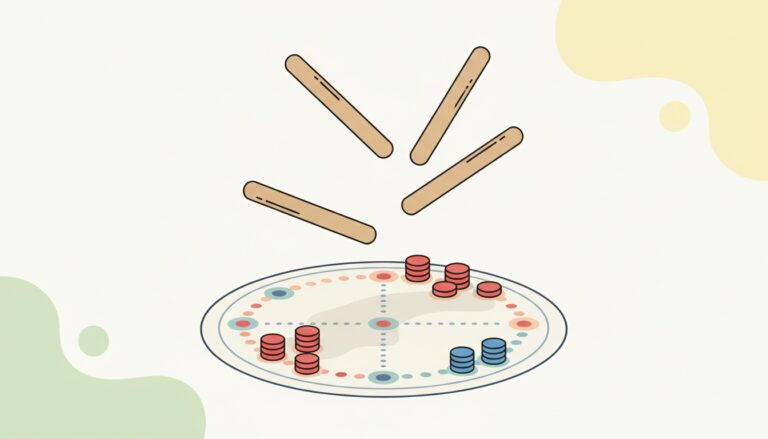
So, you’ve been invited to a Korean friend’s house for Seollal (Lunar New Year) or Chuseok. You see a blanket spread on the floor, four wooden sticks, and a diagram that looks like a circle inside a square. Suddenly, the atmosphere shifts. Your gentle Korean friends start screaming, high-fiving, and shouting words that sound like farm animals.
Welcome to Yutnori (윷놀이).
At the C1 level, we aren’t just learning how to count Do, Gae, Geol, Yut, Mo. Anyone can throw sticks. But knowing how to argue over the game board (말판), negotiate strategy, and use the specific verbs for moving pieces? That’s what separates the “foreign guest” from the “honorary family member.”
Today, we are diving deep into the strategic vocabulary of Yutnori. This guide is based on real questions from advanced learners who got destroyed by their Korean in-laws because they didn’t know the rule of ‘Nak’ (낙).
Phase 2: Deep Dive into Core Expressions
To play Yutnori like a pro, you need to command the Mal (말 – game pieces). Here are the three most critical verbs used during the game.
1. 말을 쓰다 [mareul sseu-da]
- Pronunciation: mareul sseu-da [Sounds like: ‘mah-reul’ + ‘sue’ (like filing a lawsuit) + ‘da’]
- Meaning: Literal: To use the horse / Real Nuance: To move the game piece on the board.
- Editor’s Insight: You don’t say “move the piece” (옮기다). In Yutnori, you “use” the piece. It implies making a strategic decision on which piece to move.
- Situation Check: Used constantly throughout the game. (Casual/Formal)
2. 업다 [eop-da]
- Pronunciation: eop-da [Sounds like: ‘up’ (direction) + ‘da’]
- Meaning: Literal: To carry on one’s back / Real Nuance: To stack your pieces together to move them as a unit.
- Editor’s Insight: This is a high-risk, high-reward strategy. If you stack two pieces, they move together (faster!), but if they get caught, they die together. It’s the ultimate trust exercise.
- Situation Check: Essential for strategy discussions.
3. 잡다 [jap-da]
- Pronunciation: jap-da [Sounds like: ‘chap’ + ‘da’]
- Meaning: Literal: To catch / Real Nuance: To capture the opponent’s piece and send it back to the start.
- Editor’s Insight: This is the most thrilling part of the game. When you land on an opponent’s spot, you “catch” them. In Yutnori, this also gives you a bonus turn!
- Situation Check: Use this with aggressive enthusiasm.
Phase 3: Textbook vs. Real Life
Textbooks teach you the rules; the streets (and living rooms) teach you the survival skills. Here is how advanced speakers actually talk during the game.
| Textbook / Standard (Korean Class) | Real Life / Advanced (Korean Living Room) |
|---|---|
| 윷을 던지세요. (Please throw the Yut.) | 니가 던져! (You throw!) or 굴려! (Roll it!) |
| 말을 옮길게요. (I will move the piece.) | 이거 업고 가자. (Let’s stack this and go.) |
| 잡았습니다! (I caught it!) | 나이스! 잡았다! 한 번 더! (Nice! Caught ‘em! One more turn!) |
| 판 밖으로 나갔어요. (It went outside the board.) | 낙이야! 낙! (It’s Nak! It doesn’t count!) |
- Editor’s Note: “낙 (Nak)” is a crucial C1 term. It refers to when a stick falls off the mat/blanket. If you get a Nak, your turn is forfeited immediately. It causes the most arguments!
Phase 4: Cultural Context & Manners
1. The Art of “Nunchi” (Strategy Disputes)
Yutnori is a team sport. At the C1 level, you are expected to participate in the strategy meeting after every throw. If you throw a Yut (4 spaces), your teammates will debate: “Should we catch their piece?” or “Should we start a new piece?”
* Tip: If you are playing with elders, you can politely suggest a move, but let the most senior person make the final call on the board (말판).
2. “Back-do” (The Game Changer)
One of the sticks usually has a special mark (often written as ‘Seoul’ or ‘Back-do’). If you throw a result of 1 with this marked stick facing up, you must go back one step. This can be a disaster, or a miracle (if it helps you catch someone behind you or exit the board quickly). Treat the Back-do (뒷도) with respect.
Phase 5: Roleplay Script (Real Scenario)
Setting: A fierce game between Team A (Foreigner & Uncle) and Team B (Cousins).
Situation: The Foreigner (You) just threw a ‘Geol’ (3 spaces). You have a choice.
Uncle (Team A): 오! 걸이다! 잘했어.
(Oh! It’s a Geol! Well done.)
You: 삼촌, 저거 잡을까요, 아니면 그냥 업고 갈까요?
(Uncle, shall we catch that one, or just stack and go?)
Uncle (Team A): 음… 안전빵으로 가자. 업어! 업고 튀어!
(Hmm… Let’s play it safe. Stack it! Stack and run!)
Cousin (Team B): 아, 재미없게 왜 그래요? 남자는 모 아니면 도지!
(Ah, why are you being so boring? For a man, it should be all or nothing!)
You: (Smiling) 죄송해요. 저는 이기고 싶거든요. 말 쓸게요!
(Sorry. I want to win. I’m moving the piece!)
Phase 6: 10-Second Shadowing Drill
Let’s practice the most famous idiom derived from this game. Use this when you are taking a big risk.
“에라 모르겠다! 모 아니면 도지!”
(I don’t care! It’s all or nothing / Mo or Do!)Focus:
* Intonation: Stress on Mo and Do.
* Pausing: 에라 모르겠다!/모 아니면/도지!
Phase 7: FAQ & Troubleshooting
Q: Is it rude to cheer when I capture an elder’s piece?
A: Generally, no! Yutnori is one of the few times hierarchy relaxes slightly. Loud cheering and teasing are part of the fun. Just don’t mock them too aggressively.
Q: What is “안전빵 (Anjeon-ppang)” from the dialogue?
A: This is very common slang meaning “playing it safe” or a “sure thing.” It fits perfectly in C1 level conversation.
Q: Can I throw the sticks with one hand?
A: Yes, but usually only if the sticks are small (mini-yut). With standard sticks, using two hands is more common to prevent them from flying everywhere (and avoiding a Nak).
Phase 8: Wrap-up
One-Liner Summary: Yutnori is not about luck; it’s about knowing when to stack (업다), when to catch (잡다), and avoiding the dreaded Nak (낙).
Action Mission: Next time you see a decision-making moment in a K-Drama or reality show, shout “모 아니면 도!” (All or nothing!) to impress your friends.
Question: Have you ever played Yutnori? Did you get a ‘Back-do’ miracle? Tell me in the comments!
Phase 9: Pop Quiz
- What do you call it when your stick goes off the designated mat?
a) Out
b) Nak (낙)
c) Mang (망) -
Which verb means “to stack pieces together”?
a) 잡다 (Jap-da)
b) 업다 (Eop-da)
c) 먹다 (Meok-da) -
What does “Mo animyeon Do” mean?
a) Slow and steady wins the race.
b) All or nothing (High risk, high return).
c) Respect your elders.
(Answers: 1-b, 2-b, 3-b)
Frequently Asked Questions (FAQ)
Q: What does "말을 쓰다 [mareul sseu-da]" mean in Korean and how do you pronounce it?
A: In Korean, "말을 쓰다 [mareul sseu-da]" is pronounced [mareul sseu-da [Sounds like: 'mah-reul' + 'sue' (like filing a lawsuit] and means: Literal: To use the horse / Real Nuance: To move the game piece on the board.
Q: What does "업다 [eop-da]" mean in Korean and how do you pronounce it?
A: In Korean, "업다 [eop-da]" is pronounced [eop-da [Sounds like: 'up' (direction] and means: Literal: To carry on one's back / Real Nuance: To stack your pieces together to move them as a unit.
Q: What does "잡다 [jap-da]" mean in Korean and how do you pronounce it?
A: In Korean, "잡다 [jap-da]" is pronounced [jap-da [Sounds like: 'chap' + 'da'] and means: Literal: To catch / Real Nuance: To capture the opponent's piece and send it back to the start.







