

1. Introduction: Beyond “Don’t Do It”
Hello! This is your Senior Editor at Daily Hangul.
Imagine this: You are at an international ODA conference in Seoul. The topic is serious—eradicating child labor in the coffee industry. You want to argue passionately about supply chain transparency, but all you can manage to say is, “아이들이 일하면 안 돼요” (Children shouldn’t work).
While grammatically correct, at a C2 level—especially in professional development cooperation circles—this sounds too elementary. It lacks the weight, the nuance, and the “professional despair” that drives policy change.
Today, we are stepping away from basic survival Korean. We are diving into the language of advocacy, ethics, and systemic change. This is how you sound like a leader in the Korean NGO sector.
2. Deep Dive: The Vocabulary of Change
Here are the three heavy-hitters you need to master for high-level discussions on human rights and ODA.
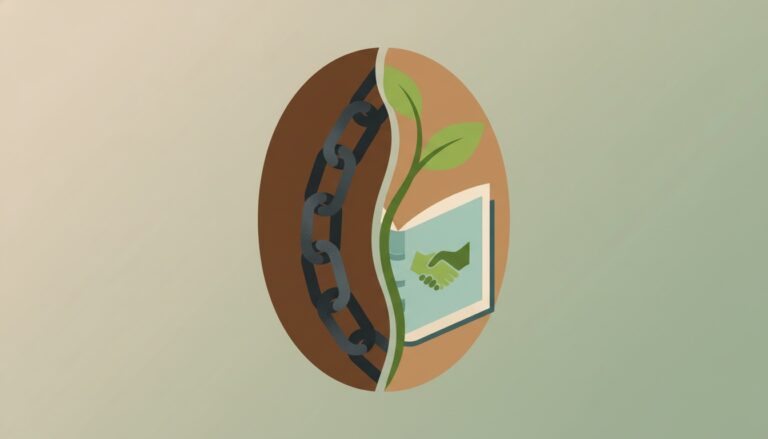
1. 착취의 고리를 끊다 (To break the chain of exploitation)
- Pronunciation: Chak-chwi-ui go-ri-reul kkeun-ta [Sounds like: ‘Chak’ as in chalk + ‘chwi’ (like chewy but shorter) + ‘ui’ + ‘go-ree’ + ‘keun-ta’]
- Meaning: To break the vicious cycle of exploitation.
- Editor’s Insight: The word ‘고리’ (ring/link/chain) is crucial here. Koreans view systemic issues as connected links. You don’t just ‘stop’ child labor; you ‘sever the link’ of the structure that causes it. It’s a very active, powerful verb phrase used in manifesto-style speeches.
- Situation Check: Formal debates, presentations, or serious strategy meetings. Too heavy for a casual coffee chat.
2. 정당한 대가 (Fair compensation / Just price)
- Pronunciation: Jeong-dang-han dae-ga
- Meaning: Literally “Justifiable price/cost,” but in this context, it means paying a fair wage that matches the labor value.
- Editor’s Insight: In the Fair Trade movement, avoid using simple words like ‘돈’ (money) or ‘월급’ (salary). ‘대가’ (Dae-ga) implies a reciprocal exchange—value for value. Using ‘정당한’ (Righteous/Just) appeals to the listener’s sense of moral duty.
- Situation Check: Business negotiations, contract discussions, ethical consumerism campaigns.
3. 선순환 구조 (Virtuous cycle structure)
- Pronunciation: Seon-sun-hwan gu-jo
- Meaning: A structure where good actions lead to more good results (opposite of a vicious cycle).
- Editor’s Insight: This is the ultimate goal of ODA. You aren’t just giving aid; you are creating a system that feeds itself positively. If you use this word in a proposal, your Korean counterparts will nod in approval. It shows you understand sustainability.
- Situation Check: Grant proposals, impact reports, sustainability briefings.
3. Textbook vs. Real Life (Professional Edition)
At the C2 level, “Real Life” means “Professional Polish.”
| Textbook Korean (Correct but plain) | Professional/News Korean (Impactful) |
|---|---|
| 아동 노동을 없애야 합니다. (We must get rid of child labor.) |
아동 노동 근절을 위한 사회적 합의가 필요합니다. (We need social consensus for the eradication of child labor.) |
| 공정 무역 물건을 삽시다. (Let’s buy fair trade items.) |
윤리적 소비를 통해 가치 실현에 동참합시다. (Let’s participate in realizing values through ethical consumption.) |
| 이 회사는 아이들을 시켜서 물건을 만들어요. (This company makes kids make things.) |
이 기업의 공급망은 인권 침해 논란에서 자유롭지 못합니다. (This company’s supply chain is not free from controversy regarding human rights violations.) |
Note: Notice the shift from active verbs to noun phrases (Sino-Korean words). This “noun-heavy” style adds authority.
4. Cultural Context: Myung-bun (명분)
In Korean business and diplomacy, especially in the NGO/ODA sector, logic is important, but Myung-bun (명분 – Moral Justification/Cause) is everything.
When you persuade a Korean company to adopt Fair Trade practices despite the higher cost, don’t just show them the Excel sheet. Appeal to their Myung-bun.
- Don’t say: “You will get bad press if you use child labor.”
- Do say: “Participating in this movement will elevate your company’s status as a global leader in ESG management.” (이 운동에 동참하는 것은 귀사가 ESG 경영의 글로벌 리더로서 위상을 높이는 계기가 될 것입니다.)
Give them a noble reason to say yes. That is the art of high-level Korean persuasion.
5. Roleplay: The Strategy Meeting
Setting: A meeting room in Seoul. You (Alex) are convincing a Korean retail executive (Director Kim) to switch to Fair Trade coffee.
Characters:
* Alex: ODA Specialist (Foreigner, C2 Korean speaker)
* Director Kim: Korean Executive (Skeptical about costs)
Dialogue:
Director Kim: (Looking at the report) 단가가 너무 비싸지 않나요? 주주들을 설득하기 쉽지 않을 텐데요.
(Isn’t the unit price too high? It won’t be easy to convince the shareholders.)
Alex: (Nods respectfully but firmly) 네, 단기적인 비용은 상승할 수 있습니다. 하지만 장기적인 관점에서 봐야 합니다.
(Yes, short-term costs may rise. But we must look at it from a long-term perspective.)
Director Kim: 장기적인 관점이요?
(Long-term perspective?)
Alex: 네, 지금 소비 트렌드는 ‘가치 소비’로 이동하고 있습니다. 아동 노동 착취 없는 투명한 공급망을 확보하는 것이 결국 브랜드의 지속 가능성을 보장해 줍니다.
(Yes, current consumption trends are shifting to ‘value consumption.’ Securing a transparent supply chain free of child labor exploitation ultimately guarantees the brand’s sustainability.)
Director Kim: (Impressed) 투명한 공급망이라… 우리 회사의 새로운 명분이 될 수도 있겠군요.
(Transparent supply chain… That could indeed become a new moral justification for our company.)
6. 10-Second Shadowing Drill
Read this aloud. Focus on the pauses (/) to sound authoritative.
“우리의 목표는 / 단순한 원조가 아니라, / 아동들이 노동 현장이 아닌 / 학교로 돌아갈 수 있는 / 지속 가능한 선순환 구조를 / 만드는 것입니다.”
- Romanization: U-ri-ui mok-pyo-neun / dan-sun-han won-jo-ga a-ni-ra, / a-dong-deu-ri no-dong hyeon-jang-i a-nin / hak-gyo-ro do-ra-gal su it-neun / ji-sok ga-neung-han seon-sun-hwan gu-jo-reul / man-deu-neun geot-im-ni-da.
- Translation: Our goal is not simple aid, but creating a sustainable virtuous cycle where children can return to school instead of labor sites.
7. FAQ & Troubleshooting
Q: Can I use the word ‘착취’ (Exploitation) to a business partner?
A: Be careful. If you say “당신 회사는 착취하고 있어요” (Your company is exploiting), the meeting is over. Instead, use the passive or third-party voice: “노동 착취 논란을 미연에 방지하기 위해서…” (In order to prevent any controversy regarding labor exploitation in advance…). This frames you as a helper protecting them from risk, not an accuser.
8. Wrap-up & Action Item
- Summary: To discuss Fair Trade at a C2 level, move from “helping kids” to “creating virtuous cycles” and “securing transparent supply chains.”
- Action Mission: Next time you buy Fair Trade coffee in Korea, read the back label. Look for words like ‘공정’ (Fair), ‘환원’ (Return/Redistribution), or ‘지원’ (Support). If you find a sentence with ‘선순환’ (Virtuous cycle), take a picture and post it!
What represents ‘Ethical Consumption’ to you? Let me know in the comments!
9. Quiz: Test Your C2 Skills
1. Which word best fills the blank?
“We need to create a _______ where profits are reinvested into the community.”
(이익이 지역사회로 재투자되는 _______을/를 만들어야 합니다.)
a) 악순환 (Vicious cycle)
b) 선순환 (Virtuous cycle)
c) 대가 (Compensation)
2. What is the professional way to say “Pay them properly”?
a) 돈 많이 주세요 (Give lots of money)
b) 정당한 대가를 지불하다 (Pay fair compensation)
c) 알바비를 챙겨주다 (Give part-time wage)
3. In a business context, what is ‘Myung-bun’?
a) The profit margin.
b) The legal contract.
c) The moral justification or cause.
Click for Answers
1. b) 선순환
2. b) 정당한 대가를 지불하다
3. c) The moral justification or cause
Frequently Asked Questions (FAQ)
Q: What does "'고리'" mean in Korean and how do you pronounce it?
A: In Korean, "'고리'" is pronounced [ring/link/chain] and means: is crucial here. Koreans view systemic issues as connected links. You don't just 'stop' child labor; you 'sever the link' of the structure that causes it. It’s a very active, powerful verb phrase used in manifesto-style speeches.
Q: What does "'대가'" mean in Korean and how do you pronounce it?
A: In Korean, "'대가'" is pronounced [Dae-ga] and means: implies a reciprocal exchange—value for value. Using '정당한' (Righteous/Just) appeals to the listener's sense of moral duty.
Q: What does "'환원'" mean in Korean and how do you pronounce it?
A: In Korean, "'환원'" is pronounced [Return/Redistribution] and means: , or
Q: What does "'지원'" mean in Korean and how do you pronounce it?
A: In Korean, "'지원'" is pronounced [Support] and means: . If you find a sentence with '선순환' (Virtuous cycle), take a picture and post it!







