

Introduction: The “Intercom Panic” Moment 😱
Hello! This is your Daily Hangul Editor.
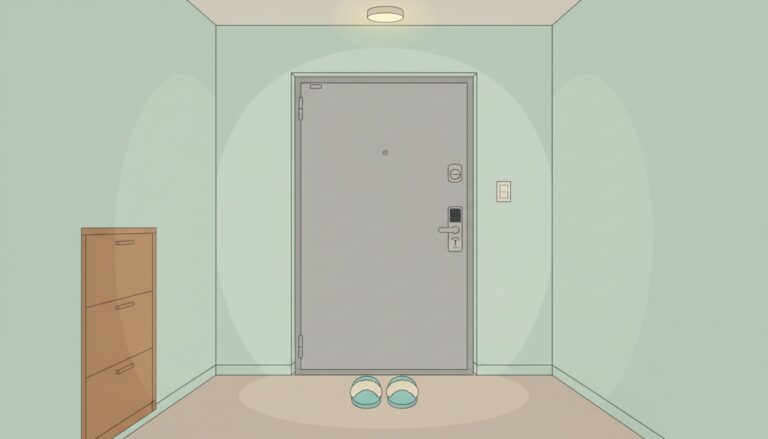
Imagine this: You finally moved into your shiny new Korean apartment (officetel). You are excited, maybe doing a little happy dance in your living room. Suddenly… Ding-dong.
It’s the neighbor from downstairs. Or maybe the security guard calls via the intercom. They are talking about “Cheung-gan-so-eum” (층간 소음)—inter-floor noise.
Panic sets in. You want to say, “I didn’t know the walls were this thin! I’m so sorry!” but your brain freezes.
Don’t worry. In Korean apartments, sound travels fast, and this happens to everyone (even Koreans!). Today, I will teach you the essential survival phrases to handle this awkward situation with politeness and grace.
This isn’t just about language; it’s about being a good neighbor. Let’s dive in!
Phase 2: Core Expressions (Deep Dive)
Here are the top 3 phrases you need to survive a noise complaint. Since we are at Level A1, we will focus on polite apologies rather than arguing.
1. 죄송합니다 (I am sorry)
- Pronunciation: [Joe-song-ham-ni-da]
- Sound-alike: Think of “Joe” (the name) + “Song” (music) + “Ham” (food) + “Ni-da“.
- Meaning: I apologize / I am sorry.
- Editor’s Insight: This is the magic word. Even if you don’t understand exactly what the neighbor is saying, if they look annoyed, start with this. It immediately lowers the tension.
- Situation Check: ✅ Formal (Perfect for neighbors/strangers).
2. 조심할게요 (I will be careful)
- Pronunciation: [Jo-sim-hal-ge-yo]
- Sound-alike: “Joe” + “Seem” + “Hal” + “Kay-yo“.
- Meaning: I will be careful / I will watch out.
- Editor’s Insight: Just saying “Sorry” isn’t enough. You need to show intent. This phrase tells them, “I hear you, and I will try not to do it again.”
- Situation Check: ✅ Polite but friendly.
3. 너무 시끄러워요? (Is it too noisy?)
- Pronunciation: [Neo-mu Si-kkeu-reo-wo-yo?]
- Sound-alike: “No-moo” + “She-kku” (strong K) + “Luh-wo-yo“.
- Meaning: Is it too loud/noisy?
- Editor’s Insight: Use this if you are confused about why they visited you. It’s a gentle question.
- Situation Check: ✅ Standard Polite.
Phase 3: Textbook vs. Real Life
Textbooks often teach stiff sentences. Here is how real Koreans handle it.
| Textbook (Robot Style 🤖) | Real Life (Human Style 🙆♂️) |
|---|---|
| 소음을 줄이겠습니다. (I will reduce the noise.) |
조용히 할게요. (I’ll be quiet/do it quietly.) |
| 무슨 일입니까? (What is the matter?) |
무슨 일이세요? (What’s going on? / How can I help?) |
Editor’s Note: For A1 beginners, “조용히 할게요” (Jo-yong-hi hal-ge-yo) is a lifesaver. It’s softer and sounds more natural than promising to “reduce noise.”
Phase 4: Cultural Context & Manners (The “Slipper” Rule)
🤫 The Culture of Silence
Korean apartments are often built with concrete, which amplifies impact sounds (like footsteps). Walking on your heels is the #1 enemy.
👟 The Magic Item: Slippers
If a neighbor complains about noise, pointing to your feet and showing you are wearing slippers (슬리퍼) is a great defense! It shows you are already trying.
Body Language Tip:
When apologizing (죄송합니다), do not stare straight into their eyes aggressively. Look slightly down, bow your head slightly, and clasp your hands together. This shows genuine regret.
Phase 5: Real-Life Scenario (Roleplay)
Setting: A neighbor (Stranger) knocks on your door at 10 PM. You open the door.
Neighbor: (Annoyed face) 저기요, 너무 시끄러워요. 쿵쿵 소리가 나요.
(Excuse me, it’s too noisy. There is a thumping sound.)
You: (Surprised & Apologetic) 아! 죄송합니다.
(Ah! I am sorry.) [Ah! Joe-song-ham-ni-da.]
Neighbor: 잠을 못 자겠어요.
(I can’t sleep.)
You: 정말 몰랐어요. 조심할게요.
(I really didn’t know. I will be careful.) [Jeong-mal mol-la-sseo-yo. Jo-sim-hal-ge-yo.]
(Action): You bow politely.
Phase 6: 10-Second Shadowing Drill
Let’s practice the most important combination. Read this out loud three times!
“Ah, I’m sorry. I will be careful.”
아, 죄송합니다. / 조심할게요.
[Ah, Joe-song-ham-ni-da. / Jo-sim-hal-ge-yo.]
- Focus Point: Pause at the
/. - Intonation: Drop your tone at the end of “Yo” to sound sincere, not questioning.
Phase 7: FAQ & Troubleshooting
Q: What if the neighbor is being aggressive?
A: As a beginner, do not try to argue. Just say “죄송합니다” and close the door gently. If it continues, contact your building manager (관리실 – Gwallisil).
Q: Can I use “미안해 (Mianhae)”?
A: NO! 🛑 That is casual/banmal. Using casual language to an angry neighbor is like pouring gasoline on a fire. Always use polite forms ending in ‘Yo’ or ‘Nida’.
Phase 8: Wrap-up & Action Item
Summary: When facing a noise complaint, stay calm, bow slightly, and say “죄송합니다. 조심할게요” (Sorry, I’ll be careful).
🔥 Today’s Mission:
Do you have Korean slippers at home? If not, go to a Daiso or a mart today and buy a pair of “거실화” (living room shoes). It’s the best investment for apartment peace!
Have you ever had a noise issue in Korea? Tell me in the comments!
Phase 9: Quick Quiz
1. Your neighbor says you are loud. What is the polite response?
A) 미안해. (Mianhae)
B) 죄송합니다. (Joesonghamnida)
C) 안 들려요. (I can’t hear you)
2. What phrase means “I will be careful”?
A) 사랑해요 (Saranghaeyo)
B) 조심할게요 (Josimhalgeyo)
C) 배고파요 (Baegopayo)
3. Which item helps prevent floor noise in Korea?
A) High heels
B) Slippers (슬리퍼)
C) Boots
Click for Answers
1. B, 2. B, 3. B
Frequently Asked Questions (FAQ)
Q: What does "죄송합니다 (I am sorry)" mean in Korean and how do you pronounce it?
A: In Korean, "죄송합니다 (I am sorry)" is pronounced [Joe-song-ham-ni-da] and means: a key conversational Korean expression covered in this lesson.
Q: What does "조심할게요 (I will be careful)" mean in Korean and how do you pronounce it?
A: In Korean, "조심할게요 (I will be careful)" is pronounced [Jo-sim-hal-ge-yo] and means: a key conversational Korean expression covered in this lesson.
Q: What does "너무 시끄러워요? (Is it too noisy?)" mean in Korean and how do you pronounce it?
A: In Korean, "너무 시끄러워요? (Is it too noisy?)" is pronounced [Neo-mu Si-kkeu-reo-wo-yo?] and means: a key conversational Korean expression covered in this lesson.







