

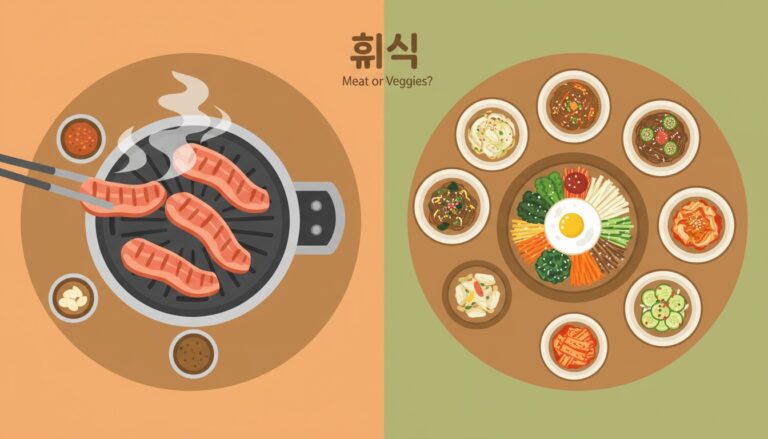
Surviving ‘Hoesik’ (Company Dinner): The Vegetarian Strategy Guide 🥬
Phase 1: Introduction
안녕하세요! This is your Daily Hangul Editor.
If you are working in Korea, or even just hanging out with a group of Korean friends, you will eventually face the “Hoesik” (회식 – team dinner) boss battle. For a vegetarian, this can feel like walking into a minefield. The default option is almost always Samgyeopsal (pork belly) or Chimaek (fried chicken).
I’ve seen many intermediate (B2) students freeze up when the boss asks, “What should we eat?” They don’t want to be the “difficult foreigner,” so they end up eating only corn salad and drinking beer all night.
Don’t do that. You can respect the group culture and your diet. This guide is based on real strategies my students have used to survive—and even thrive—at Korean team dinners.
Phase 2: Deep Dive into Key Expressions
Here are three B2-level phrases that strike the perfect balance between politeness and clarity.
1. 혹시 메뉴에 채식 옵션도 있을까요?
- Pronunciation: [Hoksi menyu-e chaesik opsyeon-do isseulkkayo?]
- Sound Analogy: Hok-she (like ‘she’) + Menu-eh + Che-sick + Option-do + Iss-eul-ka-yo?
- Meaning: “By any chance, are there vegetarian options on the menu?”
- Editor’s Insight: Starting with ‘혹시’ (Hoksi – by any chance) is crucial. It softens the question instantly. Using the English loanword ‘옵션’ (option) is very natural in modern business settings.
- Situation Check: ✅ Casual / ✅ Formal (Perfect for asking a colleague before the venue is decided).
2. 저는 고기를 못 먹는데, 사이드 메뉴가 많은 곳은 어떨까요?
- Pronunciation: [Jeoneun gogi-reul mot meongneunde, saideu menyu-ga maneun goseun eotteolkkayo?]
- Sound Analogy: Jeo-neun + Gogi-rule + Moat (stop the t) mung-neun-deh…
- Meaning: “I can’t eat meat, so how about a place with many side dishes?”
- Editor’s Insight: Notice I used ‘못’ (cannot) instead of ‘안’ (do not). In Korean culture, saying you can’t eat something (due to constitution or strong belief) is often better received than saying you won’t eat it (preference). Suggesting a solution (“side dishes”) shows you are constructive, not just complaining.
- Situation Check: ✅ Semi-Formal (Good for suggesting to a peer or immediate supervisor).
3. 육수 베이스가 고기인가요, 아니면 해물인가요?
- Pronunciation: [Yuksu beiseu-ga gogi-ingayo, animyeon haemul-ingayo?]
- Sound Analogy: Yook-sue base-ga + Gogi-in-ga-yo + Ani-myeon + Ham-ool-in-ga-yo?
- Meaning: “Is the broth base meat or seafood?”
- Editor’s Insight: This is a pro-level question. Many stews (jjigae) look vegetarian but are made with pork or beef broth. Asking this specifically shows high proficiency.
- Situation Check: ✅ To Restaurant Staff (Polite inquiry).
Phase 3: Textbook vs. Real Life
| Textbook Korean (Standard) | Real Life Korean (Natural & Socially Smart) |
|---|---|
| 저는 채식주의자입니다. (I am a vegetarian.) |
제가 고기를 좀 못 먹어서요. (I actually can’t really eat meat…) |
| 고기 없는 메뉴 주세요. (Give me a menu without meat.) |
고기 빼고 요리해 주실 수 있나요? (Could you possibly cook this without the meat?) |
| 여기는 제가 먹을 게 없어요. (There is nothing for me to eat here.) |
저는 된장찌개만 있어도 괜찮아요! (I’m totally fine with just soybean paste stew!) |
Editor’s Note: The “Real Life” versions use ‘좀’ (a little/bit) to soften the blow. It makes you sound humble rather than demanding.
Phase 4: Cultural Context & Manners
1. The ‘Nunchi’ (눈치) Game
In a Hoesik, the group harmony (Teamwork/Vibe) is more important than the food. If everyone wants Korean BBQ and you insist on a Salad Bar, you might be seen as lacking Nunchi.
- Strategy: Don’t reject the venue. Instead, accept the BBQ place but focus on the side dishes (Naengmyeon, Bibimbap, Grilled Vegetables). Korean BBQ places usually have amazing mushrooms and onions!
2. The ‘Empty Plate’ Signal
If you are just sitting with an empty plate while others eat, your Korean colleagues will feel guilty and uncomfortable.
- Tip: Keep your plate full of lettuce, kimchi, or garlic. Even if you aren’t eating much, looking “engaged” in the meal puts everyone at ease.
Phase 5: Real-World Scenario (Roleplay)
Setting: Lunchtime at the office. The team is deciding on the Hoesik venue for tonight.
Characters: Alex (Vegetarian B2 Learner), Minji (Korean Colleague).
(Alex looks a bit worried as the team talks about pork belly)
Minji: 알렉스 씨, 오늘 회식 때 삼겹살집 간다는데 괜찮아요?
(Alex, they say we’re going to a pork belly place for dinner tonight. Is that okay?)
Alex: 아, 사실 제가 고기를 못 먹어서요… (smiling apologetically) 혹시 사이드 메뉴가 다양한 곳인가요?
(Ah, actually I can’t eat meat… Is it a place with a variety of side dishes by any chance?)
Minji: 음, 아마 김치찌개랑 냉면은 있을 거예요.
(Hmm, they probably have kimchi stew and cold noodles.)
Alex: (Relieved tone) 다행이네요! 그럼 저는 찌개에 고기만 빼 달라고 부탁드리면 돼요.
(That’s a relief! Then I can just ask them to leave the meat out of the stew.)
Minji: 오, 센스 있네요! 제가 부장님께 말씀드려 놓을게요.
(Oh, good thinking! I’ll mention it to the manager.)
Phase 6: 10-Second Shadowing Drill
Practice this sentence to politely negotiate with restaurant staff.
“Please exclude the meat from the Bibimbap, but keep the egg.”
비빔밥에 / 고기는 빼 주시고 / 계란은 그대로 주세요.
[Bibimbap-e / gogi-neun ppae jusigo / gyeraneun geudaero juseyo.]
- Focus: Pause slightly at the
/. Emphasize ‘빼’ (exclude) and ‘그대로’ (as is).
Phase 7: FAQ & Troubleshooting
Q: Can I bring my own lunch box (Dosirak) to a Hoesik?
A: Generally, No. Unless you have a severe medical allergy, bringing outside food to a restaurant is considered rude to the owner and awkward for your colleagues. It’s better to eat a heavy snack beforehand and nibble on side dishes there.
Q: Is Kimchi always vegetarian?
A: No! Traditional Kimchi uses fish sauce (Myeolchi-jeot) or shrimp paste. If you are a strict vegan, you must ask: “김치에 젓갈이 들어갔나요?” (Did fish sauce go into the Kimchi?).
Phase 8: Wrap-up
- One-Liner: Being a vegetarian in Korea isn’t about saying “No” to culture, it’s about suggesting “Alternatives” with a smile.
- Action Mission: Next time you go to a Korean restaurant, ask the server: “고기 빼고 요리해 주실 수 있나요?” even if you eat meat, just to practice the sentence structure!
- Engagement: What is your favorite Korean vegetarian dish? Bibimbap? Japchae? Let me know in the comments!
Phase 9: Pop Quiz
- Which phrase is the most natural way to say you can’t eat meat due to dietary reasons?
a) 고기 싫어해요. (I hate meat.)
b) 고기를 못 먹어요. (I can’t eat meat.)
c) 고기 먹지 않을래요. (I won’t eat meat.) -
How do you politely ask if there are vegetarian options?
a) 야채 있어요? (Do you have veggies?)
b) 채식 옵션도 있을까요? (Are there vegetarian options?)
c) 고기 없는 거 빨리 주세요. (Give me non-meat stuff quickly.) -
True or False: Most Kimchi stew (Kimchi-jjigae) broth is naturally vegetarian.
a) True
b) False
(Scroll down for answers)
Click to see answers
1. b) 고기를 못 먹어요.
2. b) 채식 옵션도 있을까요?
3. b) False (It usually uses pork broth or anchovy stock!)
Frequently Asked Questions (FAQ)
Q: What does "혹시 메뉴에 채식 옵션도 있을까요?" mean in Korean and how do you pronounce it?
A: In Korean, "혹시 메뉴에 채식 옵션도 있을까요?" is pronounced [Hoksi menyu-e chaesik opsyeon-do isseulkkayo?] and means: "By any chance, are there vegetarian options on the menu?"
Q: What does "저는 고기를 못 먹는데, 사이드 메뉴가 많은 곳은 어떨까요?" mean in Korean and how do you pronounce it?
A: In Korean, "저는 고기를 못 먹는데, 사이드 메뉴가 많은 곳은 어떨까요?" is pronounced [Jeoneun gogi-reul mot meongneunde, saideu menyu-ga maneun goseun eotteolkkayo?] and means: "I can't eat meat, so how about a place with many side dishes?"
Q: What does "육수 베이스가 고기인가요, 아니면 해물인가요?" mean in Korean and how do you pronounce it?
A: In Korean, "육수 베이스가 고기인가요, 아니면 해물인가요?" is pronounced [Yuksu beiseu-ga gogi-ingayo, animyeon haemul-ingayo?] and means: "Is the broth base meat or seafood?"







