

Phase 1: Introduction
Greeting: 안녕하세요! This is your Senior Editor at Daily Hangul.
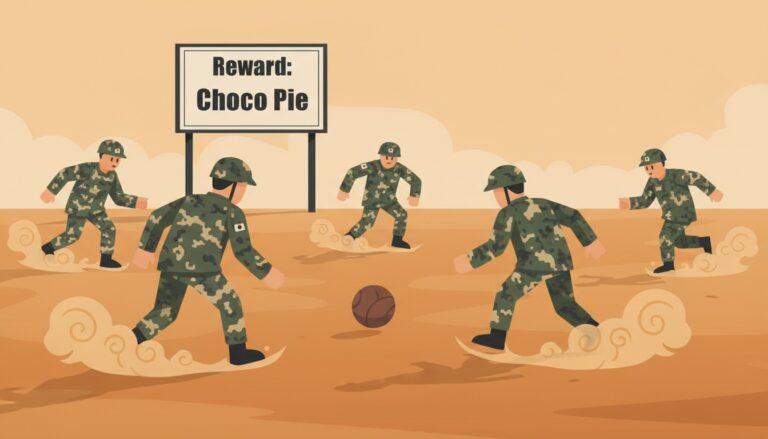
The Scenario: You are at a chi-maek (chicken & beer) gathering with Korean male friends. Suddenly, one of them mentions his time in the military, and the topic shifts to soccer. His eyes light up, his voice gets louder, and he starts using words that sound like German soccer leagues but definitely aren’t.
The ‘Why’: You’ve just entered the zone of ‘Gun-dae-s-liga’ (군대스리가). To the untrained ear, it sounds like just sports talk. But knowing these specific terms is the key to understanding the intense male bonding culture in Korea. If you can nod along and throw in a comment like “Did you play for a reward vacation?”, you will instantly become the coolest foreigner at the table.
Transparency: This guide is based on real stories from our male tutors who claim they were the “Messi of their platoon” (we can’t verify this, but let’s humor them).
Phase 2: Deep Dive into Key Expressions
Since you are at a B2 (Intermediate) level, we will skip the basic sports terms and focus on the slang that carries cultural weight.
1. 군대스리가 (Gun-dae-s-liga)
- Pronunciation: Gun-dae-sue-ree-ga [Sounds like ‘Gun’ + ‘Day’ + ‘S’ + ‘League-ah’]
- Meaning: Military (Gundae) + Bundesliga (German Football League).
- Editor’s Insight: This is a classic Korean portmanteau. It mocks the poor quality of the game (played on dust and gravel) by comparing it to a world-class league. It’s self-deprecating humor at its finest.
- Situation Check: Casual. Use this with friends. Don’t use it with a very serious elderly veteran unless the mood is light.
2. 전투 축구 (Jeon-tu Chuk-gu)
- Pronunciation: Jeon-too Chook-goo [Think ‘Jeon’ as in Jeonju + ‘Too’ + ‘Chook-goo’]
- Meaning: Literal: Combat Soccer / Real Nuance: A soccer match where there are no rules, physical tackles are encouraged, and injuries are common.
- Editor’s Insight: If someone says they played Jeon-tu Chuk-gu, they aren’t talking about strategy. They are talking about grit and chaos. It implies, “I survived a war on the field.”
- Situation Check: Casual/Descriptive.
3. 포상 휴가 (Posang Hyuga)
- Pronunciation: Po-sang Hyu-ga [‘Po’ like ‘Post’ + ‘Sang’ + ‘Hyu’ like ‘Phew’ + ‘Ga’]
- Meaning: Prize Vacation / Reward Leave.
- Editor’s Insight: This is the Holy Grail of military service. Soldiers don’t play soccer for fun; they play because the winning team might get an extra 2-3 days off to go home. Understanding this explains why they play so desperately.
- Situation Check: Formal/Casual. This is a standard military administrative term.
Phase 3: Textbook vs. Real Life
How does a B2 learner sound versus a “Korean Insider”?
| Textbook Korean (Standard) | Real Life Korean (The ‘Vibe’) |
|---|---|
| 군대에서 축구를 했어요. (I played soccer in the army.) |
연병장에서 먼지 먹으면서 뛰었지. (I ran around the drill ground eating dust.) |
| 경기가 아주 치열했어요. (The match was very intense.) |
완전 전투 축구였어. 정강이 다 나가는 줄. (It was total combat soccer. Thought my shins were gonna break.) |
| 이겨서 휴가를 받았어요. (We won and got a vacation.) |
포상 휴가 따려고 목숨 걸고 했어. (We bet our lives on it to snag that reward leave.) |
Editor’s Note: Notice the use of “목숨 걸고” (betting one’s life). Koreans love hyperbole to emphasize effort!
Phase 4: Cultural Context & Manners
1. The “Triple Threat” (Avoid this on dates!)
There is an old joke in Korea about the three stories women hate hearing the most:
1. Military stories.
2. Soccer stories.
3. Military Soccer stories.
- Nunchi Tip: If you are a male learner, refrain from talking about Gun-dae-s-liga on a date with a Korean woman. However, if you are a female learner and you listen to a Korean guy’s story and say, “와, 진짜 힘들었겠다” (Wow, that must have been really tough), you will win his loyalty forever.
2. Hierarchy on the Field (Jeop-dae Soccer)
Even in sports, rank matters. Sometimes, subordinates intentionally pass the ball to a high-ranking officer (like a Commander) or “accidentally” let him score. This is called 접대 축구 (Jeop-dae Chuk-gu) or “Hospitality Soccer.”
Phase 5: Real-Life Scenario (Roleplay)
Setting: A pub in Hongdae. Min-su is reminiscing about his army days to his foreign friend, Leo.
Characters:
* Min-su (Korean): Excited, reliving his glory days.
* Leo (You): B2 Learner, showing empathy and wit.
Dialogue:
Min-su: (Gesturing wildly) 야, 우리 부대장님이 축구광이었잖아. 주말마다 불려 나갔어.
(Ya, uri budaejang-nim-i chukgu-gwang-ieot-jana. Jumal-mada bullyeo nagasseo.)
Hey, you know my unit commander was a soccer maniac. We got called out every weekend.
Leo: (Nodding) 아, 그 군대스리가 말하는 거지?
(Ah, geu Gun-dae-s-liga mal-haneun geoji?)
Ah, you’re talking about that **Gun-dae-s-liga, right?**
Min-su: (Surprised laugh) 오, 그 말도 알아? 맞아. 진짜 전투 축구가 따로 없었지.
(Oh, geu mal-do ara? Maja. Jinjja Jeon-tu Chuk-gu-ga ttaro eop-seot-ji.)
Oh, you know that word? Right. It was seriously like **Combat Soccer out there.**
Leo: (Cheeky smile) 그래서, 포상 휴가는 좀 땄어?
(Geuraeseo, Posang Hyuga-neun jom ttasseo?)
So, did you manage to snag any **Reward Vacation?**
Min-su: (Sighs) 아니… 개발려서 PX 내기만 엄청 했다.
(Ani… gae-ballyeoseo PX naegi-man eomcheong haetda.)
No… we got destroyed and just did a lot of betting for PX snacks.
Phase 6: 10-Second Shadowing Drill
Let’s practice the rhythm. Emphasize the bold parts to sound natural.
“솔직히 / 축구가 아니라 / 전쟁이었죠.”
(Honestly / it wasn’t soccer / it was war.)
Sol-jik-hi / chuk-gu-ga a-ni-ra / jeon-jaeng-i-eot-jjo.
- Tip: Drop your pitch on “jeon-jaeng” (war) to sound serious and dramatic.
Phase 7: FAQ & Troubleshooting
- Q: Can I use ‘Gun-dae-s-liga’ with a boss at work?
- Maybe. If your boss is male and you are sharing a drink, it’s a great icebreaker. If it’s a formal meeting, definitely not.
- Q: What if I don’t like soccer?
- You don’t have to! Just say: “저는 개발이라서 응원만 했어요.” (I have ‘dog feet’ [bad player], so I just cheered.) This is a funny way to admit you aren’t athletic.
Phase 8: Wrap-up & Mission
One-Liner Summary: Gun-dae-s-liga isn’t about sports; it’s about the shared struggle and hierarchy of Korean military life.
Your Mission: Next time a Korean friend mentions the army, ask: “축구 많이 했어요?” (Did you play a lot of soccer?) and watch their reaction!
Let’s Chat: Have you ever heard a “Military Soccer Story”? Did you understand it, or did you just zone out? Tell me in the comments!
Phase 9: Pop Quiz
1. What does “Gun-dae-s-liga” combine?
A) Guns + League
B) Gundae (Military) + Bundesliga
C) Gundae + Serie A
2. Why do soldiers play soccer so desperately?
A) To join the national team
B) For Posang Hyuga (Reward Vacation)
C) Because the uniforms are comfortable
3. Which term best describes a rough, rule-breaking game?
A) Jeop-dae Chuk-gu (Hospitality Soccer)
B) Jeon-tu Chuk-gu (Combat Soccer)
C) Gae-bal (Dog foot)
(Answers: 1-B, 2-B, 3-B)
Frequently Asked Questions (FAQ)
Q: What does "군대스리가 (Gun-dae-s-liga)" mean in Korean and how do you pronounce it?
A: In Korean, "군대스리가 (Gun-dae-s-liga)" is pronounced [Gun-dae-sue-ree-ga [Sounds like 'Gun' + 'Day' + 'S' + 'League-ah'] and means: Military (Gundae) + Bundesliga (German Football League).
Q: What does "전투 축구 (Jeon-tu Chuk-gu)" mean in Korean and how do you pronounce it?
A: In Korean, "전투 축구 (Jeon-tu Chuk-gu)" is pronounced [Jeon-too Chook-goo [Think 'Jeon' as in Jeonju + 'Too' + 'Chook-goo'] and means: Literal: Combat Soccer / Real Nuance: A soccer match where there are no rules, physical tackles are encouraged, and injuries are common.
Q: What does "포상 휴가 (Posang Hyuga)" mean in Korean and how do you pronounce it?
A: In Korean, "포상 휴가 (Posang Hyuga)" is pronounced [Po-sang Hyu-ga ['Po' like 'Post' + 'Sang' + 'Hyu' like 'Phew' + 'Ga'] and means: Prize Vacation / Reward Leave.







