

Phase 1: Greeting & Introduction
안녕하세요! Daily Hangul Editor here. 👋
So, you’ve mastered ordering at a restaurant and you can hold a decent conversation about your hobbies. But have you ever been camping in Korea? The Korean camping scene (often called ‘Chabak’ when sleeping in a car, or just ‘Camping’) is a massive cultural phenomenon, and it comes with its own set of vocabulary that you won’t find in standard textbooks.
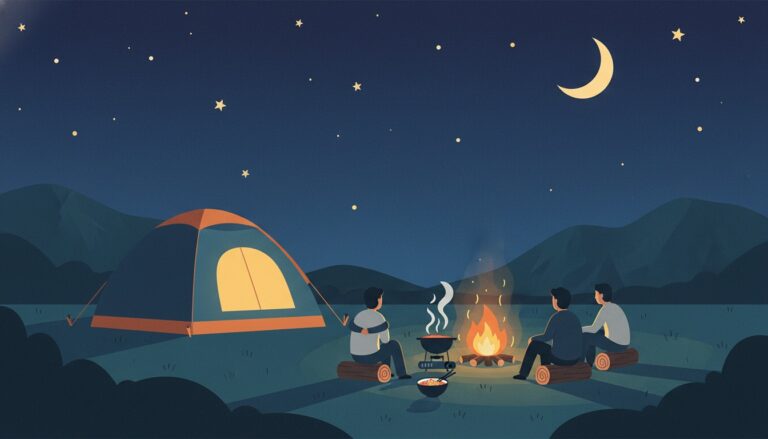
Imagine this: You are sitting around a campfire with Korean friends. The air is crisp, the pork belly (Samgyeopsal) is sizzling, and everyone suddenly stops talking and stares blankly at the fire. If you break the silence by asking, “Why is everyone quiet?” you might ruin the vibe.
Today, we are diving into the C1 (Advanced) level expressions for Camping Cooking & ‘Bulmeong’. These phrases will help you transition from a ‘foreigner who speaks Korean well’ to an ‘insider who gets the vibe.’ Let’s get started!
Phase 2: Deep Dive into Key Expressions
Here are the three expressions that will earn you instant respect at the campsite.
1. 불멍 (Bulmeong)
- Pronunciation: [Bul-meong] Sounds like ‘Bull’ + ‘Mung’ (as in mung bean).
- Meaning:
- Literal: Fire (Bul) + Bruised/Blank (Meong, from ‘Meong-ttaeri-da’).
- Real Nuance: Zoning out while staring at a fire to relax and heal your mind.
- Editor’s Insight: This is the heart of Korean camping. It’s not just “looking at the fire.” It’s a meditative state. You can also combine ‘Meong’ with other things: 물멍 (Mulmeong – staring at water/ocean) or 숲멍 (Supmeong – staring at the forest).
- Situation Check: Casual ✅ | Close Colleagues ✅ | Formal Business Meetings ❌ (Don’t say you were doing ‘Meong’ during a meeting!)
2. 국룰 (Gungnul)
- Pronunciation: [Gung-nul] Pronounced like ‘Kung-nool’.
- Meaning:
- Literal: National (Guk) + Rule (Rul).
- Real Nuance: An unwritten rule that everyone accepts; the standard procedure; the “GOAT” combination.
- Editor’s Insight: At a C1 level, you shouldn’t just say “This is popular.” You should say, “This is Gungnul.”
- Example: Eating fried rice (Bokkumbap) after Samgyeopsal is Gungnul.
- Situation Check: Casual ✅ | Semi-Formal (humorous context) ✅
3. 입가심 (Ipgasim)
- Pronunciation: [Ip-ga-sim]
- Meaning:
- Literal: Mouth (Ip) + Rinsing/Cleansing (Gasim).
- Editor’s Insight: Advanced learners often use “Dessert” (hu-sik). However, Ipgasim implies washing away the grease or heavy taste of the main meal. It could be coffee, fruit, or ironically, spicy Ramen after greasy meat.
- Situation Check: All Situations ✅
Phase 3: Textbook vs. Real Life (The Vibe Check)
Let’s upgrade your sentences from “correct” to “natural.”
| Textbook Korean (Correct but stiff) | Real Korean (Natural & Trendy) |
|---|---|
| 불을 보면서 쉬자. (Let’s rest while watching the fire.) |
우리 불멍 좀 때리자. (Let’s zone out with the fire.) |
| 삼겹살 먹은 후에 라면을 먹어야 해요. (We must eat ramen after pork belly.) |
삼겹살 먹고 라면은 국룰이지. (Ramen after Samgyeopsal is the unwritten law.) |
| 요리가 다 탔어요. (The cooking is all burnt.) |
완전 숯검댕이가 됐네! (It completely turned into charcoal soot!) |
Note: ‘숯검댕이’ (Sutgeomdaengi) is a vivid word used when food is burnt to a crisp or when someone has soot on their face. Using this shows high-level vocabulary command.
Phase 4: Cultural Context & Manners
🤫 The Art of Silence
In Western camping, bonfires often mean loud songs or ghost stories. In Korea, while chatting is common, the ‘Bulmeong’ time is often a shared silence. Don’t feel pressured to fill the audio gap. Being comfortable in silence is a sign of a strong relationship (or high ‘Nunchi’).
🍜 The ‘Course’ Meal Culture
Even at a campsite, Koreans often eat in courses. You don’t just eat meat and finish. The sequence usually goes:
1. Meat (BBQ)
2. Carbohydrates (Fried Rice or Ramen cooked in the meat grease)
3. Ipgasim (Fruit or Mix Coffee)
Expecting this flow shows you understand the culture.
Phase 5: Real-Life Scenario (Roleplay)
Setting: Late night at a glamping site in Gapyeong. Minji (Korean) and Alex (Foreigner, C1 level) are finishing dinner.
(Alex is scraping the burnt part off the sausage)
Alex: 아, 잠깐 한눈팔았더니 소세지가 숯검댕이가 될 뻔했네.
(Ah, I looked away for a second and the sausage almost turned into charcoal.)
Minji: ㅋㅋ 괜찮아, 탄 맛도 캠핑의 묘미지. 그나저나 고기 다 먹었으니까 이제 라면 끓일까?
(Haha, it’s okay. Burnt taste is the charm of camping. Anyway, since we finished the meat, shall we boil Ramen?)
Alex: 당근이지! 기름진 거 먹고 얼큰한 라면으로 입가심하는 건 국룰이잖아.
(Absolutely! cleansing the palate with spicy Ramen after greasy food is the unwritten rule.)
Minji: 오~ 알는데? 그럼 라면 먹고 장작 좀 더 넣고 불멍 때리자.
(Oh~ You know your stuff? Then let’s eat Ramen, add more firewood, and zone out.)
Phase 6: 10-Second Shadowing Drill
Read this aloud to practice your intonation and rhythm. Focus on the pause marks (/).
“배부르게 먹었으니까 / 이제 따뜻한 차 한 잔으로 / 입가심하면서 / 불멍이나 때리자.”
- Romanization: Baebureuge meogeosseunikka / ije ttatteutan cha han janeuro / ipgasim-hamyeonseo / bulmeong-ina ttaerija.
- Translation: Since we ate until we’re full, let’s cleanse our palate with a warm cup of tea and zone out by the fire.
Phase 7: FAQ & Troubleshooting
- Q: Can I use ‘Bulmeong’ for a gas stove or a video of a fire?
- A: Yes! Watching a YouTube video of a fireplace is often called 랜선 불멍 (LAN-cable Bulmeong). It’s perfectly acceptable.
- Q: Is ‘Gungnul’ slang? Can I use it with my boss?
- A: It is slang originating from the internet, but it has become very mainstream. You can use it with a boss IF the atmosphere is casual and friendly (like at a company workshop). Avoid it in a formal report or serious meeting.
Phase 8: Wrap-up & Mission
Summary:
Today we learned that Bulmeong is for healing, Gungnul is for undeniable trends, and Ipgasim is the sophisticated finish to a meal.
🚀 Your Mission:
Next time you finish a heavy meal with a Korean friend (even if it’s not camping), suggest going for a coffee by saying: “커피로 입가심하러 갈까요?” (Shall we go cleanse our palate with coffee?). Watch their eyes widen in surprise!
Have you ever experienced ‘Bulmeong’? Tell me in the comments!
Phase 9: Quiz
1. Which word best describes a situation where you stare blankly at the ocean to relax?
A) 불멍 (Bulmeong)
B) 물멍 (Mulmeong)
C) 밥멍 (Bapmeong)
2. Your friend suggests eating Ramen right after a heavy BBQ dinner. What is the perfect response?
A) 그건 불법이야. (That’s illegal.)
B) 그건 국룰이지. (That’s the unwritten rule.)
C) 그건 숯검댕이야. (That’s charcoal.)
3. What does ‘Ipgasim’ literally mean?
A) Mouth exercise
B) Mouth filling
C) Mouth rinsing/cleansing
(Answers: 1.B, 2.B, 3.C)
Frequently Asked Questions (FAQ)
Q: What does "불멍 (Bulmeong)" mean in Korean and how do you pronounce it?
A: In Korean, "불멍 (Bulmeong)" is pronounced [Bul-meong] and means: Literal: Fire (Bul) + Bruised/Blank (Meong, from 'Meong-ttaeri-da').
Q: What does "국룰 (Gungnul)" mean in Korean and how do you pronounce it?
A: In Korean, "국룰 (Gungnul)" is pronounced [Gung-nul] and means: Literal: National (Guk) + Rule (Rul).
Q: What does "입가심 (Ipgasim)" mean in Korean and how do you pronounce it?
A: In Korean, "입가심 (Ipgasim)" is pronounced [Ip-ga-sim] and means: Literal: Mouth (Ip) + Rinsing/Cleansing (Gasim).







