

Phase 1: Introduction
Hello! It’s your Daily Hangul Editor.
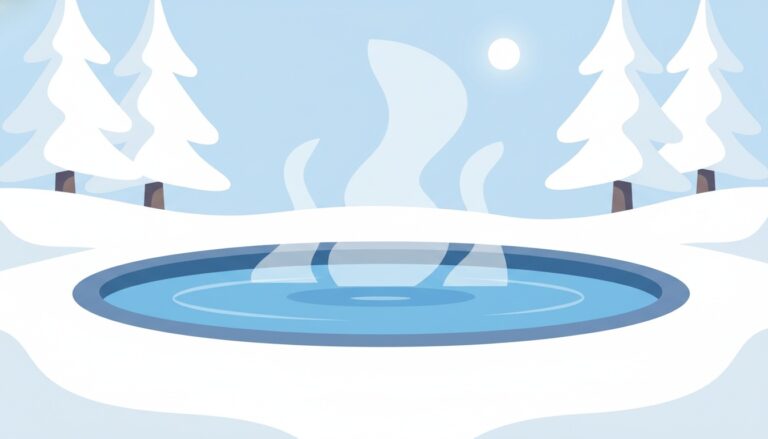
Imagine this: It’s the middle of January in Korea. The air is freezing, maybe there’s even a light dusting of snow on the pine trees. But you? You are sitting in steaming hot water, waist-deep, with the cold wind brushing against your face. This is the magic of 노천탕 (Nocheontang – Open-air bath).
At the C1 level, simply saying “It is hot” (뜨거워요) or “I like the bath” (목욕이 좋아요) isn’t enough to capture the poetic contrast of this experience. You need words that describe physical sensations, atmosphere, and that specific Korean feeling of “melting” your stress away.
Today, we are going to learn how to express the romantic vibe (운치) of an outdoor bath like a true local. These are the expressions that will make Koreans stop and say, “Wow, how do you know that feeling?”
Phase 2: Deep Dive into Key Expressions
1. 몸을 지지다 (Mom-eul jijida)
- Pronunciation: [Mom-eul jijida] (Sounds like jee-jee-da)
- Meaning: Literally “to sear/fry the body,” but in reality, it means “to warm one’s body thoroughly on a hot floor or in hot water to relieve fatigue.”
- Editor’s Insight: This is the ultimate “Ahjussi/Ajumma” phrase, but younger people use it too when they are exhausted. It’s not about getting clean; it’s about therapy. If you just say “warm up,” you miss the nuance of the heat penetrating your muscles.
- Situation Check: Casual (O) / Polite (O – 몸을 지지러 왔어요)
2. 노곤하다 (Nogonhada)
- Pronunciation: [Nogonhada] (No-gon-ha-da)
- Meaning: To feel pleasantly listless, drowsy, or languid due to warmth or fatigue.
- Editor’s Insight: You know that feeling when you get out of a hot bath, your limbs feel heavy like wet cotton, and you just want to collapse into a nap? That is 노곤하다. It is a positive, relaxing exhaustion.
- Situation Check: Mostly used to describe one’s own feeling.
3. 운치 있다 (Unchi itda)
- Pronunciation: [Unchi itda]
- Meaning: To be atmospheric, picturesque, or have a romantic/tasteful vibe.
- Editor’s Insight: This is a high-level C1 word. A neon sign is not unchi. But snow falling silently on a hot spring? That is the definition of 운치. Use this when the scenery matches the mood perfectly.
Phase 3: Textbook vs. Real Life
Let’s upgrade your vocabulary from “Tourist” to “Resident.”
| Textbook / Basic (B1) | Real Korean / Advanced (C1) | Nuance Difference |
|---|---|---|
| 물이 따뜻해서 좋아요. (The water is warm, so it’s good.) | 뜨끈하니 피로가 싹 풀리네요. (It’s piping hot/toasty, so my fatigue is completely dissolving.) | ‘뜨끈하다’ implies a satisfying, deep heat, unlike just ‘따뜻하다’. |
| 경치가 아름다워요. (The scenery is beautiful.) | 겨울 노천탕이 참 운치 있네요. (The winter open-air bath is truly atmospheric.) | ‘운치’ adds a layer of emotional aesthetic/mood. |
| 졸려요. (I’m sleepy.) | 몸이 노곤노곤해지네요. (My body is getting all drowsy and soft.) | ‘노곤노곤’ is a mimetic word emphasizing the melting feeling. |
Editor’s Note: Notice the use of “싹 (ssak)” in the first example. It means “completely” or “cleanly” (like a broom sweeping). Adding these adverbs makes your Korean sound much sharper.
Phase 4: Cultural Context & Manners
The Paradox of “Siwonhada” (시원하다)
If you enter a 40°C (104°F) tub and hear a Korean sigh, “으~ 시원하다! (Euh~ Siwonhada!),” do not check the thermometer.
- Literal Meaning: It is cool/cold.
- Bathhouse Meaning: It is refreshing / My muscles are unknotting / It hits the spot.
- Nunchi Tip: If you say “Ah, siwonhada~” while entering hot water, you will instantly earn respect from everyone around you. It signifies you understand the physical release of tension.
The Silence of the Nocheontang
Unlike the loud, splashing indoor pools, the outdoor Nocheontang is often a place of quiet contemplation. People are there to enjoy the cool air on their heads and hot water on their bodies. Keep your voice low. It adds to the 운치 (atmosphere).
Phase 5: Roleplay Script
Setting: An outdoor hot spring resort (Oncheon) in Gangwon-do during winter.
Characters: Alex (Foreigner, C1 Level), Min-ho (Korean Friend).
(Alex and Min-ho step out into the freezing air and quickly slide into the hot outdoor tub.)
Min-ho: (Shivering then sighing) 으아, 추워! …하아, 들어오니까 살 것 같다.
(Ugh, so cold! …Haa, I feel alive now that I’m in.)
Alex: (Leaning back and closing eyes) 와, 물 온도 딱 좋은데? 제대로 지질 수 있겠다.
(Wow, the water temperature is perfect. I can properly sear (soothe) my body.)
Min-ho: (Laughing) 야, 너 표현이 완전 아저씨 다 됐네.
(Hey, your expression has become a total middle-aged man.)
Alex: (Looking at the steam rising) 솔직히 이 맛에 오는 거지. 머리는 차갑고 몸은 뜨겁고… 진짜 운치 있다.
(Honestly, I come for this taste/experience. Head is cold, body is hot… it’s really atmospheric.)
Min-ho: 인정. 나중에 나가면 노곤해서 바로 잠들 것 같은데?
(Agreed. When we get out later, I think I’ll fall asleep right away because I’ll be so drowsy.)
Phase 6: 10-Second Shadowing
Listen to the rhythm. Focus on the contrast between the tense cold and the relaxed heat.
차가운 바람 맞으면서 / 뜨거운 물에 들어가니까 / 피로가 싹 풀리는 기분이야.
(Cha-ga-un ba-ram ma-jeu-myeon-seo / tteu-geo-un mul-e deu-reo-ga-ni-kka / pi-ro-ga ssak pul-li-neun gi-bun-i-ya.)Meaning: entering the hot water / while facing the cold wind / feels like the fatigue is completely dissolving.
Phase 7: FAQ & Troubleshooting
Q: Can I bring my phone into the Nocheontang to take photos of the ‘Unchi’?
A: NO. This is a huge taboo in most public bathhouses for privacy reasons. Unless it is a private villa pool or specifically allowed (and you are wearing swimwear), keep the phone in the locker. Capture the 운치 with your eyes, not your lens.
Q: Is “몸을 지지다” only for old people?
A: It sounds “mature,” but it’s acceptable for anyone to say when they are physically tired. Using it as a foreigner is charming and shows high proficiency.
Phase 8: Wrap-up
- One-Liner: Use “몸을 지지다” when you want therapeutic heat, and “운치 있다” when the winter vibe is perfect.
- Mission: Next time you take a hot bath or shower after a long day, say out loud: “아, 노곤하다.” Feel the weight of the day leaving your body.
Does your country have a bathing culture? Tell me in the comments how you describe that relaxed feeling!
Phase 9: Quiz
- Which word best describes the atmospheric, romantic vibe of a snowy outdoor bath?
a) 시원하다 (Siwonhada)
b) 운치 있다 (Unchi itda)
c) 답답하다 (Dapdap-hada) -
What does “몸을 지지다” imply?
a) Getting a sunburn.
b) Washing quickly with cold water.
c) Warming the body thoroughly to relieve fatigue. -
(Fill in the blank) After a long bath, my body feels heavy and relaxed. I feel ______.
a) 노곤하다 (Nogonhada)
b) 억울하다 (Eogulhada)
c) 섭섭하다 (Seopseop-hada)
(Answers: 1. b, 2. c, 3. a)
Frequently Asked Questions (FAQ)
Q: What does "몸을 지지다 (Mom-eul jijida)" mean in Korean and how do you pronounce it?
A: In Korean, "몸을 지지다 (Mom-eul jijida)" is pronounced [Mom-eul jijida] and means: Literally "to sear/fry the body," but in reality, it means "to warm one's body thoroughly on a hot floor or in hot water to relieve fatigue."
Q: What does "노곤하다 (Nogonhada)" mean in Korean and how do you pronounce it?
A: In Korean, "노곤하다 (Nogonhada)" is pronounced [Nogonhada] and means: To feel pleasantly listless, drowsy, or languid due to warmth or fatigue.
Q: What does "운치 있다 (Unchi itda)" mean in Korean and how do you pronounce it?
A: In Korean, "운치 있다 (Unchi itda)" is pronounced [Unchi itda] and means: To be atmospheric, picturesque, or have a romantic/tasteful vibe.







