

Phase 1: Introduction
Hello! This is your Senior Editor from Daily Hangul.
Have you noticed a strange trend in Korean variety shows lately? You turn on the TV, and instead of K-Pop idols dancing in a studio, famous actors and comedians are sitting on a boat for 12 hours, staring at the ocean.
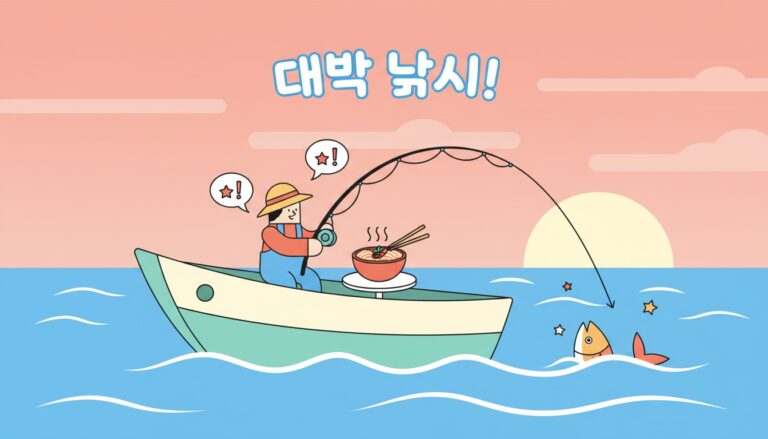
This is the “City Fisherman” (도시어부) effect. Fishing, once considered a hobby for older generations, has exploded into a trendy activity for young people and couples.
As a tutor, I’ve had students ask me, “Teacher, why are they screaming ‘Hit! Hit!’ on TV? Is that English or Korean?”
If you don’t know the specific lingo used on these boats, you miss half the fun of the show (and the culture). Today, we are going to learn the “real” Korean fishing vocabulary—words that describe the thrill, the frustration, and the taste of victory. These are B2-level expressions that will make your Korean friends say, “Wow, you really know the vibe!”
Phase 2: Deep Dive into Core Expressions
Here are the three words you will hear every 5 minutes on any Korean fishing show.
1. 손맛 (Son-mat)
- Pronunciation: [Son-mat] (Sound analogy: Son like ‘son’ + mat like ‘mutt’)
- Meaning: Literally “Hand taste.”
- Real Nuance: The thrilling physical sensation of the fish pulling on the line. It describes the vibration and weight felt through the hands.
- Editor’s Insight: This is a very sensory word. You can’t learn this from a book; you have to feel it. Interestingly, we also use this to describe someone who is good at cooking (hands that make food taste good) or even the feeling of hitting a ball in sports.
- Situation Check: Casual & Polite friendly (O).
2. 월척 (Wol-cheok)
- Pronunciation: [Wol-cheok] (Sound analogy: Wol like ‘wall’ + cheok like ‘chuck’)
- Meaning: Traditionally, a fish roughly 30.3cm or larger.
- Real Nuance: A “huge catch” or a “big success.”
- Editor’s Insight: While it’s a technical fishing term, Koreans use this metaphorically all the time. If you land a great job, find an amazing boyfriend/girlfriend, or buy something valuable at a cheap price, you can say, “I caught a Wol-cheok!”
- Situation Check: Casual to Formal (Metaphorical use is very common).
3. 꽝 치다 (Kkwang chi-da)
- Pronunciation: [Kkwang chi-da] (Sound analogy: Kkwang sounds like a loud gong crashing)
- Meaning: To strike out; to catch absolutely nothing.
- Real Nuance: A total failure or a bust.
- Editor’s Insight: The sound “Kkwang” mimics an empty, banging sound. On shows like City Fisherman, when the time is up and someone has an empty cooler, the caption always says “꽝!” (Bust!). It’s a fun, self-deprecating way to admit failure.
- Situation Check: Casual (O). Avoid in serious business meetings.
Phase 3: Textbook vs. Real Life
Let’s see how a standard learner speaks versus a “City Fisherman” fan.
| Textbook Korean (Standard) | Real Korean (Insider Vibe) |
|---|---|
| 물고기를 잡았을 때 기분이 좋아요. (I feel good when I catch a fish.) |
와, 손맛이 장난 아니에요! (Wow, the ‘hand-taste’ is no joke!) |
| 아주 큰 물고기예요. (It is a very big fish.) |
대박! 이거 완전 월척이다! (Daebak! This is a total ‘Wol-cheok’!) |
| 오늘 한 마리도 못 잡았어요. (I didn’t catch a single one today.) |
오늘 완전히 꽝 쳤어요. (I totally struck out/went bust today.) |
Note: B2 learners should focus on using “장난 아니다” (no joke) to emphasize the intensity of the Son-mat.
Phase 4: Cultural Context & Manners
1. The “Ramyeon” Rule
In Korea, fishing isn’t just about the fish. It’s about the Ramyeon you eat on the boat. Even if you catch a Wol-cheok, the highlight is often boiling spicy noodles with freshly caught seafood (usually octopus or crab) right on the deck. If you are invited to go fishing, expect to eat instant noodles. It’s a ritual.
2. Nunchi (Eye-measure) on the Boat
If your friend is “꽝 치다” (failing) and looks frustrated, but you keep screaming about your amazing “손맛” (hand taste), you have no Nunchi.
In Korean culture, shared suffering is important. If everyone is failing, complain together. If you are the only one succeeding, show some humility (or share your catch for the Ramyeon!).
Phase 5: Roleplay Script (Real Scenario)
Setting: On a fishing boat near Incheon. Min-su (Korean) and Alex (Foreigner) have been fishing for 3 hours.
Alex: (Rod suddenly bends like crazy)
어? 어?! 뭐가 잡힌 것 같아!
(Uh? Uh?! I think something is caught!)
[Eo? Eo?! Mwo-ga jap-hin geot ga-ta!]
Min-su: (Looking excited)
대를 세워! 릴 감아, 빨리! 손맛 어때?
(Pull the rod up! Reel it in, fast! How’s the hand-taste?)
[Dae-reul se-wo! Lil ga-ma, ppal-li! Son-mat eo-ttae?]
Alex: (Gritting teeth)
우와… 손맛 진짜 묵직한데? 이거 월척 아니야?
(Whoa… the hand-taste is really heavy/solid. Isn’t this a huge catch?)
[U-wa… son-mat jin-jja muk-jik-han-de? I-geo wol-cheok a-ni-ya?]
Min-su: (Looking at the water)
잠깐… 저거 그냥 미역인데? 꽝이다, 꽝.
(Wait… that’s just seaweed? It’s a bust, a total bust.)
[Jam-kkan… jeo-geo geu-nyang mi-yeok-in-de? Kkwang-i-da, kkwang.]
Phase 6: 10-Second Shadowing
Practice this sentence to describe the perfect weekend. Focus on the bold accents.
“낚시는/ 기다림이 아니라/ 손맛을/ 느끼러 가는 거죠.”
(Fishing isn’t about waiting; it’s about going to feel the thrill of the catch.)
Drill Guide:
1. Nak-shi-neun / (Pause slightly)
2. Gi-da-rim-i a-ni-ra / (Raise intonation at ‘ra’)
3. SON-MAT-eul / (Stress this word!)
4. Neu-kki-reo ga-neun geo-jyo. (Drop pitch at the end for confidence)
Phase 7: FAQ & Troubleshooting
- Q: Can I use “손맛” for things other than fishing?
- A: Yes! As mentioned, you can use it for mobile games (the feeling of hitting buttons), golf (hitting the ball), or even driving a sports car. It implies a tactile satisfaction.
- Q: Is “월척” only for good things?
- A: Mostly, yes. But be careful—sometimes sarcastic friends might use it when you step in a big puddle or make a big mistake. “Wow, you caught a ‘Wol-cheok’ of a problem there.”
Phase 8: Wrap-up
- Summary: Today we learned that 손맛 is the thrill, 월척 is the big success, and 꽝 is the funny failure.
- Mission: Next time you accomplish something big (like finishing a difficult project), tell your Korean friend: “오늘 완전 월척 낚았어!” (I caught a huge one today!)
- Let’s Chat: Have you ever watched City Fisherman (도시어부)? What’s the biggest “Wol-cheok” (success) you’ve had recently? Tell me in the comments!
Phase 9: Pop Quiz
1. Which word describes the physical thrill of fishing?
A) 눈맛 (Eye taste)
B) 입맛 (Mouth taste)
C) 손맛 (Hand taste)
2. If your friend catches nothing all day, what situation is this?
A) 대박 (Jackpot)
B) 꽝 (Bust)
C) 월척 (Huge catch)
3. (Advanced) How would you politely boast about a successful blind date using fishing terms?
A) 오늘 꽝 쳤어. (I struck out today.)
B) 오늘 손맛이 없었어. (There was no thrill.)
C) 오늘 완전 월척이었어! (It was a huge catch!)
(Answers: 1-C, 2-B, 3-C)
Frequently Asked Questions (FAQ)
Q: What does "손맛 (Son-mat)" mean in Korean and how do you pronounce it?
A: In Korean, "손맛 (Son-mat)" is pronounced [Son-mat] and means: Literally "Hand taste."
Q: What does "월척 (Wol-cheok)" mean in Korean and how do you pronounce it?
A: In Korean, "월척 (Wol-cheok)" is pronounced [Wol-cheok] and means: Traditionally, a fish roughly 30.3cm or larger.
Q: What does "꽝 치다 (Kkwang chi-da)" mean in Korean and how do you pronounce it?
A: In Korean, "꽝 치다 (Kkwang chi-da)" is pronounced [Kkwang chi-da] and means: To strike out; to catch absolutely nothing.







