

Hello! I’m your Daily Hangul Editor.
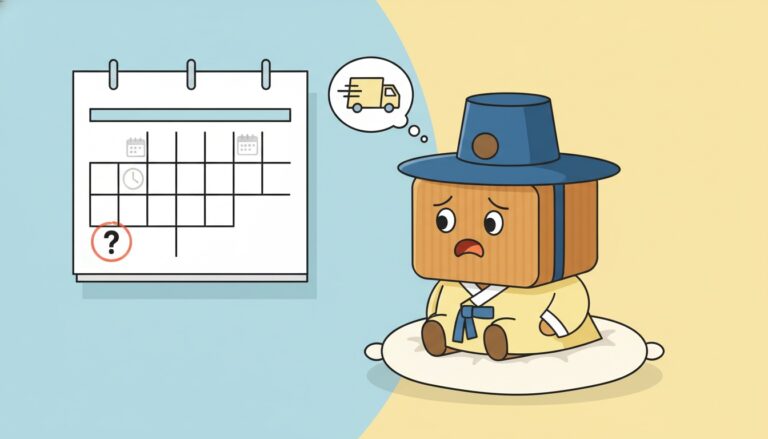
Imagine this: You ordered a beautiful jacket from a Korean online mall three days ago. In Korea, where “Ppalli-ppalli” (Hurry-hurry) culture rules, three days feels like three weeks. You check the app, but the tracking hasn’t moved.
You want to ask the customer service center or the building guard, “Where is my stuff?” but your mind goes blank. Don’t worry. This is a situation even Koreans find stressful.
Today, I will teach you the essential survival phrases to track down your missing package without losing your cool. These are real questions I’ve helped my students use to successfully rescue their deliveries!
Phase 1: Deep Dive into Key Phrases
Here are the top 3 phrases you need when your doorbell isn’t ringing. We are aiming for Level A1, so we will stick to the polite “-Yo” style.
1. 배송 언제 와요? (When is the delivery coming?)
- Pronunciation: [Bae-song on-je wa-yo?]
- “Bae” sounds like Bay.
- “Song” is soft, like a Song you sing.
- “Wa-yo” sounds like Why-o without the ‘h’.
- Meaning:
- Literal: Delivery when comes?
- Real Nuance: When can I expect my package?
- Editor’s Insight: This is the magic phrase. It’s direct but polite enough for customer service bots, delivery drivers, or shop owners.
- Situation Check: ✅ Casual (Friends) | ✅ Polite (Strangers/Service)
2. 아직 안 왔어요. (It hasn’t come yet.)
- Pronunciation: [A-jik an wa-sseo-yo]
- “A-jik” (Yet)
- “An” (Not) – Make this sound short and sharp!
- Meaning: It has not arrived yet.
- Editor’s Insight: You use this to explain why you are calling. The word “An” (안) is crucial—it makes the sentence negative. If you miss it, you are saying “It came already”!
- Situation Check: ✅ Casual (Drop ‘yo’) | ✅ Polite (Keep ‘yo’)
3. 확인해 주세요. (Please check for me.)
- Pronunciation: [Hwa-gin-hae ju-se-yo]
- “Hwa-gin” sounds a bit like Wagon but with an H breath at the start.
- Meaning: Please confirm/verify it.
- Editor’s Insight: If the staff says something complicated that you don’t understand, just use this phrase. It gently pushes the responsibility to them to find out where your box is.
Phase 2: Textbook vs. Real Life
Textbooks often teach formal written styles that sound robotic in speech. Let’s see how locals actually speak.
| Textbook / Formal | Real Life (Spoken) | Note |
|---|---|---|
| 배송이 지연되었습니다. (Delivery has been delayed.) |
배송이 늦어요. (Delivery is late.) |
“Ji-yeon” (Delay) is a difficult word. “Nut-eo-yo” (Late) is easier! |
| 택배가 도착하지 않았습니다. ( The package has not arrived.) |
택배가 안 와요. (The package isn’t coming.) |
“An wa-yo” is much more natural for complaining. |
💡 Editor’s Note: At Level A1, simple is best. Koreans prefer shorter sentences in spoken conversation too!
Phase 3: Cultural Context & Manners
The “Taek-bae” (Parcel) Culture
In Korea, delivery drivers (Taek-bae Gisa-nim) are incredibly busy. They might deliver hundreds of packages a day.
- Don’t call immediately: If you get a text saying “Delivery Complete” but you don’t see it, wait 10 minutes. Sometimes they scan it in the truck before walking to your door.
- Check the photo: Most Korean couriers take a photo of where they left the package and send it to you via text or KakaoTalk. Look at the photo first before asking “Where is it?”
Phase 4: Roleplay Scenario
Setting: Jason calls the customer center because his clothes haven’t arrived for a week.
Characters:
* Jason: Foreign Student (A1 Level)
* Agent: Customer Service Staff
(Phone rings)
Agent: 안녕하세요. 무엇을 도와드릴까요? (Hello. How can I help you?)
Jason: (Nervous but clear) 배송 언제 와요? (When is the delivery coming?)
Agent: 운송장 번호가 뭐예요? (What is the tracking number?)
Jason: 잠시만요… (One moment…) 아직 안 왔어요. (It hasn’t come yet.)
Agent: 네, 조회해 볼게요. (Okay, I will look it up.)
Jason: 네, 확인해 주세요. 감사합니다. (Yes, please check for me. Thank you.)
Phase 5: 10-Second Shadowing
Let’s practice the rhythm. In Korean, we pause slightly after the subject.
“My package / hasn’t come / yet.”
제 택배 / 아직 / 안 왔어요.
- 제 택배 (Je Taek-bae)
[Pause] - 아직 (A-jik)
[Pause] - 안 왔어요 (An Wa-sseo-yo)
[Falling Tone]
Tip: Emphasize the “An” strongly to show your frustration!
Phase 6: FAQ (Troubleshooting)
Q: Can I say these phrases to the delivery driver directly?
A: Yes! But always add “Gisa-nim” (Driver-sir) at the start to be polite. ex) “Gisa-nim, bae-song on-je wa-yo?”
Q: What if I am angry? Can I shout?
A: I recommend staying calm. In Korea, getting angry often slows down the process. A polite “Hwa-gin-hae ju-se-yo” (Please check) usually gets faster results than shouting.
Phase 7: Wrap-up
Today’s One-Liner:
To ask about a late package, just remember: “On-je Wa-yo?” (When comes?)
Your Mission:
Check your online order list (Coupang, Gmarket, etc.). Even if nothing is late, practice saying “A-jik an wa-sseo-yo” while looking at the “Pending” status!
Question:
Have you ever lost a package in a foreign country? How did you solve it? Tell me in the comments!
Phase 8: Pop Quiz
1. How do you say “It hasn’t come yet”?
A) Wa-sseo-yo.
B) A-jik an wa-sseo-yo.
C) Ppalli wa-yo.
2. Which phrase means “Please check for me”?
A) Hwa-gin-hae ju-se-yo.
B) Mi-an-hae-yo.
C) Sa-rang-hae-yo.
3. In Korea, if a delivery is late, you should…
A) Call the police immediately.
B) Check the tracking photo or text first.
C) Cry loudly.
Click to see answers
1. B, 2. A, 3. B
Frequently Asked Questions (FAQ)
Q: What does "배송 언제 와요? (When is the delivery coming?)" mean in Korean and how do you pronounce it?
A: In Korean, "배송 언제 와요? (When is the delivery coming?)" is pronounced [Bae-song on-je wa-yo?] and means: a key conversational Korean expression covered in this lesson.
Q: What does "아직 안 왔어요. (It hasn't come yet.)" mean in Korean and how do you pronounce it?
A: In Korean, "아직 안 왔어요. (It hasn't come yet.)" is pronounced [A-jik an wa-sseo-yo] and means: a key conversational Korean expression covered in this lesson.
Q: What does "확인해 주세요. (Please check for me.)" mean in Korean and how do you pronounce it?
A: In Korean, "확인해 주세요. (Please check for me.)" is pronounced [Hwa-gin-hae ju-se-yo] and means: a key conversational Korean expression covered in this lesson.







