

Phase 1: Empathy & Intro
Hello! This is your Daily Hangul Editor.
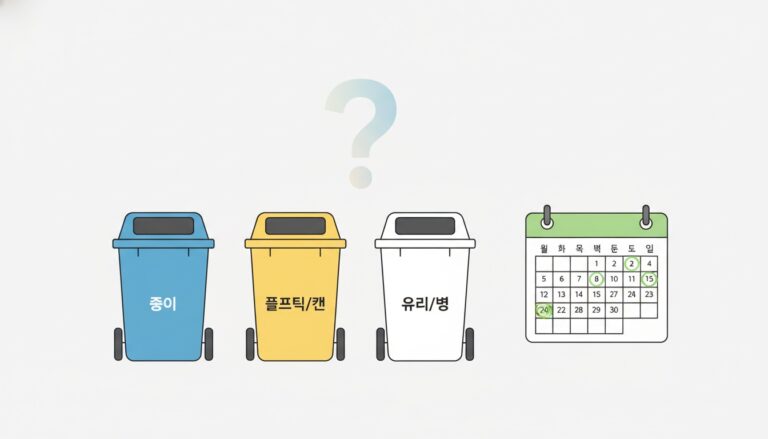
Let’s be honest—moving to Korea is exciting until you stand in front of the trash cans. You are holding a plastic bottle, looking at five different bins, and suddenly, a security guard (Gyeongbi ajeossi) is waving his hands at you shouting something about ‘Tuesday.’ Panic sets in, right?
Korea has one of the strictest recycling systems in the world. In many neighborhoods, you cannot just throw trash away whenever you want. If you miss the designated day, you might have to keep that pile of cardboard in your room for another week. (I’ve seen students use pizza boxes as temporary tables because they missed paper recycling day!)
Today, we will learn how to ask “When should I throw this away?” so you can keep your house clean and your neighbors happy.
Phase 2: Deep Dive into Core Expressions
Here are the top 3 phrases you need to survive the Korean trash system.
1. 이거 언제 버려요?
(When do I throw this away?)
- Pronunciation: I-geo eon-je beo-ryeo-yo? [Ee-guh un-jeh buh-ryuh-yo?]
- Meaning: ‘I-geo’ (this) + ‘eon-je’ (when) + ‘beo-ryeo-yo’ (throw away/discard).
- Editor’s Insight: This is your magic wand. It works for everything—food waste, old furniture, or that confusing plastic wrapper. It’s polite enough for neighbors and security guards.
- Situation Check: ✅ Casual (Friends) | ✅ Polite (Neighbors/Guard)
2. 재활용 하는 날이 언제예요?
(When is the recycling day?)
- Pronunciation: Jae-hwal-yong ha-neun na-ri eon-je-ye-yo? [Jae-hwal-yong ha-neun nah-ree un-jeh-yeh-yo?]
- Meaning: ‘Jae-hwal-yong’ (Recycling) + ‘ha-neun nal’ (doing day) + ‘eon-je-ye-yo’ (when is it?).
- Editor’s Insight: Use this when you first move into a new building. You want to know the schedule, not just about one specific item.
- Situation Check: ✅ Formal / Polite Standard
3. 오늘 버려도 돼요?
(Can I throw this away today?)
- Pronunciation: O-neul beo-ryeo-do dwae-yo? [Oh-neul buh-ryuh-do dway-yo?]
- Meaning: ‘O-neul’ (Today) + ‘beo-ryeo-do’ (even if I throw) + ‘dwae-yo?’ (is it okay?).
- Editor’s Insight: Use this when you see a pile of trash outside and think, “Wait, is it okay if I add mine to that pile?” It shows you are being careful and considerate.
- Situation Check: ✅ Polite Request
Phase 3: Textbook vs. Real Life
Textbooks teach you to sound like a news anchor. We want you to sound like a local.
| Textbook Korean (Too Formal) | Real Life Korean (Natural) |
|---|---|
| 쓰레기 배출일이 언제입니까? (When is the waste discharge date?) |
재활용 언제예요? (When is recycling?) |
| 이것을 여기에 놓아도 됩니까? (May I place this here?) |
이거 여기 둬도 돼요? (Can I put this here?) |
| 플라스틱은 수요일입니다. (Plastic is Wednesday.) |
플라스틱은 수요일에만 돼요. (Plastic is only okay on Wednesday.) |
- Editor’s Note: The word 배출 (discharge) is seen on signs, but in speech, everyone uses 버리다 (throw away).
Phase 4: Cultural Context & Manners
The “Nunchi” (Eye-measure) Game
In Korea, trash areas are often monitored by CCTV or the watchful eyes of the Gyeongbi ajeossi (Security Guard). He isn’t trying to be mean; he just has to sort it all out by hand if you mess up.
- Look for the Net: If you see a yellow or green net hanging out, it usually means “Yes, put trash here now.” If the area is swept clean, hold your trash!
- Sunday Night Rule: In many residential areas (Villas), Sunday night (after sunset) is the unofficial universal trash time. But always ask first!
Phase 5: Roleplay Script
Setting: A new foreign resident (Alex) meets the Security Guard (Guard) in front of the apartment building.
Alex: (Holding a bag of plastic bottles, looking confused)
저기요, 아저씨! 이거 언제 버려요?
(Jeogiyo, ajeossi! I-geo eon-je beo-ryeo-yo?)
[Excuse me, sir! When do I throw this away?]
Guard: (Pointing at the bag)
아, 플라스틱? 오늘은 안 돼. 내일이야.
(Ah, plastic? O-neu-reun an dwae. Nae-i-ri-ya.)
[Ah, plastic? Not today. It’s tomorrow.]
Alex: 아, 내일이요? 그럼 오늘 버리면 안 돼요?
(Ah, nae-i-ri-yo? Geureom o-neul beo-rye-myeon an dwae-yo?)
[Ah, tomorrow? Then I shouldn’t throw it away today?]
Guard: 응, 내일 아침에 가져와.
(Eung, nae-il a-chi-me ga-jyeo-wa.)
[Yeah, bring it tomorrow morning.]
Alex: 네, 알겠습니다! 감사합니다.
(Ne, al-get-seum-ni-da! Gam-sa-ham-ni-da.)
[Okay, understood! Thank you.]
Phase 6: 10-Second Shadowing
Practice this sentence to ask naturally. Pay attention to the rising tone at the end!
사장님 / 재활용은 / 무슨 요일에 / 해요?
(Sa-jang-nim / jae-hwal-yong-eun / mu-seun yo-i-re / hae-yo?)
“Boss (Landlord), which day do we do recycling?”
- Key: Pause slightly after “Sa-jang-nim”. Raise your pitch on “hae-yo?”.
Phase 7: FAQ & Troubleshooting
- Q: Can I ask this to a stranger on the street?
- A: No. Only ask your neighbors, landlord, or security guard. A random person on the street won’t know your building’s rules.
- Q: What if I don’t know the word for “Styrofoam”?
- A: Just point to the item and say “이거 (This)” + “언제 버려요?” It works 100% of the time!
Phase 8: Wrap-up
One-Liner Summary:
Instead of guessing, just point and ask: “I-geo eon-je beo-ryeo-yo?” (When do I throw this away?)
Today’s Mission:
Go to your building’s recycling area. Find the notice board that lists the days (look for words like 월, 화, 수, 목, 금). If you can’t find it, ask your landlord using today’s phrase!
Comment below:
Have you ever been scolded for recycling incorrectly in Korea? Share your horror story!
Phase 9: Pop Quiz
1. You want to ask if it is okay to throw trash away right now. What do you say?
A) 이거 맛있어요? (Is this delicious?)
B) 오늘 버려도 돼요? (Can I throw this today?)
C) 쓰레기 주세요. (Please give me trash.)
2. “Eon-je” (언제) means:
A) Where
B) Who
C) When
3. Which person is the BEST to ask about recycling schedules?
A) The bus driver
B) Your security guard (Gyeongbi ajeossi)
C) A tourist
(Answers: 1-B, 2-C, 3-B)
Frequently Asked Questions (FAQ)
Q: What does "배출" mean in Korean and how do you pronounce it?
A: In Korean, "배출" is pronounced [discharge] and means: is seen on signs, but in speech, everyone uses






