

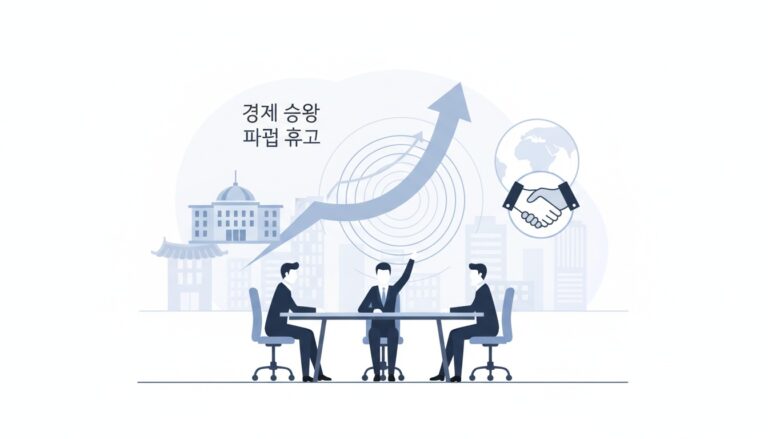
1. Introduction: So, You Want to Talk Business?
안녕하세요! This is your Senior Editor at Daily Hangul.
If you have reached this level (C2), you are likely no longer just asking for directions to the subway station. You might be preparing for a job interview at a Korean corporation, writing a thesis, or perhaps you are a professional in the Tourism & MICE (Meeting, Incentive, Convention, Exhibition) sector.
Here is a scenario: You are in a strategy meeting. Everyone is discussing how to boost the local economy. You want to say, “The MICE industry creates a massive economic ripple effect compared to general tourism.”
If you just say, “MICE는 돈을 많이 벌어요” (MICE makes a lot of money), you sound like a high schooler, not a professional expert.
Today, we are going to upgrade your vocabulary from “daily conversation” to “policy & strategy expert.” We will dissect the language used to describe the economic impact of the MICE industry.
2. Deep Dive: The Vocabulary of Strategy
At the C2 level, precision is power. Here are three expressions that will make your Korean colleagues nod in respect.
1. 파급 효과 (Pageup Hyogwa)
- Pronunciation:
Pa-geup Hyo-gwa[Think of ‘Pa’ as in ‘Papa’ + ‘Geup’ sounds like ‘Gulp’ without the ‘l’] - Meaning: Ripple Effect / Repercussion
- Editor’s Insight: This is the gold standard word in economics and policy. It describes how an event (like hosting a global summit) spreads its benefits to other sectors like lodging, transport, and dining.
- Literal: Wave-reaching effect.
- Nuance: Positive, far-reaching impact.
- Situation: Highly Formal (Reports, News, Presentations).
2. 고부가가치 (Gobugagachi)
- Pronunciation:
Go-bu-ga-ga-chi[Go + Bu (like ‘boot’) + Ga + Ga + Chi (like ‘cheese’)] - Meaning: High Value-Added
- Editor’s Insight: You will hear this constantly in Korean business news. General tourism is great, but MICE is 고부가가치 because business travelers spend significantly more per person than leisure travelers.
- Situation: Formal & Business Professional.
3. 신성장 동력 (Sinseongjang Dongnyeok)
- Pronunciation:
Sin-seong-jang Dong-nyeok[Sin (like ‘seen’) + Seong + Jang + Dong + Nyeok] - Meaning: New Growth Engine
- Editor’s Insight: This is a metaphorical term. ‘동력’ means motive power. When traditional industries slow down, Korea often looks for a ‘new engine’ to drive the economy. MICE is often cited as a future growth engine.
- Situation: Strategic Planning, Policy Making.
3. Textbook vs. Real Life (The Boardroom Edition)
In a C2 context, “Real Life” doesn’t mean slang; it means “Professional Efficiency.”
| Textbook / Written Report (Written Style) | Professional Meeting (Spoken Professional) |
|---|---|
| 경제적 파급 효과가 상당할 것으로 예상됩니다. (It is expected that the economic ripple effect will be significant.) |
낙수 효과가 확실하죠. (The trickle-down effect is certain/clear.) |
| 이 산업을 육성해야 할 필요성이 제기됩니다. (The necessity to foster this industry is being raised.) |
지금이 딱 키워야 할 타이밍입니다. (Now is the exact timing to grow/foster it.) |
| 국가 이미지 제고에 기여합니다. (It contributes to enhancing the national image.) |
국격 높이는 데는 이만한 게 없죠. (There’s nothing like this for raising national stature.) |
Editor’s Note: Notice how the right column is still polite (
-죠,-입니다) but uses more direct, punchy phrasing like “타이밍” (timing) or “이만한 게 없다” (there is nothing like this).
4. Cultural Context: The Art of “Modest Confidence”
When presenting a strategy in Korea, especially regarding something as big as the MICE industry, you need to balance Expertise (전문성) with Humility (겸손).
- Do not say: “I am right, and here is why.”
- Do say: “Based on the data, the potential for high value-added creation suggests that…”
The “Our” (우리) Culture in Business:
Even if you did the analysis, when presenting the economic benefits, frame it as a benefit for “our company” or “our country.” Using phrases like “우리 경제의 활력소” (a vitality booster for our economy) appeals to the collective goal, which is a powerful persuasion tactic in Korean corporate culture.
5. Roleplay: The Strategy Meeting
Setting: A meeting room at the Seoul Tourism Organization.
Characters:
* Ji-min (Local): Team Leader.
* Alex (You): Senior Strategy Consultant.
Ji-min: 이번 국제 회의 유치가 단순 관광보다 나은 점이 뭘까요?
(Ibeon gukje hoeui yuchiga dansun gwangwangboda naeun jeomi mwolkkayo?)
(What makes hosting this international conference better than simple tourism?)
Alex: 가장 큰 차이는 1인당 지출액입니다. MICE 참가자는 일반 관광객보다 체류 기간이 길고 소비 규모가 큽니다.
(Gajang keun chaineun 1-in-dang jichuraek-imnida. MICE chamgajaneun ilban gwangwanggaekboda cheryu gigani gilgo sobi gyumoga keumnida.)
(The biggest difference is the expenditure per person. MICE participants stay longer and spend more than general tourists.)
Ji-min: 맞는 말씀이네요. 지역 경제에 미치는 영향도 크겠군요.
(Manneun malsseumineyo. Jiyeok gyeongje-e michineun yeonghyangdo keugetgunyo.)
(You are right. The impact on the local economy must be significant too.)
Alex: 네, 맞습니다. 숙박, 외식, 쇼핑 등 연관 산업으로 이어지는 파급 효과가 엄청납니다. 확실한 고부가가치 사업이죠. (자신감 있는 표정으로 차트를 가리키며)
(Ne, matseumnida. Sukbak, oesik, shopping deung yeongwan saneubeuro ieojineun pageup hyogwa-ga eomcheongnamnida. Hwaksilhan gobugagachi saeobijyo.)
(Yes, correct. The ripple effect leading to related industries like lodging, dining, and shopping is immense. It is definitely a high value-added business.)
6. 10-Second Shadowing (Professional Tone)
Read this like a news anchor or a CEO making a speech. Pay attention to the pauses.
“MICE 산업은 / 단순한 관광을 넘어 / 도시 전체의 브랜드를 높이는 / 핵심적인 신성장 동력입니다.”
- Pronunciation: MICE sa-neobeun / dan-sun-han gwang-wangeul neo-meo / do-si jeon-che-ui beu-raen-deu-reul no-pi-neun / haek-sim-jeog-in sin-seong-jang dong-nyeog-im-nida.
- Translation: The MICE industry is a core new growth engine that goes beyond simple tourism to elevate the brand of the entire city.
7. FAQ & Troubleshooting
- Q: Can I use words like ‘대박’ (Daebak – Jackpot) when talking about economic success?
- A: Avoid it in meetings. While ‘대박’ means a big success, in a C2 context discussing economic strategy, it sounds unprofessional. Use ‘괄목할 만한 성과’ (remarkable outcome) or ‘호재’ (favorable factor) instead.
- Q: Is ‘육성 전략’ (Promotion Strategy) only for government?
- A: Mostly, yes. ‘육성’ (fostering/rearing) implies a top-down support system. If you are in a private company talking about sales, use ‘마케팅 전략’ (Marketing Strategy) or ‘시장 확대 방안’ (Market Expansion Plan).
8. Wrap-up
- Summary: Today we learned that MICE is not just tourism; it is a ‘High Value-Added’ (고부가가치) industry with a massive ‘Ripple Effect’ (파급 효과), serving as a ‘New Growth Engine’ (신성장 동력).
- Action Mission: Find a Korean news article about “Busan Expo” or a recent convention. Identify the word ‘경제적 효과’ (Economic Effect) and see what numbers follow it.
Are you ready to lead the meeting? Share your favorite “Business Korean” word in the comments!
9. Quick Quiz
- Which word best describes the indirect benefits spreading to other industries?
- a) 나비 효과 (Butterfly Effect)
- b) 파급 효과 (Ripple Effect)
- c) 온실 효과 (Greenhouse Effect)
- Fill in the blank: MICE is considered a ‿‿‿‿ industry because it generates high profit per person.
- (Hint: High Value-Added)
- (True/False) It is professional to use slang like ‘돈쭐내다’ (to scold with money/buy everything) in a formal strategy report.
(Answers: 1-b, 2-고부가가치, 3-False)
Frequently Asked Questions (FAQ)
Q: What does "'경제적 효과'" mean in Korean and how do you pronounce it?
A: In Korean, "'경제적 효과'" is pronounced [Economic Effect] and means: and see what numbers follow it.







