

Phase 1: Introduction
Hello! This is your Head Editor at Daily Hangul.
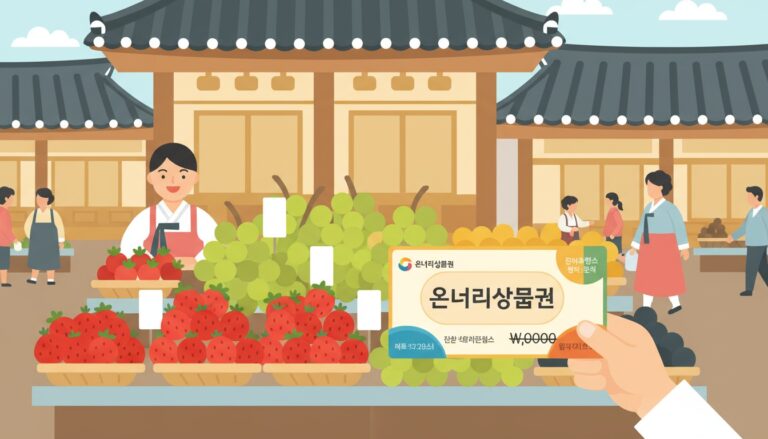
So, you’ve heard the tip: “Smart travelers and residents in Korea save money by buying Onnuri Gift Certificates (온누리상품권).” You know they offer a 5-10% discount on cash value. You bought a stack of them at the bank or via the app. Now, you are standing in the middle of Gwangjang Market or Mangwon Market, surrounded by delicious smells, but you freeze.
“What if they don’t accept this paper?”
“What if I don’t buy enough to get change back?”
I’ve seen many students awkwardly fumble with these vouchers, only to put them back in their pockets and pay with a credit card instead. Don’t let that be you! Today, we are going to master the art of using Onnuri Vouchers with the confidence of a local housewife.
This guide answers real questions from our B2-level students who want to shop smarter.
Phase 2: Deep Dive into Key Expressions
Here are the three most critical phrases you need to secure your transaction.
1. 혹시 온누리 상품권 받으세요?
(Do you happen to accept Onnuri Vouchers?)
- Pronunciation: Hok-shi On-nu-ri Sang-poom-gwon Ba-du-se-yo?
- Tip: ‘Hok-shi’ is like a soft opener, similar to “By any chance…”
- Meaning:
- Literal: By chance, do you receive Onnuri Gift Certificates?
- Real Nuance: “Can I pay with this voucher here?”
- Editor’s Insight: Even if you see the Onnuri sticker, it’s polite to ask first. Some stalls might prefer cash for small amounts (under 5,000 KRW), though they technically should accept vouchers.
- Situation Check: Essential for any interaction with a vendor (Casual or Formal).
2. 현금영수증 해주실 수 있나요?
(Could you issue a cash receipt?)
- Pronunciation: Hyeon-geum-yeong-su-jeung Hae-ju-shil Su In-na-yo?
- Meaning:
- Literal: Can you do a cash receipt for me?
- Real Nuance: “I need the tax deduction proof for this voucher payment.”
- Editor’s Insight: This is a B2 level power move. Since Onnuri vouchers count as cash, you are entitled to a cash receipt (which helps with your year-end tax settlement in Korea). Don’t be shy to ask!
- Situation Check: Use this after they agree to take the voucher.
3. 거스름돈은 어떻게 되나요?
(How does the change work?)
- Pronunciation: Geo-seu-reum-don-eun Eo-tteo-ke Dwe-na-yo?
- Meaning:
- Literal: How does the change become?
- Real Nuance: “I know I haven’t spent the full amount. Will you give me the rest in cash?”
- Editor’s Insight: This is crucial because of the 60% Rule (explained below in Phase 4). Asking this shows you understand how the system works but are checking their specific policy.
Phase 3: Textbook vs. Real Life
How does a textbook robot speak versus a hungry shopper in Seoul?
| Textbook Korean 📚 | Real Market Korean 🛒 |
|---|---|
| 이 상품권을 사용할 수 있습니까? (Can I use this gift certificate?) |
이거(온누리) 돼요? (Does this work?) |
| 거스름돈을 주십시오. (Please give me the change.) |
잔돈은 그냥 현금으로 주세요. (Just give me the change in cash, please.) |
| 영수증을 발급해 주세요. (Please issue a receipt.) |
영수증 좀 끊어주세요. (Please ‘cut’ me a receipt.) |
💡 Editor’s Note: In a busy market, short and loud is better than long and grammatically complex. “이거 돼요?” (I-geo Dwae-yo?) is the magic phrase.
Phase 4: Cultural Context & Manners
1. The “60% Rule” (Buying enough)
In Korea, if you use a paper voucher (e.g., 10,000 KRW note), the vendor is only legally obligated to give you change in cash if you spend 60% or more of the face value.
* Example: If you use a 10,000 KRW voucher to buy a 2,000 KRW Hotteok, the vendor might refuse or look annoyed. You should buy at least 6,000 KRW worth of goods.
2. The Sticker Hunt
Not every stall in a “Traditional Market” accepts these. Look for the “온누리상품권 가맹점” (Onnuri Affiliate Store) sticker usually posted on the wall or the cart. However, even without the sticker, many grandmas (Halmoni) accept them because they use them like cash. Just ask!
Phase 5: Real-Life Scenario (Roleplay)
Setting: A fruit stall at Mangwon Market. You have a 10,000 KRW Onnuri voucher and want to buy strawberries (7,000 KRW).
Characters:
* Alex (Foreigner): Hungry for strawberries.
* Sajang-nim (Owner): Busy arranging fruits.
(Alex points to a basket of strawberries)
Alex: 사장님, 딸기 한 바구니에 얼마예요?
(Boss, how much is one basket of strawberries?)
Sajang-nim: 칠천 원! 방금 들어와서 싱싱해.
(7,000 won! They just came in, very fresh.)
(Alex holds out the paper voucher tentatively)
Alex: 맛있겠네요. 혹시 온누리 상품권도 받으세요?
(Looks delicious. Do you happen to accept Onnuri Vouchers?)
Sajang-nim: 그럼요~ 주이소.
(Of course~ Give it here. [Note: ‘주이소’ is a friendly dialect variant of 주세요])
Alex: 여기 만 원짜리요. 나머지는 현금으로 주시는 거죠?
(Here is a 10,000 won note. You give the rest in cash, right?)
Sajang-nim: (Handing back 3,000 won) 자, 여기 거스름돈 삼천 원.
(Here, 3,000 won change.)
Phase 6: 10-Second Shadowing Drill
Read this aloud to practice your intonation. Pause where the slash / is.
“사장님, / 이거 온누리 상품권인데 / 혹시 사용 가능한가요?”
- Romanization: Sajang-nim, / i-geo On-nu-ri Sang-poom-gwon-in-de / hok-shi sa-yong ga-neung-han-ga-yo?
- Focus: Raise your tone slightly at “ga-neung-han-ga-yo?” to sound polite but inquiring.
Phase 7: FAQ & Troubleshooting
- Q: Can I use Onnuri vouchers at convenience stores inside the market?
- A: Generally, NO. Major chains (CU, GS25, Starbucks) located within market boundaries usually do not accept them. It is for small business owners.
- Q: Can I use the Mobile (App) version?
- A: Yes, via a QR code! You would say “모바일 온누리 되나요?” (Do you take Mobile Onnuri?). However, elderly vendors often prefer the paper version.
Phase 8: Wrap-up
Today’s One-Liner:
When using a 10,000 won voucher, always aim to spend at least 6,000 won to get your change back smile-free!
Your Mission:
Go to your local market this weekend, look for the sticker, and buy a snack using the phrase “이거 돼요?”
Tell me in the comments: Have you ever been refused when trying to use a voucher? Share your story!
Phase 9: Pop Quiz
1. You have a 10,000 KRW Onnuri voucher. How much should you spend to guarantee cash change?
a) 1,000 KRW
b) 3,000 KRW
c) 6,000 KRW
2. Which phrase is the most natural way to ask if a voucher works in a busy market?
a) 본 매장에서 이 상품권의 사용이 허가되었습니까?
b) 이거 돼요?
c) 돈 받으세요?
3. True or False: You can use Onnuri vouchers at the Starbucks inside the traditional market.
(True / False)
(Answers: 1. c, 2. b, 3. False)
Frequently Asked Questions (FAQ)
Q: What does ""온누리상품권 가맹점"" mean in Korean and how do you pronounce it?
A: In Korean, ""온누리상품권 가맹점"" is pronounced [Onnuri Affiliate Store] and means: sticker usually posted on the wall or the cart. However, even without the sticker, many grandmas (Halmoni) accept them because they use them like cash. Just ask!







