

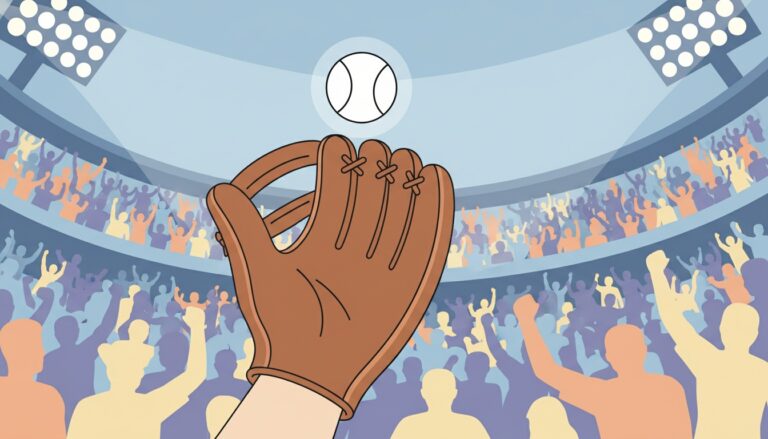
Introduction: The “Warzone” in the Outfield
Hello! I’m your editor from Daily Hangul.
So, you’ve decided to visit a Korean baseball stadium (Jamsil or Sajik, perhaps?). Great choice! But here is a scenario: You are sitting in the outfield, eating your fried chicken, and suddenly—CRACK! The batter hits a massive home run, and the ball is flying straight toward you.
In that split second, the polite Korean society disappears. It becomes a fierce competition. People will jump, reach out, and scream. If you don’t know the right expressions, you might get shoved aside or, worse, misunderstood.
Today, we are diving into the adrenaline-pumping B2-level expressions used during that chaotic scramble for a home run ball. This isn’t just about language; it’s about survival and fitting in with the passionate “K-Baseball” crowd. Let’s get you ready to catch that souvenir!
Deep Dive: 3 Key Expressions for the Scramble
1. 밀지 마세요! (Don’t push!)
- Pronunciation: [Mil-ji ma-se-yo]
- Sound analogy: ‘Mil’ sounds like ‘Meal’, ‘ji’ like ‘gee’ in ‘geese’.
- Meaning:
- Literal: Please do not push.
- Nuance: “Back off, it’s dangerous!” or “Give me some space!”
- Editor’s Insight: This is crucial. When the ball lands, the crowd acts like a wave. Use this firmly. Since you are in a public crowd, using the polite ending -seyo is standard, but you shout it loudly to show urgency.
- Situation Check: Safe to use with strangers. If it’s your close friend pushing you jokingly, just say “밀지 마! (Mil-ji ma!)”.
2. 아, 까비! (Ah, so close!)
- Pronunciation: [Ah, Kka-bi]
- Sound analogy: ‘Kka’ sounds like ‘Ga’ in ‘Garden’ but with a much harder, tighter throat sound (tensed sound).
- Meaning:
- Origin: Short for “아깝다” (Akkapda – It’s a shame/waste).
- Real Nuance: “Dang it!” or “I almost had it!”
- Editor’s Insight: This is slang widely used by the younger generation and sports fans. If the ball hits your glove and drops, or someone else catches it right in front of you, scream this. It shows you are fluent in “modern Korean emotion.”
- Situation Check: Casual/Self-talk. Don’t say this to your boss if they fail a project!
3. 잡았다! / 내 거야! (I caught it! / It’s mine!)
- Pronunciation: [Ja-bat-da] / [Nae ggeo-ya]
- Meaning: I caught it! / It belongs to me!
- Editor’s Insight: Possession is key. In the chaos, if you catch the ball, raise your hand high and yell “잡았다!” to signal the end of the war. It prevents others from digging around your feet.
Textbook vs. Real Life (B2 Level)
Real Korean at a baseball game is fast, abbreviated, and emotional. Compare these:
| Textbook Korean (Awkward Robot) | Real “Stadium” Korean (Native Vibe) |
|---|---|
| 공을 잡으세요. (Please catch the ball.) | 잡아! 잡아! (Catch it! Catch it!) |
| 정말 아쉽습니다. (It is very regrettable.) | 아, 진짜 까비… (Ah, seriously, so close…) |
| 위험하니까 밀지 마십시오. (Please do not push as it is dangerous.) | 아, 밀지 좀 마요! (Hey, stop pushing!) |
Note: The “좀” (jom) in the last example softens the command slightly but adds a nuance of irritation: “Come on, stop pushing.”
Cultural Context: The “Kid Rule”
Here is a piece of advanced Nunchi (눈치) training.
In Korean baseball culture, if a fierce adult man catches a home run ball and there is a disappointed elementary school kid standing right next to him looking at the ball…
The “Cool Person” move is to give the ball to the kid.
If you do this, the surrounding crowd will cheer for you, and you might even appear on the stadium screen as a “Good Samaritan.” You can say:
- “너 가져.” (You take it. – Casual to a child)
- “선물이야.” (It’s a gift.)
Of course, if it’s a historic home run (like a record-breaking ball), keep it! But for a regular one, generosity is the ultimate flex.
Roleplay Scenario: The Fly Ball
Setting: Jamsil Baseball Stadium, outfield seats. 9th inning.
Characters:
* Alex: B2 Level Learner, wearing a glove.
* Hoon: Korean friend.
(The batter hits a high ball coming toward them)
Hoon: 어! 온다, 온다! 저거 홈런이야!
(Uh! It’s coming, it’s coming! That’s a home run!)
Alex: (Standing up rapidly) 내가 잡을게! 비켜!
(I’ll catch it! Move!)
(The crowd pushes in from all sides)
Alex: 아, 밀지 마세요! 위험해요!
(Ah, don’t push! It’s dangerous!)
(The ball hits Alex’s glove and bounces to the person behind him)
Alex: 아… 까비! 진짜 잡을 수 있었는데.
(Ah… So close! I really could have caught it.)
Hoon: 와, 진짜 아깝다. 그래도 나이스 캐치 시도였어!
(Wow, that was really a shame. But it was a nice catch attempt!)
10-Second Shadowing Drill
Read this aloud to practice your intonation. Imagine you are frustrated but excited.
“밀지 좀 마세요! / 아, / 진짜 / 까비!”
(Stop pushing me! / Ah, / seriously / so close!)
- Focus: Emphasize 밀지 (Don’t push) and 까비 (So close). Keep the middle part fast.
FAQ & Troubleshooting
- Q: Can I use “까비” (Kkabi) in a business meeting?
- A: No! It is slang derived from Akkapda. In a meeting, use “정말 아쉽네요” (That is truly regrettable/shameful) instead. “까비” makes you look very unprofessional in a suit.
- Q: What if I accidentally stepped on someone’s foot while jumping?
- A: Immediately say “죄송합니다!” (I’m sorry!) bowing slightly. Even in the heat of the moment, manners matter.
Wrap-up
One-Liner Summary: Use “밀지 마세요” for safety, “까비” for disappointment, and remember the “Kid Rule” for social points.
Action Mission: Next time you watch a sports game (even on TV), shout “아, 까비!” instead of “Oh my god” when a player makes a mistake. It feels surprisingly satisfying!
See you in the next lesson!
Quick Quiz
- Which phrase is the most natural (slangy) way to say “That was so close/What a shame” at a stadium?
a) 유감입니다 (Yugam-imnida)
b) 까비! (Kkabi!)
c) 슬퍼요 (Seulpeoyo) -
Why might you give the ball to a child after catching it?
a) It is illegal for adults to keep balls.
b) The child will pay you for it.
c) It is good “Nunchi” and considers good manners in the stadium culture. -
How do you tell people politely but firmly not to push you?
a) 밀지 마세요 (Mil-ji ma-se-yo)
b) 밀어요 (Mi-reo-yo)
c) 사랑해요 (Sarang-hae-yo)
Click to see answers
1. b, 2. c, 3. a
Frequently Asked Questions (FAQ)
Q: What does "밀지 마세요! (Don't push!)" mean in Korean and how do you pronounce it?
A: In Korean, "밀지 마세요! (Don't push!)" is pronounced [Mil-ji ma-se-yo] and means: a key conversational Korean expression covered in this lesson.
Q: What does "아, 까비! (Ah, so close!)" mean in Korean and how do you pronounce it?
A: In Korean, "아, 까비! (Ah, so close!)" is pronounced [Ah, Kka-bi] and means: a key conversational Korean expression covered in this lesson.
Q: What does "잡았다! / 내 거야! (I caught it! / It's mine!)" mean in Korean and how do you pronounce it?
A: In Korean, "잡았다! / 내 거야! (I caught it! / It's mine!)" is pronounced [Ja-bat-da] and means: I caught it! / It belongs to me!







