

Phase 1: Introduction
Hello! This is your Daily Hangul Editor.
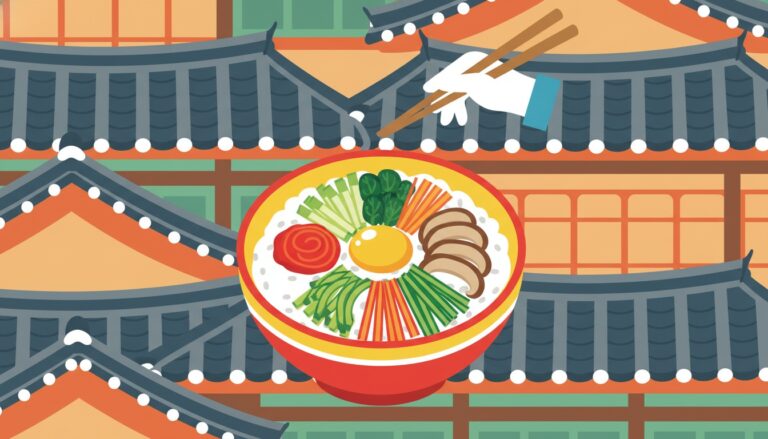
Have you ever stood in the middle of a bustling Korean food festival, surrounded by delicious smells, but felt completely frozen? Imagine you are at the famous Jeonju Bibimbap Festival. There’s a giant cast-iron pot (gamasot) mixing thousands of servings of bibimbap, music is blasting, and the line behind you is getting longer.
You want to order a specific type of Bibimbap, but you hate cucumbers, or maybe you’re worried it’ll be too spicy. A beginner might just point and say “Igeo juseyo” (Give me this). But you? You are a B2 (Intermediate) learner. You want to eat exactly what you want, how you want it.
Today, I’ll teach you how to navigate the chaotic energy of a Korean food festival with confidence, based on real questions from our students who visited Jeonju last autumn. Let’s make sure you don’t just eat, but you enjoy the process!
Phase 2: Deep Dive into Core Expressions
Here are three expressions that will upgrade your survival Korean to “local foodie” status.
1. 양념장은 따로 주시겠어요? (Could you give me the sauce separately?)
- Pronunciation: [Yang-nyeom-jang-eun tta-ro ju-si-ge-sseo-yo?]
- Tip: ‘Tta-ro’ sounds a bit like ‘Ta-da!’ but with an R sound. It means ‘separately’.
- Meaning:
- Literal: As for the seasoned sauce, would you give it separately?
- Real Nuance: “I’m not sure how spicy this is, so I want to control the amount myself.”
- Editor’s Insight: At a festival, Bibimbap often comes with a huge dollop of Gochujang (red chili paste) already on top. If you aren’t good with spice, this phrase is your lifesaver. Using ‘~si-ge-sseo-yo?’ adds a polite, gentle tone suitable for B2 learners, rather than a demanding command.
- Situation Check: Perfect for any restaurant or food stall ordering situation.
2. 혹시 오이는 빼 주실 수 있나요? (By any chance, can you leave out the cucumbers?)
- Pronunciation: [Hok-si o-i-neun ppae ju-sil su in-na-yo?]
- Tip: ‘Hoksi’ implies hesitation, like ‘By any chance…’. It softens the blow of being a picky eater!
- Meaning: Can you remove the cucumbers?
- Editor’s Insight: Many people dislike cucumbers (or mushrooms/carrots). The verb ‘ppae-da’ (to subtract/remove) is essential here. Adding ‘Hoksi’ at the beginning shows you have ‘nunchi’ (social sense) and know you are asking for a special favor during a busy time.
- Situation Check: Use this when customizing any dish, from Kimbap to Bibimbap.
3. 여기 줄이 어디가 끝인가요? (Where is the end of the line here?)
- Pronunciation: [Yeo-gi ju-ri eo-di-ga kkeun-nin-ga-yo?]
- Tip: Connect ‘kkeut’ and ‘in’ to sound like ‘kkeun-nin’.
- Meaning: Where does the line end?
- Editor’s Insight: Korean festivals are crowded. Sometimes there are three different lines intertwined. Instead of awkwardly standing in the wrong spot, confidently ask this to the people waiting. It shows you respect the order.
- Situation Check: Casual to Polite. Use it whenever you see a crowd.
Phase 3: Textbook vs. Real Life
Textbooks teach you to be correct. Real life requires you to be fast and natural.
| Context | Textbook Korean (Robot Mode 🤖) | Real Street Korean (Jeonju Local Mode 😎) |
|---|---|---|
| Calling the staff | 저기요. (Excuse me.) | 사장님! / 여기요! (Boss! / Over here!) |
| Ordering | 비빔밥 하나 주세요. (Please give me one Bibimbap.) | 여기 비빔밥 하나요! (Here, one Bibimbap!) |
| Too spicy | 너무 매워요. (It is too spicy.) | 와, 이거 입에서 불나요! (Wow, my mouth is on fire!) |
Editor’s Note: At a festival, using “사장님” (Sajangnim – Boss) is the magic word. Even if they aren’t the owner, it makes them feel respected. Avoid “Ajumma” as it can sound rude to younger vendors or in professional settings.
Phase 4: Cultural Context & Manners
The Art of “Ppalli-ppalli” (Hurry Hurry)
At the Jeonju Bibimbap Festival, the stalls are incredibly busy. The vendors are moving at light speed.
- Decide BEFORE you get to the front: Don’t look at the menu when it’s your turn. Have your card or cash ready in your hand.
- Volume Control: It’s noisy. Speak 1.5x louder than your normal conversational volume. Being quiet here causes confusion.
- Receive with Two Hands: Even at a street stall, when you pay or receive your food, use two hands (or support your right elbow with your left hand). It’s the universal sign of respect.
Phase 5: Real-Life Scenario (Roleplay)
Setting: A very busy Bibimbap stall at the festival. You finally reached the front.
- Characters:
- Alex: A hungry tourist (B2 Level).
- Sajangnim: A busy vendor grilling beef.
Sajangnim: (Loudly grilling meat) 어서 오세요! 몇 분이세요?
(Eoseo oseyo! Myeot buniseyo?)
(Welcome! How many people?)
Alex: 한 명이요. 육회 비빔밥 하나 주세요.
(Han myeong-iyo. Yukhoe bibimbap hana juseyo.)
(Just one. I’d like one Raw Beef Bibimbap, please.)
Sajangnim: 드시고 가세요?
(Deusigo gaseyo?)
(Are you eating here?)
Alex: 네, 먹고 갈게요. 아, 그리고 사장님! 혹시 고추장은 따로 주실 수 있나요?
(Ne, meokgo galgeyo. Ah, geurigo sajangnim! Hoksi gochujang-eun ttaro jusil su innayo?)
(Yes, I’ll eat here. Ah, and Boss! By any chance, can you give me the gochujang separately?)
Sajangnim: (Smiling) 그럼요! 맵찔이인가 보네?
(Geureomyo! Maepjjiri-inga bone?)
(Sure! Looks like you can’t handle spice [Baby-sprout]?)
Alex: (Laughing) 네, 맞아요. 조금만 넣으려고요.
(Ne, majayo. Jogeumman neoeuryeogoyo.)
(Yes, that’s right. I plan to put in just a little.)
Phase 6: 10-Second Shadowing Drill
Let’s practice the most useful sentence for customization. Focus on the pause to sound polite.
“사장님, / 육회 비빔밥 하나 주시는데, / 양념장은 따로 담아 주세요.”
- Romanization: Sajangnim, / yukhoe bibimbap hana jusineunde, / yangnyeomjang-eun ttaro dama juseyo.
- Intonation Guide: Raise your tone slightly at ‘Sajangnim’ to grab attention. Pause after ‘jusineunde’ to signal a request is coming.
Phase 7: FAQ & Troubleshooting
- Q: Can I share one bowl of Bibimbap between two people?
- A: At a street stall (standing), yes. But if you sit down at a table inside a booth, it’s polite to order at least one menu item per person (1인 1메뉴). If you are not hungry, order a side dish like Jeon (pancake) instead of a main meal.
- Q: What if I don’t know the name of the ingredient I want to remove?
- A: Just point at the picture or the food display and say “이거는 빼 주세요” (Please take this out). It works 100% of the time!
Phase 8: Wrap-up
Today’s One-Liner: Don’t be afraid to customize your order with “따로 주세요” (Give it separately) or “빼 주세요” (Take it out).
Your Mission: Next time you go to a Korean restaurant or cafe, try asking for something “separately” (like syrup, sauce, or pickles). “피클은 따로 주세요!”
Did you ever have a spicy food disaster in Korea? Tell me in the comments below! 👇
Phase 9: Pop Quiz
1. Which title is best to use when calling a vendor at a festival?
a) 아저씨 (Ajeossi)
b) 사장님 (Sajangnim)
c) 야! (Ya!)
2. How do you say “Please give me the sauce separately”?
a) 양념장 많이 주세요. (Give me lots of sauce.)
b) 양념장 없어요. (I don’t have sauce.)
c) 양념장 따로 주세요. (Give me sauce separately.)
3. What implies you are hesitating politely before asking a favor?
a) 빨리 (Ppalli)
b) 혹시 (Hoksi)
c) 진짜 (Jinjja)
(Answers: 1-b, 2-c, 3-b)
Frequently Asked Questions (FAQ)
Q: What does "양념장은 따로 주시겠어요? (Could you give me the sauce separately?)" mean in Korean and how do you pronounce it?
A: In Korean, "양념장은 따로 주시겠어요? (Could you give me the sauce separately?)" is pronounced [Yang-nyeom-jang-eun tta-ro ju-si-ge-sseo-yo?] and means: a key conversational Korean expression covered in this lesson.
Q: What does "혹시 오이는 빼 주실 수 있나요? (By any chance, can you leave out the cucumbers?)" mean in Korean and how do you pronounce it?
A: In Korean, "혹시 오이는 빼 주실 수 있나요? (By any chance, can you leave out the cucumbers?)" is pronounced [Hok-si o-i-neun ppae ju-sil su in-na-yo?] and means: a key conversational Korean expression covered in this lesson.
Q: What does "여기 줄이 어디가 끝인가요? (Where is the end of the line here?)" mean in Korean and how do you pronounce it?
A: In Korean, "여기 줄이 어디가 끝인가요? (Where is the end of the line here?)" is pronounced [Yeo-gi ju-ri eo-di-ga kkeun-nin-ga-yo?] and means: a key conversational Korean expression covered in this lesson.







