

Hello! This is your Daily Hangul Editor.
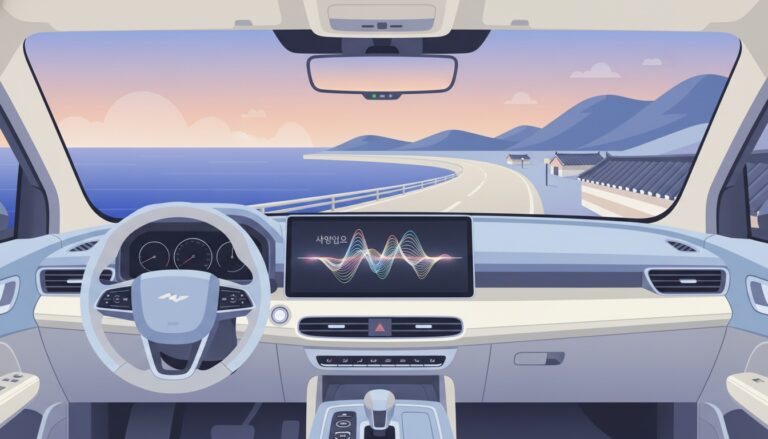
Have you ever driven a rental car in Korea, pressed the voice command button on the steering wheel with confidence, and shouted, “Go to Gangnam Station!” only to have the car respond with a polite but infuriating, “죄송합니다. 다시 말씀해 주세요” (Sorry, please say that again)?
It’s a humbling moment. You have C1-level grammar, you can debate social issues in Korean, but you can’t get your Hyundai to turn on the heated seats.
Today, we are bridging the gap between “Textbook Korean” and “Smart Car Korean.” As AI technology like Kakao i and Naver Clover becomes integrated into Korean vehicles (Genesis, Hyundai, Kia), talking to your car has become a daily ritual for locals.
This isn’t just about directions; it’s about mastering the nuanced syntax of command and request that defines the modern Korean driving experience. Let’s get your car to listen to you.
Phase 2: Deep Dive into Core Expressions
For C1 learners, simple commands like “가 주세요” (Please go) are too basic. You need precision. Here are the three most critical expressions for managing your in-car AI.
1. [장소]로 찍어 줘 (Mark [Place] as the destination)
- Pronunciation: [Jjik-eo-jwo] (Sounds like “Jee-guh-jwo” with a tense ‘J’)
- Meaning:
- Literal: Take a picture / Stamp it.
- Real Nuance: Set the destination on the GPS.
- Editor’s Insight: While “[Place]로 안내해 줘” (Guide me to…) is standard, 찍다 (to stamp/mark) is the verb of choice for experienced drivers. It comes from the old days of “stamping” a point on a map. It implies, “Lock this target in.”
- Situation Check: Used with friends or AI assistants (Casual/Intimate).
2. 가는 길에 [장소] 좀 들러 줘 (Stop by [Place] on the way)
- Pronunciation: [Deul-leo-jwo] (The double ‘l’ creates a rolling liquid sound)
- Meaning:
- Literal: Stop by [Place] while going.
- Real Nuance: Add a waypoint/stopover.
- Editor’s Insight: This is perfect for the C1 grammar point
~다가(while doing something) combined with the auxiliary verb주다(to do for me). It sounds much more sophisticated than saying “Here first, then there.” - Situation Check: Great for asking the driver or the AI (if the system supports multi-hop routing).
3. 엉따 / 통풍 켜 줘 (Turn on the seat warmer / ventilation)
- Pronunciation: [Eong-tta] / [Tong-pung]
- Meaning:
- Literal: Bum-warm / Ventilation.
- Real Nuance: Seat heater / Seat cooling.
- Editor’s Insight: You will almost never hear a young Korean say “운전석 열선 시트 켜 주세요” (Please turn on the driver’s seat heating wire sheet). We say 엉따 (short for 엉덩이 따뜻하게 – Make bum warm). Conversely, 통풍 (Ventilation) refers to the cooling seats.
- Situation Check: Highly casual slang, but modern AI systems recognize it!
Phase 3: Textbook vs. Real Life
Let’s upgrade your phrasing from “Robot” to “Local.”
| Textbook (Standard) | Real Life (Native/AI-Friendly) | Note |
|---|---|---|
| 에어컨 온도를 낮춰 주세요. (Please lower the AC temperature.) |
좀 덥다. 1도만 내려 줘. (It’s a bit hot. Drop it 1 degree.) |
Modern AI understands context like “It’s hot.” |
| 가장 가까운 주유소를 찾아 주세요. (Please find the nearest gas station.) |
가까운 주유소 검색해. (Search nearby gas stations.) |
Dropping the honorific suffix is common with AI. |
| 음악을 틀어 주세요. (Please play music.) |
신나는 노래 좀 틀어 봐. (Play something upbeat/exciting.) |
Use adjectives of mood (sad, exciting, calm) for AI curation. |
Editor’s Note: At the C1 level, you should be comfortable omitting particles (이/가, 을/를) in speech. “음악을 틀어” becomes “음악 틀어.”
Phase 4: Cultural Context & Manners
The “Half-Talk” Phenomenon with AI
In Korea, speaking to machines sits in a linguistic gray area. Unlike talking to an elder (Honorifics) or a friend (Banmal), talking to a car usually involves “Polite Banmal” or “Soft Commands.”
- Ending with
~해 줘: Even though it’s a machine, using the harsh command form~해라(Do it!) feels awkward to many Koreans. Most users default to~해 줘(Do it for me), projecting a relationship of “assistance” rather than “servitude.” - Enunciation: Korean car interfaces (Genesis, Hyundai) are tuned to standard Seoul accents. If you have a strong foreign accent, try to articulate your tense consonants (ㄲ, ㄸ, ㅃ, ㅆ, ㅉ) sharply. “Ggang-nam” (Gangnam), not “Gang-nam.”
Phase 5: Real-World Scenario (Roleplay)
Setting: You are driving a rental car in Jeju Island with your Korean friend, Min-ji. You need to find a cafe.
Characters:
* You (Driver): Confident C1 learner.
* Min-ji: Korean native friend.
(You press the voice command button on the steering wheel)
You: 아리아, 해안 도로 쪽 예쁜 카페 좀 찾아 줄래?
(Aria, can you find a pretty cafe along the coastal road?)
Car AI: 몇 번째 장소로 안내할까요?
(Which location number shall I guide you to?)
You: 첫 번째! 아, 그리고 가는 길에 편의점도 찍어 줘.
(The first one! Ah, and mark a convenience store on the way, too.)
Min-ji: 오~ ‘찍어 줘’라고 하는 거 보니까 완전 한국인 다 됐는데?
(Wow~ Seeing you say ‘mark it,’ you’ve completely become a Korean!)
You: (Smugging) 에이, 기본이지. 엉따나 켜 줄까?
((Shrugging) Eh, that’s basic. Shall I turn on the seat warmer for you?)
Phase 6: 10-Second Shadowing
Practice this sentence to master the rhythm. Focus on the pauses / to sound authoritative yet natural.
“집으로 가는 길에 / 스타벅스 사이렌 오더 되게 / 가까운 매장 좀 / 찾아 줘.”
- Pronunciation Guide: Jibeuro ganeun gire / Starbucks Siren Order doe-ge / gakkaun maejang jom / chaja-jwo.
- Translation: On the way home, find a nearby store so I can use Starbucks Siren Order.
Phase 7: FAQ & Troubleshooting
Q: My pronunciation is good, but the car ignores me. Why?
A: It might be the speed. Koreans speak commands slightly slower and more clearly than conversational speech. Also, check if the system language is set to Korean. Some rentals default to English navigation which has limited voice capabilities.
Q: Can I swear at the AI if it gets it wrong?
A: You can, and many Koreans do (haha!), but modern systems like Kakao i actually have programmed responses for curse words, usually saying something witty like “바른 말을 사용해 주세요” (Please use proper language). It’s a funny easter egg to test out!
Phase 8: Wrap-up
One-Liner Summary: To master Korean car voice commands, swap formal requests for ~해 줘, use specific verbs like 찍다 (mark) and 들르다 (stop by), and embrace slang like 엉따.
Action Mission: Next time you use Naver Map or Kakao Map on your phone, do not type. Use the microphone icon and say, “가장 가까운 맛집 찍어 줘.” See if it works!
Tell me in the comments: What is the funniest misunderstanding you’ve had with a voice assistant in Korean?
Phase 9: Pop Quiz
1. What is the slang term for “Seat Warmer”?
A) 시트 핫 (Seat Hot)
B) 엉따 (Eong-tta)
C) 엉뜨 (Eong-tteu)
2. Which verb is most natural for “Setting a destination” on GPS?
A) 그리다 (To draw)
B) 찍다 (To mark/stamp)
C) 쓰다 (To write)
3. How do you politely ask the AI to stop somewhere “on the way”?
A) 가는 길에 들러 줘
B) 멈추고 가 줘
C) 가고 서 줘
(Answers: 1. B, 2. B, 3. A)
Frequently Asked Questions (FAQ)
Q: What does "찍다" mean in Korean and how do you pronounce it?
A: In Korean, "찍다" is pronounced [to stamp/mark] and means: is the verb of choice for experienced drivers. It comes from the old days of "stamping" a point on a map. It implies, "Lock this target in."







