

Phase 1: Hook & Introduction
Hello! This is your Senior Editor at Daily Hangul. 👋
Imagine this: You are working part-time at a chic cafe in Seoul, or perhaps handling an important business call with a Korean client. Suddenly, their voice pitch goes up. They are unhappy about a mistake.
At the beginner level, you might panic and just repeat “Joesonghamnida” (I’m sorry) over and over. But you are a B2 (Intermediate) learner now. Just saying “sorry” isn’t enough; it can sometimes sound like you just want to end the conversation quickly.
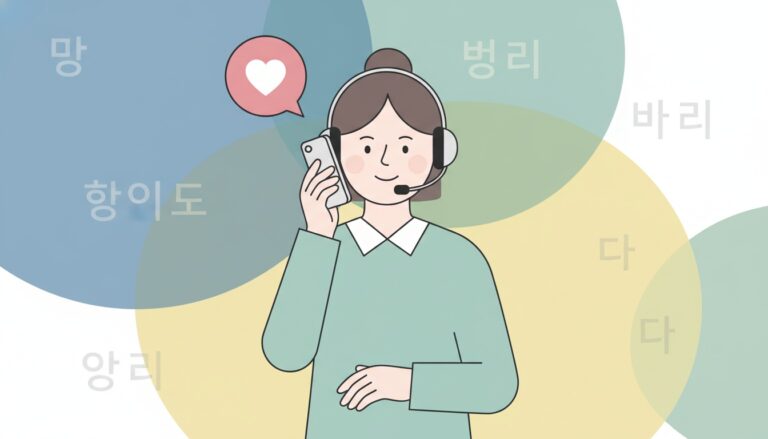
In Korea, Customer Service (CS) is an art form. It’s not just about solving the problem; it’s about “maeum-eul man-jyeo-ju-da” (마음을 만져주다)—literally “touching the heart” or soothing their feelings before fixing the issue.
Today, we will learn how to turn an angry customer into a loyal fan using the power of Empathy (공감). These are the exact phrases I teach my advanced students who work in Korean companies. Let’s dive in.
Phase 2: Deep Dive (Core Expressions)
Here are the three “Magic Phrases” to disarm a frustrated customer.
1. 많이 당황하셨겠어요.
- Pronunciation: [Mani danghwang-hasyeot-gesseoyo]
- Sound-alike: Mah-nee dang-hwang-hah-shut-gess-uh-yo
- Meaning:
- Literal: You must have been very flustered.
- Real Nuance: “I completely understand why you are upset. That was an unexpected situation for you.”
- Editor’s Insight: This is the Holy Grail of empathy. Before you admit a mistake or offer a refund, say this. It validates their emotion. It tells them, “I am on your side.”
- Situation Check: 👔 Formal (Customer/Boss) | ❌ Friends (Too stiff)
2. 불편을 드려 죄송합니다.
- Pronunciation: [Bulpyeoneul deuryeo joesong-hamnida]
- Sound-alike: Bull-pyun-eul deu-ryeo jwuh-song-ham-nee-da
- Meaning:
- Literal: I am sorry for giving you discomfort.
- Real Nuance: “I apologize for the inconvenience we caused.”
- Editor’s Insight: “Joesonghamnida” is okay, but it’s generic. Adding “Bulpyeoneul deuryeo” (for the inconvenience) makes you sound like a professional who understands specifically that their time was wasted.
- Situation Check: 👔 Formal (Standard CS phrase)
3. 제가 바로 확인해 드리겠습니다.
- Pronunciation: [Jega baro hwaginhae deuriget-seumnida]
- Sound-alike: Je-ga ba-ro hwa-gin-hae deu-ree-get-sum-nee-da
- Meaning:
- Literal: I will check it for you right away.
- Real Nuance: “I am taking ownership of this issue right now.”
- Editor’s Insight: Notice the verb ending -e deurida (to do something for someone). It sounds much more service-oriented than just “Hwagin-halkkeyo” (I’ll check).
Phase 3: Textbook vs. Real Life
Textbooks teach you to be grammatically correct. Real life requires you to be socially intelligent.
| Textbook Korean (Too Direct/Simple) | Real Korean (Empathetic & Professional) |
|---|---|
| 화내지 마세요. (Please don’t be angry.) 🚫 Never say this. It tells the customer their feeling is wrong. |
많이 속상하시죠? (You must be very upset, right?) ✅ Acknowledges their anger instead of suppressing it. |
| 기다려 주세요. (Please wait.) ⚠️ Sounds like a command. |
잠시만 기다려 주시겠습니까? (Could you please wait a moment?) ✅ Uses the question form to show respect. |
| 저희 실수입니다. (It is our mistake.) ⚠️ A bit blunt. |
저희 불찰이 컸습니다. (Our negligence was great.) ✅ A high-level B2 vocabulary word (Bulchal) that shows deep regret. |
Phase 4: Cultural Context & Manners 🙇♂️
The “Serious Face” (진지한 표정)
In many Western cultures, smiling while apologizing is a sign of friendliness and trying to de-escalate tension. In Korea, this can be fatal.
If a customer is complaining and you are smiling (even a nervous smile), they might think: “Why are you smiling? Do you think this is funny?” (웃음이 나옵니까?)
- The Tip: When listening to a complaint, drop the “Service Smile.” Maintain a neutral, concerned expression. Nod slowly and slightly lower your gaze to show you are reflecting on the issue.
The “Cushion Language” (쿠션어)
Koreans love Cushion Language—words that soften the blow. Instead of saying “No” or “Wait,” we wrap the negative content in soft words like:
* Joe-song-ha-ji-man… (I am sorry, but…)
* Yang-hae-bu-tak-deu-rim-ni-da… (I ask for your understanding…)
Phase 5: Roleplay Scenario 🎭
Setting: A customer calls a clothing brand because they received the wrong size.
Characters: 👤 Customer (Angry) vs. 🎧 You (CS Agent)
(Phone rings)
👤 Customer: 아니, 배송이 왜 이렇게 엉망이에요? 사이즈가 안 맞잖아요!
(Look, why is the delivery such a mess? The size doesn’t fit!)
🎧 You: (Use a calm, low tone) 고객님, 우선 배송 문제로 많이 당황하셨겠어요.
(Customer, first of all, you must have been very flustered due to the delivery issue.)
👤 Customer: 당황이 아니라 화가 나죠! 당장 입어야 하는데!
(I’m not flustered, I’m angry! I need to wear it right now!)
🎧 You: 정말 죄송합니다. 겪으신 불편을 제가 해결해 드리고 싶습니다.
(I am truly sorry. I want to resolve the inconvenience you experienced.)
🎧 You: 주문 번호를 알려 주시면, 제가 바로 확인해 드리겠습니다.
(If you let me know the order number, I will check it for you immediately.)
Phase 6: 10-Second Shadowing 🗣️
Let’s practice the professional rhythm. Focus on the pauses (/) to sound calm and in control.
“Customer, you must have been very upset. I will check it immediately.”
고객님, / 많이 속상하셨죠? // 제가 / 바로 / 확인해 드리겠습니다.
[Go-gaeng-nim, / ma-ni sok-sang-ha-syut-jyo? // Je-ga / ba-ro / hwa-gin-hae deu-ree-get-sum-nee-da.]
Phase 7: FAQ & Troubleshooting 🛠️
Q: Can I use these phrases with my Korean friends if I make them mad?
A: You can, but it might sound like you are distancing yourself emotionally. With friends, a simple “진짜 미안해, 내가 잘못했어” (I’m really sorry, I messed up) is more genuine. The phrases above are strictly for professional or polite settings.
Q: What if I don’t know the answer immediately?
A: Never say “Molla-yo” (I don’t know). Instead say: “담당 부서에 확인 후 다시 연락드려도 되겠습니까?” (May I contact you again after checking with the relevant department?)
Phase 8: Wrap-up & Action Item 🚀
Today’s Summary:
Handling complaints in Korea is 80% empathy and 20% solution. Validate their feelings with “당황하셨겠어요” before solving the problem.
YOUR MISSION:
Next time you hear a minor complaint (even in your native language context), try to mentally translate your response into Korean using the “Cushion Language” strategy.
“How would I say ‘I understand you are upset’ in Korean right now?”
Phase 9: Pop Quiz 📝
Which response is the MOST appropriate for a B2 level CS situation?
- 화내지 마세요. 제가 고쳐 줄게요. (Don’t be mad. I’ll fix it.)
- 몰라요. 사장님한테 물어보세요. (I don’t know. Ask the boss.)
- 많이 당황하셨겠어요. 불편을 드려 죄송합니다. (You must have been flustered. Sorry for the inconvenience.)
(Scroll down for the answer)
Correct Answer: 3번. (Option 1 is too direct and dismissive. Option 2 is rude.)
See you in the next lesson! 매일한글(Daily Hangul) Editor signing off! 👋
Frequently Asked Questions (FAQ)
Q: What does "많이 당황하셨겠어요." mean in Korean and how do you pronounce it?
A: In Korean, "많이 당황하셨겠어요." is pronounced [Mani danghwang-hasyeot-gesseoyo] and means: Literal: You must have been very flustered.
Q: What does "불편을 드려 죄송합니다." mean in Korean and how do you pronounce it?
A: In Korean, "불편을 드려 죄송합니다." is pronounced [Bulpyeoneul deuryeo joesong-hamnida] and means: Literal: I am sorry for giving you discomfort.
Q: What does "제가 바로 확인해 드리겠습니다." mean in Korean and how do you pronounce it?
A: In Korean, "제가 바로 확인해 드리겠습니다." is pronounced [Jega baro hwaginhae deuriget-seumnida] and means: Literal: I will check it for you right away.







