

안녕하세요! Daily Hangul Editor here. 👋
It is November in Korea, which usually means one thing: Gimjang (김장) season is upon us. But this year, the vibe in the local markets is… tense.
Imagine walking into a traditional market, ready to buy 50 heads of napa cabbage, only to find the price has tripled since last month. You might see Korean housewives sighing deeply, staring at the price tags with a mix of anger and resignation.
If you simply say, “Baechu-ga bissayo” (Cabbage is expensive), you sound like a textbook. But at Level C2, you need to speak the language of current affairs, economics, and cultural wit.
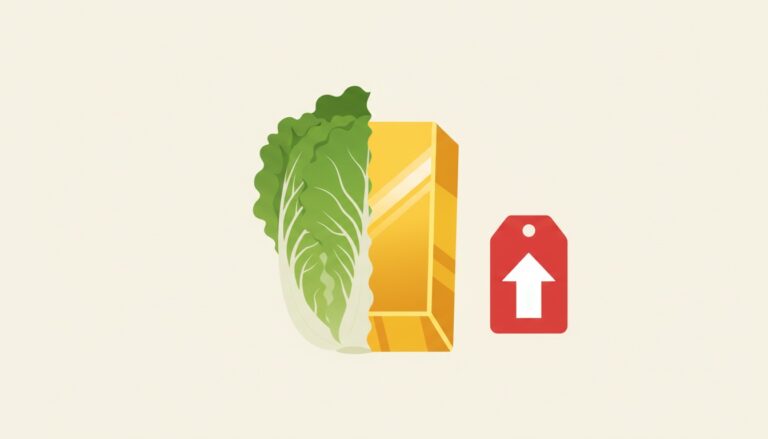
Today, we are diving into the “Kimchi Inflation”—or as we call it, the era of “Geum-chi”. Let’s learn how to complain about prices like a true local insider.
Phase 2: Deep Dive (Advanced Expressions)
Here are the three heavy-hitting expressions you will hear constantly on the news and on the streets during a price surge.
1. 금치 (Geum-chi)
- Pronunciation:
Geum-chi[Gŭm-chi]- Sound Analogy: ‘Geum’ sounds like the ‘gum’ in ‘chewing gum‘, but close your lips tighter at the end.
- Meaning:
- Literal: Gold Kimchi.
- Real Nuance: A sarcastic portmanteau of Geum (Gold) + Kimchi. It means the ingredients (cabbage, radish, pepper powder) are so expensive that the Kimchi is essentially worth its weight in gold.
- Editor’s Insight: This is satire at its finest. Use this when you want to emphasize the absurdity of the inflation. It’s not just “expensive”; it’s a luxury item now.
- Situation Check: ✅ Casual (Friends) | ✅ Formal (News/Business reports)
2. 엄두가 안 나다 (Eomdu-ga an nada)
- Pronunciation:
Eom-du-ga an na-da- Sound Analogy: ‘Eom’ rhymes with ‘Thumb’.
- Meaning:
- Literal: The thought/intention does not arise.
- Real Nuance: “I can’t even dare to think about doing it.” You use this when a task (like making Kimchi for 4 people with current prices) is so overwhelming or costly that you can’t even summon the courage to start.
- Editor’s Insight: This is a crucial C2 phrase. It describes a psychological barrier caused by external circumstances.
- Situation Check: ✅ Universal usage.
3. 천정부지로 치솟다 (Cheonjeongbuji-ro chisotda)
- Pronunciation:
Cheon-jeong-bu-ji-ro chi-sot-da - Meaning:
- Literal: To soar without knowing where the ceiling is.
- Real Nuance: “Prices are skyrocketing through the roof.” This is a high-level idiom often found in news headlines or serious discussions about the economy.
- Editor’s Insight: While “neomu bissayo” is fine, using “cheonjeongbuji” shows you read the newspaper. It implies an uncontrollable, scary rise.
- Situation Check: ✅ Formal (Discussions) | ⚠️ Casual (Can be used for dramatic effect).
Phase 3: Textbook vs. Real Life
At the C2 level, we move from describing facts to expressing sentiments.
| Textbook Korean (Correct but dry) | Real Korean (Native Vibe) |
|---|---|
| 배추 가격이 많이 올랐어요. (The cabbage price has gone up a lot.) |
배추가 아니라 금추라니까요. (It’s not cabbage, I’m telling you, it’s gold-bage.) |
| 너무 비싸서 김치를 만들 수 없어요. (It is too expensive so I cannot make Kimchi.) |
올해 김장은 엄두도 못 내겠어요. (I can’t even dare to think about Gimjang this year.) |
| 물가가 계속 오르고 있어요. (Prices keep rising.) |
장바구니 물가가 무섭네요. (The ‘shopping basket’ prices are scary.) |
Bottom Note: Notice the use of “장바구니 물가” (shopping basket prices). This refers specifically to the cost of daily groceries felt by consumers, distinct from the general inflation rate.
Phase 4: Cultural Context & Manners 🧘♂️
The “Gimjang Stress” and Nunchi
In Korea, Gimjang isn’t just cooking; it’s a massive annual project. Buying 50+ heads of cabbage, salting them, and mixing seasoning is physically exhausting. When prices spike:
- The “Gimjang Give-up” Tribe (김포족 – Gim-po-jok): This is a new slang for people who have given up (pogi) on making Kimchi and decide to buy packaged Kimchi instead.
- Nunchi Tip: If you visit a Korean family during this season, do not ask, “Why don’t you make your own Kimchi? It tastes better.” This is highly insensitive during a price crisis. Instead, say: “Making it yourself must be so hard with these prices (요즘 물가도 비싼데 직접 하시다니 대단하세요).”
Phase 5: Real-Life Scenario 🎬
Setting: A local traditional market (Sijang). You are talking to a merchant owner (Ajumma).
Characters:
* Alex (You): A long-term resident in Korea (Level C2).
* Owner: A frustrated vegetable seller.
Alex: (Looking at the price tag with shock)
아니, 사장님. 배추 가격이 실화예요? 완전 금치네요.
(Ani, sajangnim. Baechu gagyeogi silhwayeyo? Wanjeon geum-chineyo.)
Wait, owner. Is this cabbage price for real? It’s totally ‘Geum-chi’.
Owner: (Sighing and waving hand)
말도 마요. 물량이 없어서 우리도 떼오기 힘들어요.
(Maldo mayo. Mullyangi eopseoseo urido tte-ogi himdeureoyo.)
Don’t even get me started. There is no supply, so it’s hard for us to get stock too.
Alex: (Nodding sympathetically)
올해 김장은 정말 엄두가 안 나겠는데요. 그냥 조금만 사서 겉절이나 해 먹어야겠어요.
(Olhae gimjang-eun jeongmal eomdu-ga an nagetneundeyo. Geunyang jogeumman saseo geotjeori-na hae meogeoyagesseoyo.)
I really can’t dare to think about full Gimjang this year. I’ll just buy a little and make fresh salad-kimchi (Geotjeori).
Owner:
그게 현명해요. 가격 좀 내리면 그때 하든가 해요.
(Geuge hyeonmyeonghaeyo. Gagyeok jom naerimyeon geuttae hadeunga haeyo.)
That’s wise. Just do it later when the prices drop a bit.
Phase 6: 10-Second Shadowing 🗣️
Read this aloud to practice expressing empathy + advanced logic.
“배추 가격이 / 천정부지로 치솟아서, / 올해 김장은 / 엄두도 못 내고 있어요.”
- Breakdown: Baechu gagyeogi / cheonjeongbuji-ro chisot-a-seo, / olhae gimjang-eun / eomdu-do mot naego isseoyo.
- Intonation: Stress ‘Cheon-jeong’ (high pitch) to emphasize the height of prices. Drop your tone on ‘Eomdu-do’ to sound discouraged.
Phase 7: FAQ & Troubleshooting 🛠️
Q: Can I use “Geum-chi” (금치) to my boss or in a business meeting?
A: Yes, but with context. It is a widely recognized social term. If you are in a food & beverage company discussing costs, it is very appropriate. If you are just making small talk, it shows you are witty and updated on current events. It is not considered vulgar slang.
Q: Is “엄두가 안 나다” only for money?
A: No. You can use it for anything overwhelming.
* “The report is so long, I can’t even dare to start reading it.” (보고서 양이 너무 많아서 읽을 엄두가 안 나요.)
Phase 8: Wrap-up & Mission 🚀
Today’s One-Liner:
When cabbage becomes gold, don’t just say “expensive”—call it “Geum-chi” and complain about the “Cheonjeongbuji” prices.
Your Mission:
Next time you go to a mart or restaurant and see high vegetable prices (or even expensive apples!), shake your head and mutter to your Korean friend:
“와… 물가가 정말 천정부지네. 무서워서 엄두가 안 나.”
See if they agree with you instantly! 👋
Phase 9: Pop Quiz 📝
1. Which word combines “Gold” and “Kimchi” to satirize inflation?
(A) Ton-chi (Money-chi)
(B) Geum-chi
(C) Eun-chi (Silver-chi)
2. What does “Eomdu-ga an nada” mean?
(A) I have a headache.
(B) I can’t dare to think about doing it.
(C) I am very excited to start.
3. Which phrase describes prices hitting the ceiling?
(A) Cheonjeongbuji (천정부지)
(B) Ildong girip (일동 기립)
(C) Samsam-o-o (삼삼오오)
Click to see answers
1. (B) Geum-chi
2. (B) I can’t dare to think about doing it.
3. (A) Cheonjeongbuji
Frequently Asked Questions (FAQ)
Q: What does "금치 (Geum-chi)" mean in Korean and how do you pronounce it?
A: In Korean, "금치 (Geum-chi)" is pronounced [Geum-chi [Gŭm-chi] and means: a key conversational Korean expression covered in this lesson.
Q: What does "엄두가 안 나다 (Eomdu-ga an nada)" mean in Korean and how do you pronounce it?
A: In Korean, "엄두가 안 나다 (Eomdu-ga an nada)" is pronounced [Eom-du-ga an na-da] and means: a key conversational Korean expression covered in this lesson.
Q: What does "천정부지로 치솟다 (Cheonjeongbuji-ro chisotda)" mean in Korean and how do you pronounce it?
A: In Korean, "천정부지로 치솟다 (Cheonjeongbuji-ro chisotda)" is pronounced [Cheon-jeong-bu-ji-ro chi-sot-da] and means: Literal: To soar without knowing where the ceiling is.







