

Hello! We are Daily Hangul. 👋
Hello there! It’s your favorite editor from Daily Hangul.
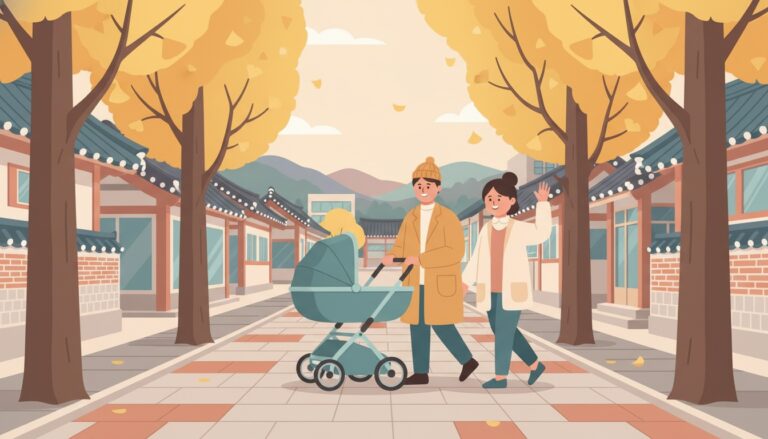
So, you’ve settled in Korea, and maybe you have a little one in a stroller (or yumocha). You decide to step out for a peaceful walk, enjoying the autumn breeze. But wait—walking a baby in Korea is rarely a “solo mission.”
In Korea, a baby in a stroller is like a magnet for neighbors, especially the warm-hearted (and sometimes chatty) ajummas (middle-aged women). They might stop you to admire the baby, ask how old they are, or even try to touch the baby’s cute cheeks!
If you don’t know how to respond, you might just awkwardly smile and run away. But today, I’ll teach you the essential B1 phrases to navigate these interactions with grace and protect your baby’s nap time. Let’s turn you into a local parent!
1. Deep Dive: Core Expressions 🔍
Here are the top 3 phrases you need when you are out with your stroller.
1) 바람 쐬러 나왔어요.
(I just came out to get some fresh air.)
- Pronunciation: [Ba-ram ssoe-reo na-wa-sseo-yo]
- Tip: ‘Ssoe’ sounds a bit like the ‘swe’ in “sweat,” but shorter.
- Meaning:
- Literal: I came out to expose myself to wind.
- Real Nuance: This is the perfect, polite answer when neighbors ask, “Where are you going?” (어디 가세요?). It implies you aren’t going anywhere specific, just taking a break.
- Editor’s Insight: Koreans ask “Where are you going?” as a greeting, not because they are stalking you. This phrase is the perfect deflective shield!
- Situation Check: ✅ Casual (Neighbors) | ✅ Formal (Elders)
2) 애가 방금 잠들었어요.
(The baby just fell asleep.)
- Pronunciation: [Ae-ga bang-geum jam-deu-reo-sseo-yo]
- Meaning:
- Literal: The child recently entered sleep.
- Real Nuance: “Please lower your voice” or “Please don’t touch the baby.” This is a soft but firm way to set boundaries without sounding rude.
- Editor’s Insight: Use this when an enthusiastic admirer gets too close to the stroller. Usually, hearing this makes people whisper immediately!
- Situation Check: ✅ Casual | ✅ Formal
3) 유모차 들어갈 수 있나요?
(Can the stroller go inside?)
- Pronunciation: [Yu-mo-cha deu-reo-gal su in-na-yo?]
- Meaning: Can we bring the stroller in?
- Editor’s Insight: Many cafes or restaurants in Korea have tight spaces or “No Kids Zones.” Always ask this at the entrance to avoid an awkward U-turn inside.
- Situation Check: ✅ General Public
2. Textbook vs. Real Life 🇰🇷
Let’s see how a textbook robot speaks versus how a cool parent in Hongdae speaks.
| Situation | Textbook Korean (A bit stiff) 🤖 | Real Spoken Korean (Natural) ✨ |
|---|---|---|
| Passing by people | 지나가겠습니다. (I will pass.) | 잠시만요~ (Just a moment~) |
| Baby is sleeping | 아이가 자고 있습니다. (The child is sleeping.) | 애기 자요~ (Baby’s sleeping~) |
| Saying baby’s age | 12개월입니다. (It is 12 months.) | 돌 지났어요. (Passed the first birthday.) |
Note: “돌 (Dol)” is the first birthday, a huge milestone in Korea. Saying “Dol jinasseoyo” sounds much more native than just counting months after age 1.
3. Cultural Context: The “Oji-rap” 💡
Have you heard of Oji-rap (오지랖)? It refers to being meddlesome or nosy.
When you push a stroller, you will experience the benevolent Oji-rap. Older Koreans generally adore babies. They might say “Aigo, yeppeora!” (Oh my, so pretty!) and might reach out to touch the baby’s foot or hand.
- Non-verbal Tip: If you are uncomfortable with strangers touching your baby (due to germs or privacy), smilingly use your body to slightly block the stroller while saying the expression we learned: “아이가 감기 기운이 있어서요” (The baby has a bit of a cold).
- Elevator Manners: In crowded elevators, people will usually make space for a stroller. A slight bow and a cheerful “Gamsahamnida” is mandatory!
4. Roleplay: In the Elevator 🎬
Setting: You are in an apartment elevator. An older neighbor lady (Ajumma) enters.
Ajumma: 어머! 애기 너무 귀엽다. 몇 개월이에요?
(Oh my! The baby is so cute. How many months is he/she?)
You: 안녕하세요! 이제 10개월 됐어요.
(Hello! He/She is 10 months old now.)
Ajumma: (Trying to touch the baby’s cheek) 아이고 예뻐라. 춥지는 않아요?
(Aww so pretty. Isn’t he/she cold?)
You: (Smiling politely but blocking slightly) 네, 괜찮아요. 근데 애가 방금 잠들어서요.
(Yes, he’s fine. But the baby just fell asleep.)
Ajumma: (Whispering) 아, 그래요? 미안해요~ 쉿!
(Ah, really? Sorry~ Shh!)
5. 10-Second Shadowing 🗣️
Read this aloud to practice your intonation. The / marks where you should pause slightly.
“죄송한데 / 유모차 때문에 / 자리 좀 / 만들어주실 수 있나요?”
(I’m sorry, but / because of the stroller / could you / make some space?)”
- Key Point: Don’t say it aggressively. Use a rising, questioning tone at the end to sound polite.
6. FAQ & Troubleshooting ❓
Q: Can I take my stroller on the bus?
A: Technically yes, but in reality, it is very difficult unless it’s a “Low-floor bus” (저상버스). Usually, the subway (Ji-ha-cheol) is much more stroller-friendly because of elevators.
Q: Is it rude to reject help?
A: Sometimes people try to help lift the stroller. If you don’t need it, just say “Gwaenchana-yo” (It’s okay) with a smile. They are just trying to be kind!
7. Wrap-up & Mission 🎁
Today’s Summary:
Don’t be afraid of neighbors! Use “Baram ssoe-reo na-wa-sseo-yo” to be friendly, and “Ae-ga jam-deu-reo-sseo-yo” to protect your peace.
Your Mission:
Next time you are out (even without a baby) and need to pass through a crowd, instead of saying “Excuse me” in English, try saying “Jam-si-man-yo~” confidently!
Have you ever experienced ‘Korean kindness’ while walking with a baby? Tell us in the comments! 👇
8. Pop Quiz 📝
1. How do you politely tell a neighbor the baby is sleeping (so please be quiet)?
A) 조용히 하세요. (Be quiet.)
B) 애가 방금 잠들었어요. (The baby just fell asleep.)
C) 저리 가세요. (Go away.)
2. What is the “Magic Word” when you need to pass by people with your stroller?
A) 비켜! (Move!)
B) 잠시만요~ (Just a moment~)
C) 안녕히 계세요. (Goodbye.)
3. Which phrase means “I came out for some fresh air”?
A) 바람 쐬러 나왔어요.
B) 바람이 너무 많이 불어요.
C) 집에 가고 싶어요.
Click to see answers!
1. B
2. B
3. A







