

🚨 Phase 1: Hello from Daily Hangul!
Hello, Daily Hangul family! This is your editor, back with a topic I hope you never have to use, but you absolutely must know.
Imagine this: You are in your Airbnb in Seoul, enjoying a nice cup of ramen. Suddenly, you smell something burning. You look out the hallway, and there is smoke. Panic sets in.
In this split second, your brain might freeze. You might try to remember the polite grammar you learned in Chapter 1. Stop. In an emergency, politeness goes out the window. You need speed, volume, and the exact right word to alert everyone.
Today, we are learning how to scream “Fire!” and get help immediately. This isn’t just a language lesson; it’s a survival skill.
🔥 Phase 2: Core Survival Expressions
Here are the top 3 expressions you need when things heat up (literally).
1. 불이야! (Fire!)
- Pronunciation: [Bul-i-ya]
- Sound Analogy: It sounds like “Burrito” without the ‘to’, adding ‘ya’ at the end. “Buri-ya!”
- Meaning: “It’s a fire!” / “Fire!”
- Editor’s Insight: This is not a sentence to be whispered. It is a scream. In Korean, adding “-ya” emphasizes the exclamation. Don’t worry about being polite here.
- Situation Check: 🟢 Universal (Use anywhere, anytime there is a fire).
2. 도와주세요! (Help me!)
- Pronunciation: [Do-wa-ju-se-yo]
- Sound Analogy: Do (like ‘dough’) + Wa (like ‘water’) + Ju (like ‘Jewel’) + Se (like ‘Say’) + Yo.
- Meaning: Please help me.
- Editor’s Insight: This is the standard cry for help. It works for fires, injuries, or if you are lost. Memorize this rhythm: Do-wa / Ju-se-yo.
- Situation Check: 🟢 Standard Polite (Safe to use with anyone).
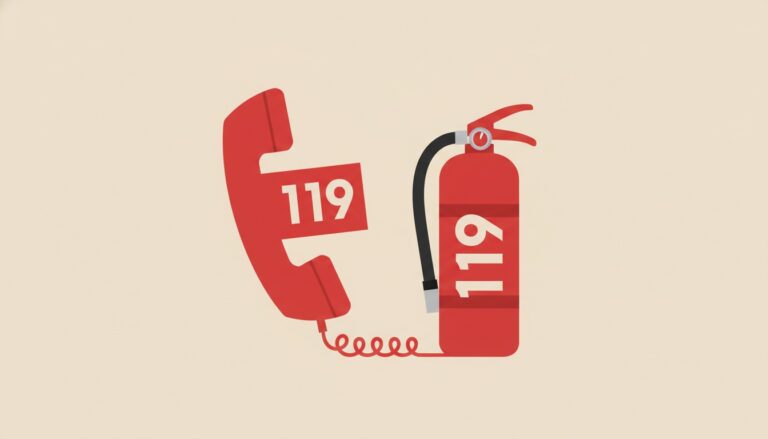
3. 119에 전화해 주세요. (Please call 119.)
- Pronunciation: [Il-il-gu-e jeon-hwa-hae ju-se-yo]
- Sound Analogy: Il-Il-Gu (This is the number). Think of an “Eel” (fish) twice, then “Goo” (slime). Eel-Eel-Goo.
- Meaning: Please call 119 (Fire/Ambulance).
- Editor’s Insight: In Korea, 911 is NOT the emergency number.
- 119 = Fire & Ambulance 🚒
- 112 = Police 🚓
- Situation Check: 🟢 Urgent Request.
🆚 Phase 3: Textbook vs. Real Life
Textbooks teach you to describe situations. Real life requires action.
| Textbook (Robot Style) 🤖 | Real Life (Survival Style) 🆘 |
|---|---|
| 화재가 발생했습니다. (A fire has occurred.) |
불이야! 불! (Fire! Fire!) |
| 소방서를 불러 주시겠습니까? (Would you mind calling the fire station?) |
119! 빨리요! (119! Hurry!) |
| 저는 도움이 필요합니다. (I am in need of assistance.) |
도와주세요! (Help me!) |
Editor’s Note: In an emergency, drop the long sentences. Just screaming “119!” (Il-Il-Gu) is enough for locals to understand what you need.
🇰🇷 Phase 4: Cultural Context & Manners
1. The “Il-Il-Gu” Rule
Many foreigners panic and dial 911. While some mobile carriers might redirect you, you cannot rely on that. Drill the number 119 into your head.
2. Nunchi? Not Today!
Korea is famous for Nunchi (reading the room) and being quiet in public spaces. However, if you see smoke, forget Nunchi. It is your duty to be the loudest person in the room. Koreans will appreciate your quick warning.
3. Pointing is Okay
Usually, pointing with one finger is considered rude. But if you see a fire, point at it frantically while yelling “불이야!” Clarity saves lives.
🎬 Phase 5: Real-Life Scenario (Roleplay)
Setting: A crowded BBQ restaurant. You see flames jumping from a vent.
Characters:
* Jason (You): A sharp-eyed tourist.
* Ajumma (Staff): Busy restaurant server.
(Jason notices the fire on the ceiling vent)
Jason: (Pointing at the ceiling) 불이야! 여기 불이야!
[Buriya! Yeogi buriya!]
(Fire! There’s a fire here!)
Ajumma: (Shocked) 어머!
[Eomeo!]
(Oh my gosh!)
Jason: 119! 빨리 전화해 주세요!
[Il-il-gu! Ppalli jeon-hwahae ju-se-yo!]
(119! Call them quickly!)
Ajumma: 알겠어요! 다들 나가세요!
[Algesseoyo! Dadeul nagaseyo!]
(Okay! Everyone get out!)
🗣️ Phase 6: 10-Second Shadowing
Let’s practice screaming. Don’t be shy. Read this aloud with urgency!
“불이야! / 119에 / 전화해 주세요!”
Guide:
* 불이야! → Pitch goes UP at the end! (Buri-YA!)
* 119에 → Il-Il-Gu-eh
* 전화해 주세요 → Jeon-hwa-hae / Ju-se-yo
❓ Phase 7: FAQ & Troubleshooting
Q: Can I just scream “Fire” in English?
A: In major cities like Seoul, many people will understand “Fire!” or “Help!” But “불이야 (Buriya)” triggers an instant reflex in Koreans that English words might not. Use Korean if possible.
Q: What if I forget the polite “-yo” ending?
A: Totally fine. If you just yell “도와줘!” (Help!) or “불!” (Fire!), nobody will scold you for being rude. Survival comes first.
🎁 Phase 8: Wrap-up
One-Liner Summary:
When you see smoke, don’t think about grammar—just scream “불이야!” (Buriya) and dial 119 (Il-Il-Gu).
🚀 Your Mission:
Look at your phone dial pad right now. Visualize typing 1-1-9. Say “Il-Il-Gu” three times. Do it now!
Have you ever had a small emergency while traveling? How did you handle the language barrier? Tell me in the comments! 👇
📝 Phase 9: Pop Quiz
1. What is the phone number for Fire/Ambulance in Korea?
a) 911
b) 112
c) 119
2. How do you scream “Fire!” in Korean?
a) Mul-iya! (It’s water!)
b) Buriya! (It’s fire!)
c) Bap-iya! (It’s rice!)
3. True or False: You must be extremely polite and bow when screaming that there is a fire.
a) True
b) False
Click to see answers
1. c) 119
2. b) Buriya!
3. b) False (Loud and clear is better than polite!)
Frequently Asked Questions (FAQ)
Q: What does "불이야! (Fire!)" mean in Korean and how do you pronounce it?
A: In Korean, "불이야! (Fire!)" is pronounced [Bul-i-ya] and means: a key conversational Korean expression covered in this lesson.
Q: What does "도와주세요! (Help me!)" mean in Korean and how do you pronounce it?
A: In Korean, "도와주세요! (Help me!)" is pronounced [Do-wa-ju-se-yo] and means: a key conversational Korean expression covered in this lesson.
Q: What does "119에 전화해 주세요. (Please call 119.)" mean in Korean and how do you pronounce it?
A: In Korean, "119에 전화해 주세요. (Please call 119.)" is pronounced [Il-il-gu-e jeon-hwa-hae ju-se-yo] and means: a key conversational Korean expression covered in this lesson.







