

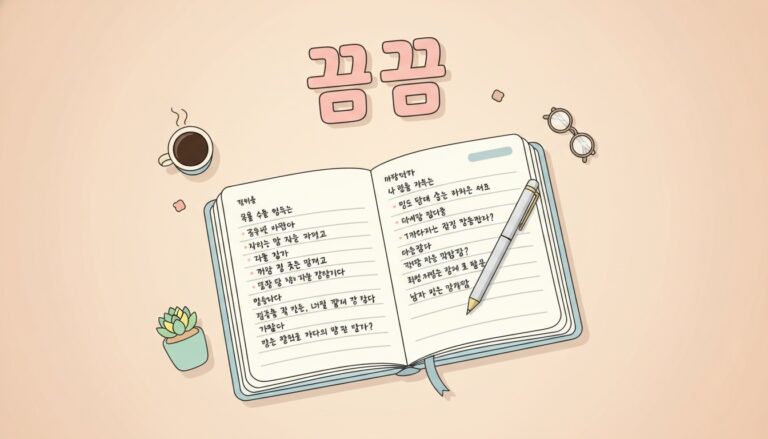
Phase 1: Hook & Empathy (Introduction)
Hello, Daily Hangul family! 👋 This is your head editor, ready to level up your Korean.
Have you ever been in a situation—maybe a group project meeting or listening to a Korean friend’s complicated story—where you were frantically writing things down? You want to show them, “I’m not ignoring you! I’m just really detailed and don’t want to miss anything!”
If you just stay silent while looking down at your notebook, you might look like you’re bored or doodling. But if you drop the perfect sentence here, you go from “distracted foreigner” to “trustworthy friend/colleague” in 3 seconds.
Today, we are tackling a B1 (Intermediate) topic: Describing your personality. Specifically, explaining that you are meticulous and love taking notes. This is a superpower phrase in Korean culture, where diligence (성실함) is highly valued. Let’s get into it!
Phase 2: Deep Dive into Core Expressions
Here are the three golden phrases you need to master today.
1. 꼼꼼하다 (To be meticulous/detailed)
- Pronunciation: [Kkom-kkom-ha-da]
- Tip: The double ‘ㄲ’ (Kk) sounds like the sharp ‘c’ in “scar” or “sky.” Tense your throat a bit!
- Meaning: Careful, detailed, meticulous. (Opposite of being sloppy).
- Editor’s Insight: This is a huge compliment in Korea. If someone calls you 꼼꼼해요, they trust your work. If you say it about yourself, don’t say “I am meticulous” (too direct). Say “I’m on the meticulous side.”
- Situation Check: ✅ Casual / ✅ Formal (Very good for job interviews!)
2. ~는 편이다 (Tend to be / On the side of)
- Grammar Usage: Adjective/Verb stem + 는 편이다
- Meaning: Rather than saying “I am X,” this means “I tend to be X” or “I’m on the X side.”
- Editor’s Insight: Koreans value humility. Saying “I am smart” sounds arrogant. Saying “I’m on the smart side” (똑똑한 편이에요) sounds softer and more natural.
3. 적다 / 메모하다 (To write down / To memo)
- Pronunciation: [Jeok-da] / [Me-mo-ha-da]
- Meaning: ‘적다’ is native Korean for ‘write down.’ ‘메모하다’ comes from the English ‘memo.’
- Situation Check: Both are used interchangeably, but ‘메모하다’ is very common in office settings.
Phase 3: Textbook vs. Real Life
Let’s see how a robot talks vs. how a Seoul local talks.
| Textbook Korean (🤖) | Real Spoken Korean (MZ Style ✨) |
|---|---|
| 저는 꼼꼼해서 메모를 잘 합니다. | 제가 성격이 좀 꼼꼼한 편이라서요. |
| (I am meticulous so I take notes well.) | (It’s ‘cause I’m kinda on the meticulous side, you know?) |
| 잊어버리지 않게 씁니다. | 안 까먹으려고 막 적어 두는 거예요. |
| (I write so I do not forget.) | (I’m just jotting it down so I don’t totally blank out later.) |
💡 Editor’s Note: Notice the word 까먹다 (kka-meok-da) in the right column? It’s the casual version of “to forget.” Use this with friends, and they’ll be shocked you know it!
Phase 4: Cultural Context & Manners (Nunchi 101)
🧠 The “Notebook” Effect
In many Western cultures, maintaining eye contact is the #1 rule of listening. In Korea, while eye contact is important, writing things down (taking notes) is often seen as a sign of respect and passion, especially with supervisors or elders.
If your boss is speaking and you are just staring at them, they might think, “Is this person actually listening? Will they remember this?”
But if you pull out a notebook and say, “잠시만요, 메모 좀 할게요” (One second, let me take notes), you instantly gain +10 Professionalism Points. It signifies that their words are important enough to be recorded.
Phase 5: Real-Life Scenario (Roleplay)
Setting: A cafe. You (Alex) are planning a trip with your Korean friend (Ji-min).
Ji-min: 와, 알렉스! 너 그거 다 적고 있어? 대단하다.
(Wow, Alex! Are you writing all that down? That’s amazing.)
Alex: (Shyly scratching head) 아, 제가 성격이 좀 꼼꼼한 편이라서요.
(Ah, it’s just that I tend to be a bit meticulous by nature.)
Ji-min: 진짜? 난 듣고 바로 까먹는데.
(Really? I forget things right after hearing them.)
Alex: 저도 그래요. 그래서 안 잊어버리려고 메모하는 습관이 있어요.
(Me too. That’s why I have a habit of taking notes so I don’t forget.)
Phase 6: 10-Second Shadowing Drill
Read this aloud to practice the natural rhythm. Focus on the pauses!
“제가 / 성격이 좀 / 꼼꼼한 편이라서… / 메모를 자주 해요.”
- Pronunciation: Je-ga / seong-gyeo-gi jom / kkom-kkom-han pyeo-ni-ra-seo… / me-mo-reul ja-ju hae-yo.
- Meaning: Since I’m a bit on the meticulous side… I take notes often.
Phase 7: FAQ & Troubleshooting
Q: Can I say “깐깐하다” (Kkan-kkan-ha-da) instead of “꼼꼼하다”?
A: ⚠️ STOP! Be careful!
While they sound similar, 꼼꼼하다 is positive (thorough, detailed), but 깐깐하다 is usually negative (fussy, picky, strict).
* Your boss is 꼼꼼하다 = They are a perfectionist leader.
* Your boss is 깐깐하다 = They complain about every little mistake and are hard to please.
Q: Is it okay to use a phone to take notes?
A: With friends? Yes. With elders or in a formal business meeting? Ideally, no. Using a physical pen and paper is safer. If you must use a phone, always preface it: “휴대폰으로 메모 좀 할게요” (I’m going to take notes on my phone), so they don’t think you’re texting.
Phase 8: Wrap-up & Action Item
📝 One-Liner Summary:
To sound modest but competent, use “꼼꼼한 편이라서” (Because I tend to be meticulous) before explaining your habits.
🚀 Today’s Mission:
Next time you are studying Korean or listening to instructions, grab a pen and say to yourself (or your tutor): “저 꼼꼼한 편이라서 지금 메모하고 있어요!”
Question for you: Are you the type to write everything down, or do you trust your brain? Tell me in the comments using “~는 편이에요”!
Phase 9: Pop Quiz
1. Which word means “meticulous/detailed” in a positive way?
(A) 깐깐하다
(B) 꼼꼼하다
(C) 심심하다
2. How do you soften the sentence “I am meticulous”?
(A) 꼼꼼한 사람이다
(B) 꼼꼼한 편이다
(C) 꼼꼼해야 한다
3. What is the casual Korean verb for “to forget”?
(A) 까먹다
(B) 먹다
(C) 기억하다
(Answers: 1-B, 2-B, 3-A)
Frequently Asked Questions (FAQ)
Q: What does "꼼꼼하다 (To be meticulous/detailed)" mean in Korean and how do you pronounce it?
A: In Korean, "꼼꼼하다 (To be meticulous/detailed)" is pronounced [Kkom-kkom-ha-da] and means: a key conversational Korean expression covered in this lesson.
Q: What does "~는 편이다 (Tend to be / On the side of)" mean in Korean and how do you pronounce it?
A: In Korean, "~는 편이다 (Tend to be / On the side of)" is pronounced [see lesson guide] and means: Rather than saying "I am X," this means "I tend to be X" or "I'm on the X side."
Q: What does "적다 / 메모하다 (To write down / To memo)" mean in Korean and how do you pronounce it?
A: In Korean, "적다 / 메모하다 (To write down / To memo)" is pronounced [Jeok-da] and means: '적다' is native Korean for 'write down.' '메모하다' comes from the English 'memo.'







