

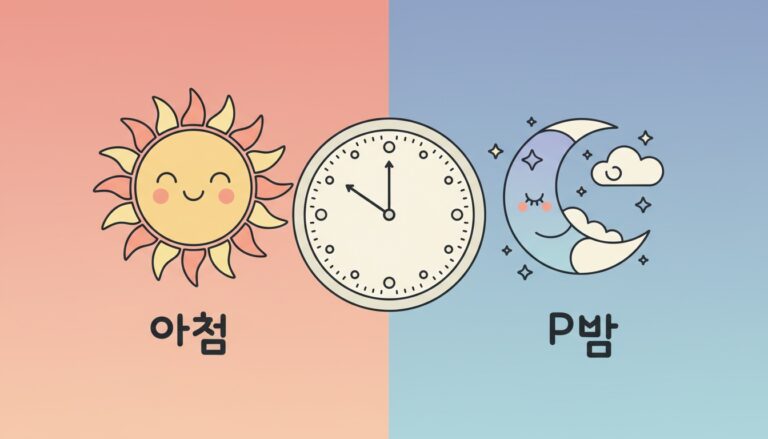
⌚ Hello! This is your editor at Daily Hangul.
Have you ever had that panic attack when booking a K-TX train ticket? You see “08:00” and freeze. Is this strictly military time? Or did you just agree to meet your Korean friend for BBQ at 7:00… in the morning?
Time confusion is a classic rite of passage for learners. In English, we casually tack on “AM” or “PM” at the end. But Korean? It demands a different logic.
Today, we are going to fix this order in your brain so you never show up to a dinner date while the birds are still chirping. This guide comes straight from questions asked by our A1 students last week!
🔍 Phase 1: Deep Dive into AM & PM
Unlike English, Korean places the “time marker” before the hour. Think of it as setting the scene (Morning/Afternoon) before telling the time.
1. 오전 (Ojeon)
- Pronunciation:
O-jeon[Sounds like “Oh” + “John” without the ‘h’] - Meaning: AM (Literally: Before Noon)
- Editor’s Insight: You won’t hear this much in casual chat. It sounds a bit formal, like a news anchor or a digital clock display. But it is essential for checking schedules.
- Situation: 💼 Formal / Written / Schedules
2. 오후 (Ohu)
- Pronunciation:
O-hoo[Sounds like “Oh” + the sound an owl makes “Hoo”] - Meaning: PM (Literally: After Noon)
- Editor’s Insight: Just like ‘Ojeon’, this is the standard “official” way to say PM. If you are booking a movie ticket, look for this word.
- Situation: 💼 Formal / Written / Schedules
3. 아침 / 저녁 (Achim / Jeonyeok)
- Pronunciation:
Ah-chim/Juh-nyeok - Meaning: Morning / Evening
- Editor’s Insight: 🚨 Real Talk! While Ojeon/Ohu are correct, in daily conversation, Koreans prefer to say “Morning 8 o’clock” or “Evening 7 o’clock.” It feels much more natural and less robotic.
- Situation: 👍 Casual / Daily Conversation
🆚 Phase 2: Textbook vs. Real Life
Here is where beginners get spotted immediately. Don’t sound like a walking dictionary!
| Textbook (Correct but stiff) | Real Korean (Natural & Fluid) |
|---|---|
| 오전 8시에 만나요. (Let’s meet at 8 AM.) |
아침 8시 어때? (How about morning 8?) |
| 오후 6시입니다. (It is 6 PM.) |
저녁 6시야. (It’s evening 6.) |
Editor’s Note: For A1 beginners, using Ojeon/Ohu is perfectly fine and polite! But knowing Achim/Jeonyeok will help you understand what your friends are actually saying.
🎭 Phase 3: Cultural Context – The “Word Order” Trap
English: 7:00 PM ➡️ Time first, then Marker.
Korean: 오후 7:00 ➡️ Marker first, then Time.
If you say “7시 오후” (7 o’clock PM), Koreans will understand you, but it sounds like Yoda speaking English (“Time it is, hmmm”).
💡 Nunchi Tip: If you are inviting a supervisor or elder, arrive 5 minutes before the stated time. If you say “오후 2시” (2 PM), being there at 1:55 PM earns you major respect points.
🎬 Phase 4: Roleplay (Survival Scenario)
Setting: You (Alex) are double-checking a dinner plan with your Korean friend (Minji).
Minji: 우리 8시에 볼까? (Uri 8-si-e bolkka?)
(Shall we meet at 8?)
Alex: 아침? 저녁? (Achim? Jeonyeok?)
(Morning? Or Evening?) – *[Acting Tip: Look confused!]
Minji: 😂 당연히 저녁이지! (Dang-yeon-hi jeonyeok-iji!)
(Of course evening!)
Alex: 아, 오후 8시! 알겠어. (Ah, Ohu 8-si! Algesseo.)
(Ah, 8 PM! Got it.)
🎤 Phase 5: 10-Second Shadowing
Read this aloud. Focus on the pause to separate the AM/PM marker from the time.
“Please come at 2 PM.”
오후 / 2시에 / 오세요.
[O-hoo / doo-si-e / o-se-yo]
- Intonation: Raise your tone slightly on ‘Ohu’ to emphasize the time of day.
- Check: Did you say ‘Ohu’ before ‘2-si’? Great job!
❓ Phase 6: FAQ (Troubleshooting)
Q: Can I use the 24-hour clock (13:00, 14:00) when speaking?
A: You can, but it sounds very military or like a GPS navigation system. Unless you are a soldier or announcing a train schedule, stick to 오후 2시 (2 PM) instead of 14시 (14 o’clock).
Q: How do I write it in a text message?
A: In texting, Koreans often just write numbers like “2시” if the context is obvious. If not, they might abbreviate to “pm 2시” or write “오후 2시”.
🎁 Wrap-up
One-Liner Summary: Always put 오전 (AM) or 오후 (PM) before the number!
Your Mission: Open your phone’s alarm app right now. Read your wake-up time aloud in Korean using “오전 [Time]”.
Tell me in the comments: Are you an 아침 (Morning) person or a 저녁 (Evening) person?
📝 Pop Quiz
1. Which word means PM (Afternoon)?
a) 오전 (Ojeon)
b) 오후 (Ohu)
c) 오늘 (Oneul)
2. How do you say “2 PM” correctly?
a) 2시 오후 (2-si Ohu)
b) 오후 2시 (Ohu 2-si)
c) PM 2
3. If you want to sound casual, instead of “오전 8시” (8 AM), you can say:
a) 아침 8시 (Morning 8 o’clock)
b) 밤 8시 (Night 8 o’clock)
c) 저녁 8시 (Evening 8 o’clock)
Click to see answers
1. b, 2. b, 3. a
Frequently Asked Questions (FAQ)
Q: What does "오전 (Ojeon)" mean in Korean and how do you pronounce it?
A: In Korean, "오전 (Ojeon)" is pronounced [O-jeon [Sounds like "Oh" + "John" without the 'h'] and means: AM (Literally: Before Noon)
Q: What does "오후 (Ohu)" mean in Korean and how do you pronounce it?
A: In Korean, "오후 (Ohu)" is pronounced [O-hoo [Sounds like "Oh" + the sound an owl makes "Hoo"] and means: PM (Literally: After Noon)
Q: What does "아침 / 저녁 (Achim / Jeonyeok)" mean in Korean and how do you pronounce it?
A: In Korean, "아침 / 저녁 (Achim / Jeonyeok)" is pronounced [Ah-chim / Juh-nyeok] and means: Morning / Evening







