

Phase 1: Hook & Introduction
Hello! This is your Daily Hangul Editor.
Imagine this: It’s Seollal (Korean Lunar New Year). You are visiting your Korean friend’s family. You successfully performed the big formal bow (Sebae). Suddenly, the grandmother hands you a beautiful silk envelope or crisp cash.
Panic sets in. 😱
Do you just take it? Do you say “Thank you” in English? Do you refuse it?
This money is called Sebaetdon (세뱃돈), and it’s not just cash; it’s a blessing. If you just grab it with one hand and say “Thanks,” the room might go silent. But if you know the exact phrase and gesture I’m about to teach you, you will instantly become the favorite guest.
Today, I’ll share the secrets I tell my private students—tips that turn awkward moments into heartwarming memories.
Phase 2: Deep Dive (Core Expressions)
Here are the top 3 expressions you need for this specific moment. Since we are at Level A1, we will focus on short but powerful phrases.
1. 새해 복 많이 받으세요 (Happy New Year)
- Pronunciation:
Sae-hae bok ma-ni ba-deu-se-yo- Sound-alike: Say-heh Bok (like ‘poke’ with a b) Money (sounds like ‘mani’) Ba-deu-say-yo.
- Meaning:
- Literal: Please receive a lot of New Year’s luck/blessings.
- Real Nuance: The standard “Happy New Year.”
- Editor’s Insight: You say this BEFORE or WHILE bowing. This is the code word to initiate the Sebaetdon process!
- Situation: Everyone (Formal & Polite).
2. 감사합니다 (Thank you)
- Pronunciation:
Gam-sa-ham-ni-da- Sound-alike: Gam-sa-ham-knee-da.
- Meaning: Thank you.
- Editor’s Insight: Standard, but crucial. Say this immediately when your hands touch the envelope.
- Situation: Formal.
3. 건강하세요 (Please stay healthy)
- Pronunciation:
Geon-gang-ha-se-yo- Sound-alike: Gun-gang-ha-say-yo.
- Meaning: Be healthy.
- Editor’s Insight: 🌟 Golden Tip! Elders love this more than “Thank you.” It shows you care about their longevity. If you say this while receiving money, you might even get extra snacks!
- Situation: To elders/parents (Polite).
Phase 3: Textbook vs. Real Life
Textbooks teach you grammar, but they don’t teach you the “vibe.” Here is how to sound natural.
| Textbook (Correct but Stiff) | Real Life (Korean Vibe) |
|---|---|
| 저에게 돈을 주셔서 감사합니다. (Thank you for giving me money.) |
(Big Smile + Eye Contact) 감사합니다! 건강하세요! |
| 새해 복 많이 받으십시오. (Extremely formal military style) |
새해 복 많이 받으세요~ (Softly, with a slight bow) |
Note: At Level A1, do not try to make long sentences. A sincere facial expression + a short phrase is much better.
Phase 4: Cultural Context (The “Nunchi” Factor)
Language is only 30% of communication in Korea. The other 70% is Manners.
1. The Two-Hand Rule (두 손)
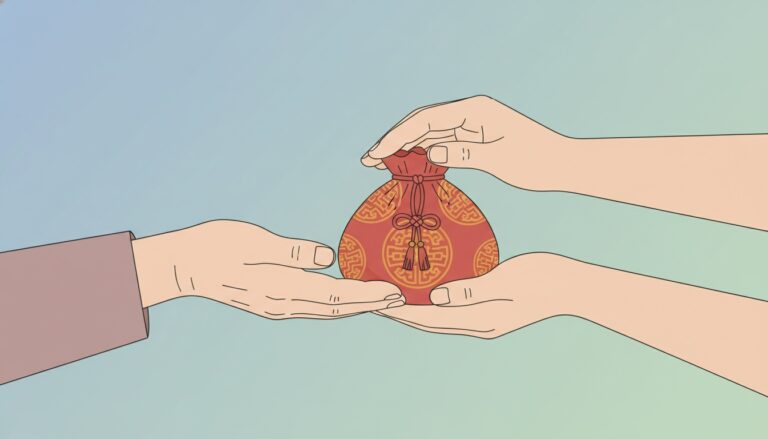
Unlike in the West, you NEVER accept anything with one hand from an elder.
* Right: Extend both hands to receive the envelope.
* Also Good: Extend your right hand, and support your right elbow/wrist with your left hand.
2. The “Don’t Look” Rule
Once you receive the Sebaetdon, DO NOT open it in front of them!
* Checking the amount immediately is considered very rude. Put it in your pocket or bag first. Check it later in the bathroom if you are curious!
Phase 5: Roleplay Script
Setting: Seollal morning at a Korean friend’s grandmother’s house.
Characters: You (Foreigner) vs. Halmeoni (Grandma).
(Action: You perform a deep bow on the floor.)
You: 새해 복 많이 받으세요!
(Saehae bok mani badeuseyo!)
“Happy New Year!”
Halmeoni: (Smiling) 오냐, 그래. 자, 여기 세뱃돈이다.
(Onya, geurae. Ja, yeogi sebaetdonida.)
“Oh, yes. Here, here is some New Year’s money.”
(Action: You extend BOTH hands to take the envelope.)
You: 감사합니다! 할머니, 건강하세요!
(Gamsahamnida! Halmeoni, geonganghaseyo!)
“Thank you! Grandma, please stay healthy!”
Halmeoni: 아이구, 한국말 잘하네!
(Aigu, Hangukmal jalhane!)
“Oh my, you speak Korean so well!”
Phase 6: 10-Second Shadowing
Let’s practice the rhythm. Don’t speak flatly like a robot. Add emotion!
Sentence: 새해 복 많이 받으세요!
Drill:
1. Saehae / bok / mani / badeuseyo! (Slow)
2. Saehaebok / manibadeuseyo! (Natural)
3. (With a smile) Saehaebok manibadeuseyo!
Phase 7: FAQ & Troubleshooting
Q: Can I refuse the money to be polite?
A: Generally, NO. In Western culture, refusing once is polite. In Korea, if an elder gives you Sebaetdon, refusing it strongly can be seen as rejecting their blessing. Accept it humbly with gratitude.
Q: Do I give money to my friend’s parents?
A: No! Sebaetdon flows down, not up. Elders give to juniors. You can bring a small gift (fruit, ginseng) instead, but don’t give cash to elders unless you are their own working child.
Phase 8: Wrap-up
One-Liner Summary: Receive with two hands, don’t open the envelope, and say “Geonganghaseyo” (Stay healthy).
Action Mission: Next time you hand something to anyone (even a pen to a friend), try using two hands. It’s great practice for the real Seollal moment!
Question: Have you ever received a red packet or white envelope in an Asian country? How did you react? Tell me in the comments!
Phase 9: Pop Quiz
1. What is the most polite way to receive Sebaetdon?
a) With one hand while checking your phone.
b) With two hands and a bow.
c) Ask “How much is inside?” first.
2. Which phrase means “Please stay healthy”?
a) Gamsahamnida
b) Saehae bok mani badeuseyo
c) Geonganghaseyo
3. When should you open the envelope?
a) Immediately, to show excitement.
b) Never.
c) Later, in private.
(Answers: 1-b, 2-c, 3-c)
Frequently Asked Questions (FAQ)
Q: What does "새해 복 많이 받으세요 (Happy New Year)" mean in Korean and how do you pronounce it?
A: In Korean, "새해 복 많이 받으세요 (Happy New Year)" is pronounced [Sae-hae bok ma-ni ba-deu-se-yo] and means: a key conversational Korean expression covered in this lesson.
Q: What does "감사합니다 (Thank you)" mean in Korean and how do you pronounce it?
A: In Korean, "감사합니다 (Thank you)" is pronounced [Gam-sa-ham-ni-da] and means: a key conversational Korean expression covered in this lesson.
Q: What does "건강하세요 (Please stay healthy)" mean in Korean and how do you pronounce it?
A: In Korean, "건강하세요 (Please stay healthy)" is pronounced [Geon-gang-ha-se-yo] and means: a key conversational Korean expression covered in this lesson.







