

Phase 1: The ‘Why’ and The Hook
Hello! This is your Senior Editor from Daily Hangul.
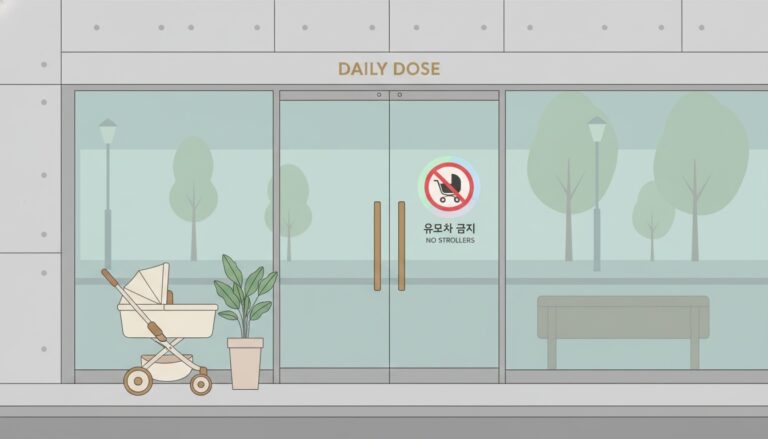
Have you ever tried to walk into a trendy cafe in Seoul, stroller in hand, only to be stopped by a sign on the door? Or maybe you’ve seen a group of mothers pushing strollers together and heard locals whisper about the ‘Exodus of the Strollers’?
Korea’s parenting culture is intense, and the concept of ‘No-Kids Zones’ (노키즈존) is a hot debate. As an intermediate (B2) learner, you need to go beyond just ordering coffee. You need to understand the social signs (literally and figuratively) around you. Knowing these expressions won’t just save you from an awkward rejection at the door; it will help you understand the nunchi (social sensing) required in Korean public spaces.
Today, we aren’t just learning words; we are learning how to navigate Korean society’s delicate balance between business rights and parenting struggles.
Phase 2: Deep Dive into Key Expressions
Here are the three heavy-hitters you’ll see on signs or hear in serious conversations.
1. 노키즈존 (No-Kids Zone)
- Pronunciation: No-Ki-Jeu-Jon [Think: “No keys?” + Zone]
- Meaning: An establishment (cafe, restaurant) where children (usually under 13) are not allowed.
- Editor’s Insight: This is a ‘Konglish’ term that has become official vocabulary. You will see this printed on glass doors. It’s not just a rule; it’s a statement about the atmosphere the owner wants to keep (quiet, adult-focused).
- Situation Check: Used in casual conversation or written on signs.
2. 출입이 제한되다 (Entry is restricted)
- Pronunciation: Chul-ib-ee Je-han-dwe-da
- Meaning: Entry is limited/restricted.
- Editor’s Insight: This is a B2 level passive verb. Instead of saying “Don’t come in” (too direct), signs use this to sound objective and formal. It removes the personal feeling from the rejection.
- Situation Check: Very Formal (Written on signs or spoken by staff explaining policy).
3. 양해를 구하다 (To ask for understanding)
- Pronunciation: Yang-hae-reul Gu-ha-da
- Meaning: To ask for someone’s understanding (apologetically).
- Editor’s Insight: If a staff member stops you from entering a No-Kids Zone, they will 100% use the word ‘양해’ (understanding). It is the polite buffer used in Korea when inconveniencing someone.
- Situation Check: Formal/Polite situations.
Phase 3: Textbook vs. Real Life
Let’s compare how a textbook teaches ‘prohibition’ versus how it actually appears in Hongdae or Gangnam.
| Textbook Korean (Grammatically correct but stiff) | Real Korean (What you see on the door) |
|---|---|
| 아이들은 들어올 수 없습니다. (Children cannot enter.) | 13세 이하 어린이의 출입을 제한합니다. (Entry restricted for children under 13.) |
| 조용히 해 주세요. (Please be quiet.) | 정숙한 분위기를 위해 협조 부탁드립니다. (We ask for your cooperation for a quiet atmosphere.) |
| 유모차는 안 돼요. (No strollers.) | 유모차는 입구에 보관해 주세요. (Please keep strollers at the entrance.) |
Editor’s Note: Notice the use of ‘협조’ (cooperation) and ‘보관’ (storage/keeping). Korean notices use highly formal Sino-Korean words to sound professional, not rude.
Phase 4: Cultural Context & Manners
The ‘Nunchi’ of the Stroller Brigade
In Korea, groups of mothers meeting up are sometimes jokingly (or cynically) called the 유모차 부대 (Stroller Brigade). While parenting is respected, there is a strong cultural expectation of 남에게 피해주지 않기 (Not causing inconvenience to others).
If you enter a cafe that allows kids (Yes-Kids Zone), the unwritten rule is strict:
1. Video Volume: Do not let kids watch YouTube without headphones.
2. Diapers: Changing diapers on a cafe table is a massive social taboo and arguably the trigger for the rise of No-Kids Zones.
3. Apology First: If your child cries, looking apologetic (bowing slightly) calms the tension immediately. If you ignore the noise, the nunchi in the room will turn icy.
Phase 5: Real-Life Roleplay
Scenario: A foreigner (Alex) tries to enter a quiet cafe with a stroller. The staff stops them.
(Alex pushes the door open, but the staff approaches quickly with a worried face.)
- Staff: 손님, 죄송하지만 저희 매장은 노키즈존으로 운영되고 있습니다.
- (Sir/Ma’am, I’m sorry, but our store is operated as a No-Kids Zone.)
- Alex: 아, 몰랐어요. 유모차만 밖에 두면 괜찮나요?
- (Ah, I didn’t know. Is it okay if I just leave the stroller outside?)
- Staff: 죄송합니다. 13세 미만은 출입이 제한되어서요. 양해 부탁드립니다.
- (I apologize. Entry is restricted for those under 13. We ask for your understanding.)
- Alex: 그렇군요. 알겠습니다. 다른 곳으로 갈게요.
- (I see. Understood. We’ll go somewhere else.)
Acting Tip: When the staff says “죄송합니다” (Sorry), they aren’t admitting guilt; they are softening the rejection. You should nod slightly to show you understand their policy, rather than arguing.
Phase 6: 10-Second Shadowing Drill
Let’s practice the sentence you will see on the sign. Read it with a polite, informative tone.
“To ensure a quiet atmosphere, entry for children is restricted.”
정숙한 분위기를 위해 / 어린이의 출입이 / 제한됩니다.
[Jeong-suk-han bun-wi-gi-reul wi-hae / eo-ri-ni-e chul-ib-ee / je-han-doem-ni-da]
- Focus Point: Pause after ‘wi-hae’ (for the sake of). Don’t rush the word ‘je-han’ (restricted).
Phase 7: FAQ & Troubleshooting
- Q: Is it legal to ban kids? Isn’t that discrimination?
- A: In Korea, it is currently legal. Business owners claim the right to control their business environment (
Frequently Asked Questions (FAQ)
Q: What does "노키즈존 (No-Kids Zone)" mean in Korean and how do you pronounce it?
A: In Korean, "노키즈존 (No-Kids Zone)" is pronounced [No-Ki-Jeu-Jon [Think: "No keys?" + Zone] and means: An establishment (cafe, restaurant) where children (usually under 13) are not allowed.
Q: What does "출입이 제한되다 (Entry is restricted)" mean in Korean and how do you pronounce it?
A: In Korean, "출입이 제한되다 (Entry is restricted)" is pronounced [Chul-ib-ee Je-han-dwe-da] and means: Entry is limited/restricted.
Q: What does "양해를 구하다 (To ask for understanding)" mean in Korean and how do you pronounce it?
A: In Korean, "양해를 구하다 (To ask for understanding)" is pronounced [Yang-hae-reul Gu-ha-da] and means: To ask for someone's understanding (apologetically).







