

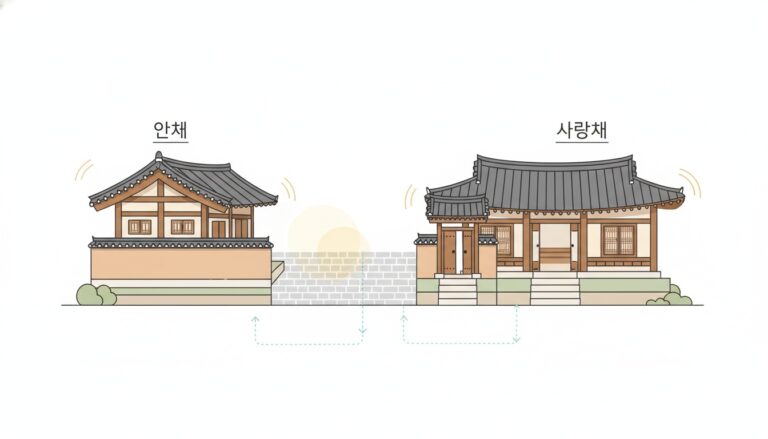
Secret Spaces of Hanok: Why You Can’t Just Walk Into ‘Anchae’ 🏠
1. Introduction: Hello, it’s Daily Hangul!
Have you ever watched a historical K-Drama (Sageuk) and wondered why the male lead waits outside while the female lead is hidden away? Or perhaps you are planning a trip to a Hanok village in Bukchon or Jeonju?
Today, we are diving into the architecture of silence and space in Korea: Hanok (Traditional Korean House). specifically the deep cultural difference between the Anchae (Inner Quarters) and the Sarangchae (Guest Quarters).
📝 Synthetic Case (Based on Student Patterns)
Many of our students visiting Hanok guesthouses often make a funny mistake. They assume the biggest room in the center is for everyone. However, historically, entering the Anchae without an invitation was a huge social taboo!
Why textbooks aren’t enough:
Dictionaries simply define these as “women’s room” and “men’s room.” But in reality, these terms hold the secrets of Korean privacy, hierarchy, and hospitality (Jeong). Understanding this helps you decipher K-Dramas and behave politely during your Hanok stay.
2. Summary at a Glance
- Today’s Expressions: Anchae, Sarangchae, Sonnim (Guest).
- Safe Usage: Essential for Hanok stays, historical tours, or discussing architecture.
- Level (C1 Focus): While the words are nouns, understanding the cultural separation is advanced contextual knowledge.
3. Table of Contents
- Deep Dive: Anchae, Sarangchae, Sonnim
- Textbook vs. Real Life: Historical Taboo vs. Modern Cafe
- Unique Analysis: The “Privacy” Thermometer
- Role Play: Checking into a Hanok Guesthouse
- Shadowing Challenge
- FAQ & Wrap-up
4. Today’s Key Expressions Deep Dive
1) Anchae (안채 / Anchae)
- Meaning: Inner quarters / The main building (historically for women)
- Usage & Register:
- Used when referring to the most private part of the house.
- Politeness: Noun, neutral.
- Tutor’s Secret Note:
- The syllable An (안) means “Inside.” Think of it as the heart of the home. In the past, this was the domain of the mother/wife. Even the husband had to ask before entering freely!
- Warning: In a modern guesthouse, if a door says “Staff Only” or looks like a private residence, it’s likely the Anchae logic applying. Don’t barge in!
- Pronunciation Clinic:
- Make sure not to drag the ‘n’ in An. It’s short.
- Chae sounds like the ‘cha’ in “Change” but with an ‘eh’ sound.
- Examples:
- Travel: 조식은 안채에서 드실 수 있어요. (Josigeun anchaeseo deusil su isseoyo.) – You can have breakfast in the inner quarters.
- Culture: 옛날에는 남자들이 안채에 들어갈 수 없었어요. (Yennareneun namjadeuri anchaee deureogal su eopseosseoyo.) – In the past, men could not enter the inner quarters.
- Drama: 어머니는 안채에 계십니다. (Eomeonineun anchaee gyesimnida.) – Mother is in the inner quarters.
2) Sarangchae (사랑채 / Sarangchae)
- Meaning: Outer quarters / Guest quarters (historically for men)
- Usage & Register:
- Space for study, drinking tea, and receiving guests.
- Tutor’s Secret Note:
- Don’t be confused by the word Sarang (Love). While it sounds the same, the Hanja origin is different. However, you can use it as a mnemonic: “I love to meet my guests here!”
- This is the public face of the house.
- Pronunciation Clinic:
- Sa-rang requires a light ‘r’ sound (like a flap ‘t’ in water), not a hard American ‘R’.
- Examples:
- Travel: 체크인은 사랑채에서 도와드릴게요. (Chekeuineun sarangchaeseo dowadeurilgeyo.) – I will help you with check-in at the guest quarters.
- History: 아버지는 사랑채에서 손님을 맞이하셨어요. (Abeojineun sarangchaeseo sonnimeul majihasyeosseoyo.) – Father welcomed guests in the outer quarters.
- Casual: 사랑채가 참 멋지네요. (Sarangchaega cham meotjineyo.) – The guest quarters are really cool.
3) Sonnim (손님 / Sonnim)
- Meaning: Guest / Customer
- Usage & Register:
- Used everywhere: shops, hotels, and homes. Highly polite.
- Tutor’s Secret Note:
- Koreans treat Sonnim with high respect. In a Hanok context, a Sonnim stays in the Sarangchae.
- Pronunciation Clinic:
- Assimilation: It is written as
Son-nimbut due to the double ‘n’, pronounce it firmly as [Son-nim].
- Assimilation: It is written as
- Examples:
- Business: 손님, 무엇을 도와드릴까요? (Sonnim, mueoseul dowadeurilkkayo?) – Guest/Customer, how may I help you?
- House: 오늘 중요한 손님이 오셔요. (Oneul jungyo-han sonnimi osyeoyo.) – An important guest is coming today.
- Travel: 외국인 손님들이 많아요. (Oegugin sonnimdeuri manayo.) – There are many foreign guests.
🎲 Mini Quiz (Click to see answer)
Q. Fill in the blank:
“Historically, the ____ was the private space for women and the family’s inner circle.”
Answer: Anchae (안채)
5. Textbook vs. Real Korean (Context Comparison)
| Context | Textbook Definition | Real Life / Modern Hanok Stay |
|---|---|---|
| Anchae | Women’s Quarters (Strictly private) | Reception / Breakfast Area / Host’s Private Room. Often the most beautiful spot for photos. |
| Sarangchae | Men’s Quarters (Scholar’s room) | Guest Rooms / Cafe Area. Where you actually sleep or drink coffee. |
| Interaction | Strict separation (Nae-oe) | Open flow. You can walk between them freely in most modern renovations. |
Tip: In a modern Hanok cafe, if you ask “Where is the Sarangchae?”, you sound very knowledgeable about the architecture, rather than just asking “Where are the seats?”
6. Unique Analysis: The “Privacy” Thermometer 🌡️
How much distance should you keep? Understanding the architecture helps you understand Korean Mindset.
- Level 1 (The Gate – Daemun): Total stranger. Delivery packages are left here.
- Level 3 (Sarangchae/Yard): Acquaintance or Guest. You are welcomed, given tea, but you are not “family” yet. You stay in the outer zone.
- Level 5 (Anchae/Room): Family or Closest Friends. If a Korean friend invites you into their Anbang (Inner room/Master bedroom) or the deep part of the house, you are considered “one of us.”
7. Real-Life Role Play: Checking into a Hanok Stay
Situation: Arrival at a traditional guesthouse in Bukchon.
Characters: Tourist (Jane), Host (Manager Kim)
Manager Kim: 안녕하세요, 손님! 예약하셨나요?
(Annyeonghaseyo, sonnim! Yeyak-hasyeonnayo?)
Hello, guest! Did you have a reservation?
Jane: 네, 제인이라고 해요. 이 건물 참 예쁘네요. 여기가 안채인가요?
(Ne, Jane-irago haeyo. I geonmul cham yeppeuneyo. Yeogiga anchae-ingayo?)
Yes, I’m Jane. This building is beautiful. Is this the Anchae?
Manager Kim: 아, 여기는 사랑채예요. 손님들이 머무시는 곳이죠.
(A, yeogineun sarangchae-yeyo. Sonnimdeuri meomusineun gosijyo.)
Ah, this is the Sarangchae. It’s where the guests stay.
Jane: 아, 그렇군요! 그럼 조식은 어디서 먹나요?
(A, geureokunyo! Geureom josigeun eodiseo meongnayo?)
Ah, I see! Then where do we eat breakfast?
Manager Kim: 조식은 내일 아침에 저쪽 안채 마루에서 드려요.
(Josigeun naeil achime jeojjok anchae marueseo deuryeoyo.)
Breakfast will be served tomorrow morning at the Anchae Maru (wooden floor) over there.
Culture Tip: Notice the Manager uses polite honorifics (-siyo / -yeyo). Even if the building is old, the service language is modern and polite.
8. Shadowing Challenge 🗣️
Read this aloud 3 times to practice the flow of Korean architecture terms.
Script:
“한옥은 안채와 사랑채로 나뉘어 있어요. 안채는 가족을 위한 따뜻한 공간이에요.”
Romanization:
“Hanogeun anchaewa sarangchaero nanwieo isseoyo. Anchaeneun gajogeul wihan ttatteutan gongganieyo.”
Meaning:
“Hanok is divided into Anchae and Sarangchae. Anchae is a warm space for the family.”
✅ Checkpoint:
* [ ] Did you pronounce ‘Anchae’ without dragging the ‘n’?
* [ ] Did you pronounce ‘Sarangchae’ softly?
* [ ] Did you pause slightly after ‘Hanogeun’?
9. FAQ (Frequently Asked Questions)
Q1: Do modern Koreans still live in Anchae and Sarangchae?
A: Most Koreans live in apartments (Apateu) now. However, people who live in preserved Hanok villages still use these terms to describe the layout of their homes.
* Ex: 우리 집은 사랑채를 개조해서 카페로 쓰고 있어요. (We renovated the Sarangchae and use it as a cafe.)
Q2: Can I use the word ‘Anchae’ in an apartment?
A: Rarely. For apartments, we use Anbang (안방) to refer to the master bedroom. It comes from the same root An (Inside).
10. Wrap-up & Mission
Today we explored the hidden hierarchy of Hanok architecture. Remember: Anchae is for privacy/family, Sarangchae is for guests/socializing.
🚀 Today’s Mission:
Go to Google Images or Instagram and search for “#Hanokstay” or “#한옥스테이”. Try to guess which building is the Anchae and which is the Sarangchae based on the layout!
💬 Comment Question:
If you had a Hanok, would you prefer spending time in the quiet Anchae or the social Sarangchae? Let me know below!
🏆 Final Quiz
- Which space was historically for men and guests?
a) Anchae
b) Sarangchae
c) Kitchen -
What does ‘Sonnim’ mean?
a) Family
b) Owner
c) Guest -
Fill in the blank: The master bedroom in a modern apartment is called ____.
Answers: 1. (b), 2. (c), 3. Anbang (안방)
Frequently Asked Questions (FAQ)
Q: What does "Sarangchae (사랑채 / Sarangchae)" mean in Korean and how do you pronounce it?
A: In Korean, "Sarangchae (사랑채 / Sarangchae)" is pronounced [see lesson guide] and means: Outer quarters / Guest quarters (historically for men)
Q: What does "Sonnim (손님 / Sonnim)" mean in Korean and how do you pronounce it?
A: In Korean, "Sonnim (손님 / Sonnim)" is pronounced [see lesson guide] and means: Guest / Customer






