

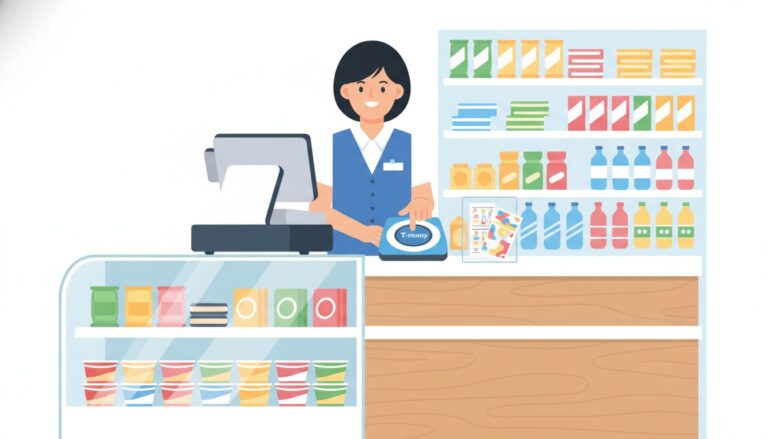
Mastering Korean Convenience Stores: Recharging T-money & Buying Lotto like a Local!
Introduction
“Please place your card again.”
Have you ever heard this dreaded beep at a subway turnstile in Seoul during rush hour? It means your T-money card is out of balance. Panic sets in as commuters rush behind you. But don’t worry! There is almost always a convenience store (GS25, CU, 7-Eleven) right near the station exit.
Hello, this is Daily Hangul!
Today, we are going to master the art of surviving in a Korean convenience store (Pyeonuijeom), specifically for two very common tasks: recharging your transport card and trying your luck with the lottery.
Synthetic Case Study:
Based on feedback from many of our students, a common mistake foreigners make is holding out a credit card to recharge their T-money card. The clerk says “No card,” and the student freezes, not understanding why or what to do next. Today, we will fix that awkward silence and help you navigate these transactions like a local.
Textbooks often teach you full sentences like “I would like to recharge my card,” but in a busy Seoul convenience store, speed is key. We need to learn the “fast track” Korean.
Summary at a Glance
- Today’s Expressions: Recharging phrases, Cash-only rules, Buying lottery tickets.
- When to use: Anytime at a convenience store (GS25, CU, 7-Eleven, Emart24).
- Difficulty: B1 (Intermediate) – Essential for daily life.
Why B1? While the grammar is simple, understanding the cultural rule (Cash vs. Card) and the rapid speed of clerks requires intermediate listening skills.
Table of Contents
- Deep Dive: Key Expressions
- Textbook vs. Real Korean
- Analysis: The “Cash Only” Rule
- Real-Life Role Play
- Shadowing Challenge
- FAQ
- Final Quiz
Deep Dive: Key Expressions
1. 교통카드 충전해 주세요
(Gyotong-kadeu chungjeon-hae juseyo)
- Meaning: Please recharge my transport card.
- Usage & Register:
- To: Convenience store part-timer (Alba).
- Tone: Polite (Haeyo-che).
- Tutor’s Secret Note:
- You don’t always need to say “Gyotong-kadeu” (Transport card). If you just place your card on the counter and say “Chungjeon-hae juseyo” (Please recharge), they will understand 100%.
- Warning: Do not just throw the card. Place it on the designated pad (usually near the register screen).
- Pronunciation Clinic:
- Chungjeon [충전]: Make sure to pronounce the ‘j’ clearly. It is not ‘chun-cheon’.
- Examples:
- 만 원 충전해 주세요. (Man won chungjeon-hae juseyo) – Please recharge 10,000 won.
- 이거 충전 돼요? (Igeo chungjeon dwaeyo?) – Can I recharge this? (Checking if a card works)
- 교통카드 충전이죠? (Gyotong-kadeu chungjeon-ijyo?) – It’s a transport card recharge, right? (Clerk asking)
2. 현금만 돼요?
(Hyeongeum-man dwaeyo?)
- Meaning: Is it cash only? / Can I only use cash?
- Usage & Register:
- To: Clerk, when you are unsure about payment methods.
- Tone: Polite question.
- Tutor’s Secret Note:
- In Korea, T-money recharge and Lottery (Lotto) are almost exclusively cash-only at convenience stores. Asking this shows you understand the culture but just want to confirm.
- Pronunciation Clinic:
- Hyeongeum [현금]: The ‘H’ is soft. ‘Geum’ sounds like ‘gum’ in English.
- Examples:
- 카드 안 돼요? (Kadeu an dwaeyo?) – Does card not work?
- 여기 현금 있어요. (Yeogi hyeongeum isseoyo.) – Here is cash.
- 현금영수증 해 주세요. (Hyeongeum-yeongsujeung hae juseyo.) – Please give me a cash receipt.
3. 로또 자동 오천 원어치 주세요
(Lotto jadong o-cheon won-eochi juseyo)
- Meaning: Please give me 5,000 won worth of automatic Lotto numbers.
- Usage & Register:
- To: Clerk selling lottery tickets.
- Tone: Standard polite request.
- Tutor’s Secret Note:
- “Jadong” (Automatic) means the machine picks the numbers. “Sudong” (Manual) means you marked the paper yourself. 5,000 won is a common amount (5 games).
- Pronunciation Clinic:
- Won-eochi [원어치]: Due to linking (Liaison), it sounds like [Wo-neo-chi].
- Examples:
- 로또 만 원어치 주세요. (Lotto man won-eochi juseyo.) – Please give me 10,000 won worth of Lotto.
- 자동으로 주세요. (Jadong-euro juseyo.) – Please give me automatic (picks).
- 스피또 있어요? (Seupitto isseoyo?) – Do you have Spitto? (Scratch-off lottery)
Alternative Expressions
- More Casual (Short): 만 원이요. (Man won-iyo.) – 10,000 won, please. (Used when placing the card).
- More Formal: 충전 부탁드립니다. (Chungjeon butak-deurimnida.) – I request a recharge. (A bit too formal for a busy store).
Mini Quiz (Click to see answer)
Fill in the blank: To ask for a recharge, you say “_______해 주세요.”
Answer: 충전 (Chungjeon)
Textbook vs. Real Korean
| Context | Textbook Korean (Book) | Real Korean (Street) |
|---|---|---|
| Asking to recharge | 교통카드를 충전하고 싶습니다. (Gyotong-kadeureul chungjeonhago sipseumnida) |
충전해 주세요. (Chungjeon-hae juseyo) |
| Specifying Amount | 만 원을 충전해 주시겠습니까? (Man woneul chungjeonhae jusigesseumnika?) |
만 원이요. (Man won-iyo) |
Situation Checklist:
* Use Real Korean: During rush hour (8-9 AM, 6-7 PM) or when there is a line behind you.
* Use Textbook Korean: Never. It sounds like you are reading a script in a historical drama.
Analysis: The “Cash Only” Rule (Must Know!)
Why do clerks get annoyed when you hand over a credit card for T-money?
| Item | Payment Method | Reason |
|---|---|---|
| Snacks / Drinks | Card or Cash | Normal merchandise |
| T-money Recharge | CASH ONLY | The store makes almost 0% profit on recharges; card fees would mean a loss. |
| Lottery (Lotto) | CASH ONLY | By Korean law, lottery cannot be bought with credit cards to prevent debt gambling. |
Ouch Point: If you hand a credit card for T-money, the clerk might say “현금만 가능하세요” (Hyeongeum-man ganeung-haseyo). Don’t take it personally!
Real-Life Role Play
Scenario: Hongik Univ. Station, GS25. 11:00 PM on a Friday. You need to get home, but your card is empty.
You: (Places card on the pad) 저기요, 충전해 주세요.
(Jeogiyo, chungjeon-hae juseyo.)
Excuse me, please recharge this.
Clerk: 얼마 해 드릴까요?
(Eolma hae deurilkkayo?)
How much should I do for you?
You: 만 원이요. 아, 카드는 안 되죠?
(Man won-iyo. Ah, kadeu-neun an dwejyo?)
10,000 won. Ah, cards don’t work, right?
Clerk: 네, 교통카드는 현금만 돼요.
(Ne, gyotong-kadeu-neun hyeongeum-man dwaeyo.)
Yes, transport cards are cash only.
You: (Hands over cash) 여기 만 원 있습니다.
(Yeogi man won isseumnida.)
Here is 10,000 won.
Clerk: 충전 되셨습니다.
(Chungjeon dwoe-syeot-seumnida.)
Recharge is done.
Culture Tip: Notice the clerk says “충전 되셨습니다” (Recharge is done [honorific]). This is grammatically incorrect (honoring the recharge, not the person), but it is very common service industry language in Korea.
Shadowing / Speaking Challenge
Let’s practice the most useful phrase. Listen to the rhythm!
Script: 만 원 충전해 주세요. (Man won chungjeon-hae juseyo)
- Slow: Man… won… chung-jeon-hae… ju-se-yo.
- Normal: Manwon chungjeonhae juseyo.
- Speedy: Manwon chungjeonyo! (Short version)
Checklist:
* [ ] Said it aloud 3 times?
* [ ] Did you link the sound in ‘Man-won’? (Sounds like Ma-nwon).
FAQ (Frequently Asked Questions)
Q1: Can I really not use a credit card for T-money anywhere?
A: At convenience stores, no. However, inside the subway stations, the ticket machines accept cash only as well. Some very new machines accept cards, but 99% of the time, cash is king for transport.
Q2: What is “Spitto”? I see it at the counter.
A: Spitto (스피또) is a scratch-off lottery ticket. You can buy it and scratch it instantly.
* Example: 스피또 두 장 주세요. (Seupitto du jang juseyo.) – Give me two Spitto tickets.
Q3: Can I withdraw cash at the convenience store to pay?
A: Yes! Look for the “Global ATM.” Most convenience stores have ATMs that accept foreign cards (Visa/Master). Withdraw cash, then pay the clerk.
Conclusion & Action Item
Today we learned that “Chungjeon” (Recharge) is your best friend, and Cash is essential for transport cards and lottery tickets.
Today’s Mission:
Next time you pass a convenience store, go in with 1,000 won cash and practice saying: “천 원만 충전해 주세요” (Please recharge just 1,000 won). Even a small amount is great practice!
Question for you: Have you ever won the lottery in your home country? Tell us in the comments!
Final Quiz
1. Which item can you usually buy with a credit card?
A) T-money Recharge
B) Lotto (Lottery)
C) Banana Milk
D) Spitto
2. What does “Jadong” (자동) mean when buying Lotto?
A) Manual pick
B) Automatic pick
C) Cancel
D) Winner
3. Fill in the blank: “_______해 주세요” (Please recharge).
A) 환불 (Hwanbul)
B) 충전 (Chungjeon)
C) 계산 (Gyesan)
Click to see answers
1. C) Banana Milk (Recharge and Lottery are cash only!)
2. B) Automatic pick
3. B) 충전 (Chungjeon)
Frequently Asked Questions (FAQ)
Q: What does ""현금만 가능하세요"" mean in Korean and how do you pronounce it?
A: In Korean, ""현금만 가능하세요"" is pronounced [Hyeongeum-man ganeung-haseyo] and means: . Don't take it personally!







