

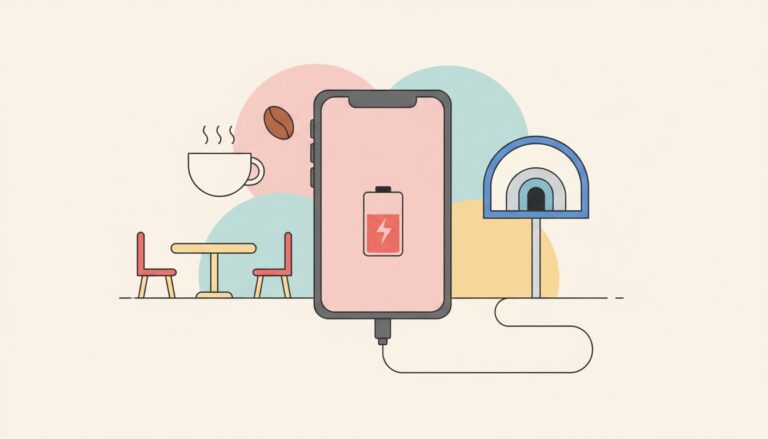
0% Battery in Seoul? How to Find Free Charging Spots Like a Local
Introduction
“Hello, this is Daily Hangul!”
Imagine this scenario: You are traveling in Seoul, relying on Naver Map to find a hidden restaurant in a maze-like alley. Suddenly, your screen dims, and the dreaded “Low Battery” notification pops up. You didn’t bring your portable charger. Panic sets in.
Synthetic Case (Based on multiple learner experiences):
Many of our students have shared similar stories. They walked into a cafe and simply said, “Charge, please?” or gestured at their phone. While helpful Koreans understood the context, the learners felt embarrassed and couldn’t ask specifically for a wall outlet versus a cable, or didn’t know about the paid rental services available in convenience stores.
Textbooks often teach formal requests like “Can I use electricity?” which sounds unnatural. Today, we will learn the survival Korean needed to keep your phone alive in cafes, subways, and convenience stores.
Summary at a Glance
- Key Expressions: Asking for a charger, finding an outlet, renting a power bank.
- Safe to Use: Cafes, Restaurants, Convenience Stores, Subway Stations.
- Level (B1): Essential for survival because losing navigation tools in a foreign country is an emergency.
Table of Contents
- Today’s Deep Dive: 3 Essential Expressions
- Textbook vs. Real Korean
- Analysis: The “Outlet” Culture in Korea
- Real-Life Role Play: At a Cafe
- Shadowing Challenge
- FAQ
Today’s Core Expressions Deep Dive
1. 충전기 있어요? (Chungjeon-gi isseoyo?)
Meaning: Do you have a charger?
Usage & Register:
* To whom: Staff at a restaurant or cafe.
* Tone: Polite informal (Haeyo-che / 해요체). This is the standard polite tone.
Tutor’s Secret Note:
In many Korean restaurants (especially BBQ places), asking this doesn’t mean “Give me a cable to my table.” It usually means, “Can I hand you my phone to charge behind the counter?” Don’t be surprised if they hold out their hand for your phone!
* Warning: Do not say “Chungjeon-gi isseo?” (dropping ‘yo’) to staff. It sounds rude.
Pronunciation Clinic:
* Chung (충): Make a strong ‘ch’ sound. The ‘u’ sounds like ‘oo’ in ‘book’, not ‘u’ in ‘up’.
* Jeon (전): Pronounce clearly.
Examples:
1. [Restaurant] 저기요, 아이폰 충전기 있어요? (Jeogiyo, a-i-pon chungjeon-gi isseoyo?)
Excuse me, do you have an iPhone charger?
2. [Cafe] 혹시 C타입 충전기 있어요? (Hoksi C-taip chungjeon-gi isseoyo?)
By any chance, do you have a C-type charger?
3. [Friend] 너 충전기 있어? (Neo chungjeon-gi isseo?)
Do you have a charger? (Casual)
Alternatives:
* More Formal: 충전기 있으세요? (Chungjeon-gi isseuseyo?)
* More Specific: 급속 충전기 있어요? (Geupsok chungjeon-gi isseoyo? – Do you have a fast charger?)
Mini Quiz (Click to see answer)
Fill in the blank: “Excuse me, do you have a charger?”
저기요, _______ 있어요?
Answer: 충전기 (chungjeon-gi)
2. 콘센트 어디에 있어요? (Konsenteu eodie isseoyo?)
Meaning: Where is the power outlet?
Usage & Register:
* To whom: Cafe staff or when looking around a public space.
* Tone: Polite informal (Haeyo-che / 해요체).
Tutor’s Secret Note:
This is a classic Konglish (Korean-English) moment. Koreans do not use the word “Outlet” or “Socket.” We use the German-derived word “Concent” (Kon-sen-teu). If you ask for an “outlet,” people might think you are looking for a shopping mall!
Pronunciation Clinic:
* Kon-sen-teu: Pronounce every syllable distinctly. Don’t blend it like “consent.”
Examples:
1. [Cafe] 콘센트 있는 자리 있어요? (Konsenteu inneun jari isseoyo?)
Are there any seats with outlets?
2. [Public Space] 여기 콘센트 써도 돼요? (Yeogi konsenteu sseodo dwaeyo?)
Can I use the outlet here?
3. [Train/KTX] 제 자리에 콘센트가 없어요. (Je jari-e konsenteu-ga eopseoyo.)
There is no outlet at my seat.
Alternatives:
* Casual: 여기 코드 꽂을 데 있어? (Yeogi kodeu kkojeul de isseo? – Is there a place to plug in a cord here?)
Mini Quiz (Click to see answer)
True or False: In Korea, you should ask for an “Outlet” to charge your phone.
Answer: False. You should ask for “Konsenteu” (콘센트).
3. 보조배터리 대여 돼요? (Bojo-baeteori daeyeo dwaeyo?)
Meaning: Can I rent a power bank?
Usage & Register:
* To whom: Convenience store staff (CU, GS25, 7-Eleven).
* Tone: Polite informal (Haeyo-che / 해요체).
Tutor’s Secret Note:
Recently, many convenience stores and subway stations have “Power Bank Rental Stations” (apps like ‘Chinggu’ etc.). You rent it via QR code and return it at another location. Knowing the word 대여 (daeyeo – rental) is crucial here.
Examples:
1. [Convenience Store] 여기 보조배터리 대여 돼요? (Yeogi bojo-baeteori daeyeo dwaeyo?)
Is power bank rental available here?
2. [Subway] 보조배터리 어디서 반납해요? (Bojo-baeteori eodiseo bannap-haeyo?)
Where do I return the power bank?
3. [General] 보조배터리 하나 살 수 있어요? (Bojo-baeteori hana sal su isseoyo?)
Can I buy a power bank?
Textbook vs. Real Korean
| Context | Textbook Korean (Book Korean) | Real Korean (Street Korean) |
|---|---|---|
| Asking to charge | 휴대전화 충전이 가능합니까? (Hyudaejeonhwa chungjeoni ganeunghamnikka?) |
저기 충전 좀 해주실 수 있어요? (Jeogi chungjeon jom haejusil su isseoyo?) |
| Looking for a plug | 전원 소켓이 어디입니까? (Jeonwon sokesi eodi-imnikka?) |
여기 콘센트 꽂아도 돼요? (Yeogi konsenteu kkojado dwaeyo?) |
Checklist:
* Textbook: Sounds like a robot or a formal news anchor. Use this only in very formal business meetings.
* Real Korean: Used in 99% of cafes, restaurants, and convenience stores. The verb 꽂다 (kkotda – to plug in) is very common.
Unique Analysis: The “Electricity” Culture Map
How freely can you use electricity in Korea? Here is a quick guide to avoid awkward stares.
| Place | Difficulty | Description |
|---|---|---|
| Starbucks / Franchise Cafes | ★☆☆☆☆ (Easy) | Very generous. Outlets are everywhere. You can stay for hours. |
| Independent / Hipster Cafes | ★★★☆☆ (Medium) | Some ban laptops or charging to ensure table turnover. Look for signs saying “No Notebook.”‘ |
| Restaurants | ★★☆☆☆ (Okay) | Usually no outlets near tables. Hand your phone to the staff at the counter. |
| Convenience Stores | ★★★★★ (Hard) | You generally cannot plug into their wall outlets. Use the Rental Service or buy a battery. |
| KTX (High-speed Train) | ★☆☆☆☆ (Easy) | Outlets are usually under the armrest or below the window. |
Real-Life Scenario: Role Play
Situation: You are at a busy cafe in Hongdae. Your battery is at 5%.
Characters:
* A: You (Learner)
* B: Cafe Staff
Dialogue:
A: 저기요, 주문하기 전에 물어볼 게 있는데요.
(Jeogiyo, jumunhagi jeone mureobol ge inneundeyo.)
Excuse me, I have a question before I order.
B: 네, 말씀하세요.
(Ne, malsseumhaseyo.)
Yes, go ahead.
A: 혹시 여기 콘센트 있는 자리 있어요?
(Hoksi yeogi konsenteu inneun jari isseoyo?)
By any chance, are there seats with outlets?
B: 네, 창가 쪽 자리에 콘센트 있어요.
(Ne, changga jjok jari-e konsenteu isseoyo.)
Yes, there are outlets at the window seats.
A: 감사합니다. 그리고 혹시 충전기 빌려주실 수 있나요?
(Gamsahamnida. Geurigo hoksi chungjeon-gi billyeojusil su innayo?)
Thank you. And also, could you lend me a charger?
B: 죄송해요. 충전기는 따로 없어요.
(Joesonghaeyo. Chungjeon-gineun ttaro eopseoyo.)
I’m sorry. We don’t have chargers [to lend].
Role Play Tip:
Even if there are outlets (Konsenteu), cafes don’t always provide the cable (Chungjeon-gi). Always carry your cable!
Shadowing Challenge (Speaking Practice)
Let’s practice the most urgent sentence. Repeat this 3 times.
“My battery is dead. Can I charge it here?”
배터리가 다 됐어요. 여기서 충전해도 돼요?
(Baeteori-ga da dwaesseoyo. Yeogiseo chungjeon-haedo dwaeyo?)
- [ ] Attempt 1 (Slowly)
- [ ] Attempt 2 (Natural Speed)
- [ ] Attempt 3 (With emotion – imagine you are panicked!)
Pronunciation Focus:
Link the sounds in 충전해도 (Chungjeon-haedo). It often flows like [Chung-jeon-nae-do] in fast speech.
FAQ (Frequently Asked Questions)
Q1: Can I charge my phone on the subway trains?
A: Mostly no. Some newer trains have wireless charging spots for pregnant women or seats with USB ports, but it’s not guaranteed. It’s safer to use the Power Bank Rental machines located inside the station, not on the train.
Q2: Do I need an adapter in Korea?
A: Yes! Korea uses Type C and F plugs (two round pins, 220V). If you ask for an “adapter” at a hotel front desk, say 변환 어댑터 (byeonhwan eodaepteo) or simply 돼지코 (dwaejiko – pig nose), which is a cute slang for the plug shape!
Q3: Is it rude to charge my phone at a restaurant?
A: Not at all. It is very common culturally. Just say: 충전 좀 부탁드려요 (Chungjeon jom butakdeuryeoyo – Please charge this for me).
Conclusion & Action Item
Today we learned how to survive a “Low Battery” crisis in Korea by asking for 충전기 (charger), finding a 콘센트 (outlet), and understanding the rental options.
Today’s Mission:
Next time you visit a cafe (even in your home country), pretend to ask the staff in Korean: “Konsenteu eodie isseoyo?” Visualize the situation so it comes out naturally when you land in Seoul.
Question for you:
Have you ever run out of battery while traveling? How did you solve it? Tell me in the comments!
Final Quiz
1. What is the Korean word for “Power Outlet”?
A) 아울렛 (Outlet)
B) 콘센트 (Konsenteu)
C) 소켓 (Socket)
Correct Answer: B
2. Which place typically DOES NOT allow you to plug into wall outlets?
A) Starbucks
B) KTX Train
C) Convenience Store (GS25, CU)
Correct Answer: C (You should use rental services there)
3. Fill in the blank: “Do you have a charger?” = _________ 있어요?
Correct Answer: 충전기 (Chungjeon-gi)
Frequently Asked Questions (FAQ)
Q: What does "대여" mean in Korean and how do you pronounce it?
A: In Korean, "대여" is pronounced [daeyeo - rental] and means: is crucial here.
Q: What does "꽂다" mean in Korean and how do you pronounce it?
A: In Korean, "꽂다" is pronounced [kkotda - to plug in] and means: is very common.
Q: What does "충전해도" mean in Korean and how do you pronounce it?
A: In Korean, "충전해도" is pronounced [Chungjeon-haedo] and means: . It often flows like
Q: What does "변환 어댑터" mean in Korean and how do you pronounce it?
A: In Korean, "변환 어댑터" is pronounced [byeonhwan eodaepteo] and means: or simply







