

Hello, this is Daily Hangul!
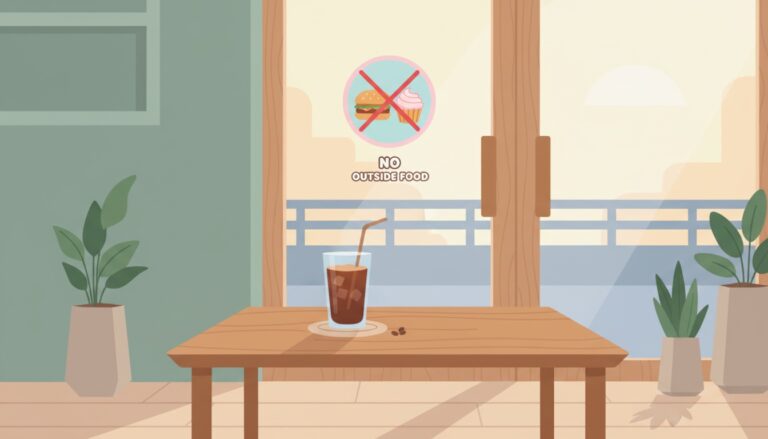
Have you ever walked into a trendy cafe in Seoul, holding a bubble tea from a different shop, only to feel the staff’s eyes burning into you? Or perhaps you bought a delicious street food snack and wanted to sit in a warm cafe to eat it with your coffee?
This is a classic “foreigner mistake” in Korea. Today, we are going to talk about the “No Outside Food” rule.
📖 The Story: “Sarah’s Bagel Incident”
(Note: This is a synthetic example based on common mistakes observed among our students.)
Sarah, an exchange student, bought a famous bagel in Anguk-dong. Since the bagel shop had no seats, she went to a nearby coffee shop, ordered an iced Americano, and started unwrapping her bagel. Immediately, a staff member approached her with an ‘X’ gesture. Sarah didn’t understand the rapid Korean and just froze. The atmosphere became awkward instantly.
Why isn’t a textbook enough here? Textbooks teach you how to order coffee, but they rarely teach you how to apologize for breaking unwritten rules or how to ask for permission delicately. In Korea, nunchi (eye measure/sense) is everything. Let’s learn how to handle this like a local.
📝 At a Glance
Today’s Key Expressions:
1. 외부 음식 반입 금지 (The sign you must recognize)
2. 혹시 이거 먹어도 되나요? (Asking for permission)
3. 죄송합니다, 바로 집어넣을게요. (Apologizing and fixing the mistake)
- Safe Zone: Use these phrases at any cafe, from Starbucks to small indie shops.
- Level: B1 (Intermediate) – While the words are simple, the social awareness required is intermediate level.
📚 Table of Contents
- Today’s Core Expressions: Deep Dive
- Textbook vs. Real Korean: The Birthday Cake Exception
- Culture Analysis: The “Trash” Etiquette
- Real-Life Role Play: At a Cafe in Hongdae
- Shadowing Challenge
- FAQ & Quiz
💡 Today’s Core Expressions: Deep Dive
1. 외부 음식 반입 금지 (Oebu eomsik banip geumji)
- Meaning: No outside food allowed (Literal: Outside food bringing-in prohibition)
- Usage & Register: Written language. You will see this on signs or stickers on the door.
- Tutor’s Secret Note: If you see this sign, don’t try to sneak food in. Korean cafe owners are sensitive about this because of trash issues and smell.
- Pronunciation Clinic: Be careful with [banip]. It is often pronounced smoothly as [banip], but make sure to close your lips tight on the ‘p’ (ㅂ).
Examples:
1. 문 앞에 ‘외부 음식 반입 금지’라고 써 있어요. (Mun ape ‘oebu eomsik banip geumji’-rago sseo isseoyo.) – It says ‘No outside food allowed’ on the door.
2. 여기는 외부 음식 반입 금지 구역입니다. (Yeogineun oebu eomsik banip geumji guyeokimnida.) – This is a no outside food zone.
3. 외부 음식 반입 금지인가요? (Oebu eomsik banip geumji-ingayo?) – Is outside food prohibited?
2. 혹시 이거 먹어도 되나요? (Hoksi igeo meogeodo doenayo?)
- Meaning: By any chance, can I eat this? (Polite request)
- Usage & Register: To staff or owner. Uses ‘Hoksi’ (by any chance) to soften the question.
- Tutor’s Secret Note: Use this ONLY for small items like a piece of chocolate or maybe a birthday cake (just for photos). Do not use this for a burger or kimchi stew!
- Warning: If you ask this while holding a smelly food item, the answer will be a firm “No.”
Examples:
1. 혹시 케이크 먹어도 되나요? (Hoksi keikeu meogeodo doenayo?) – Can we eat the cake by any chance?
2. 혹시 아기 이유식 먹여도 되나요? (Hoksi agi iyusik meogyeodo doenayo?) – Can I feed my baby baby food?
3. 사장님, 혹시 과자 좀 먹어도 되나요? (Sajangnim, hoksi gwaja jom meogeodo doenayo?) – Boss (Owner), can I eat some snacks?
3. 죄송합니다, 바로 집어넣을게요. (Joesonghamnida, baro jibeoneoeulgeyo.)
- Meaning: I’m sorry, I’ll put it away immediately.
- Usage & Register: Polite apology when caught. This is the magic phrase that stops the staff from being angry.
- Tutor’s Secret Note: Don’t argue. Just say this. It shows you respect their rules.
Examples:
1. 아, 몰랐어요. 바로 집어넣을게요. (A, mollasseoyo. Baro jibeoneoeulgeyo.) – Ah, I didn’t know. I’ll put it away right now.
2. 죄송합니다. 가방에 넣을게요. (Joesonghamnida. Gabang-e neoeulgeyo.) – I’m sorry. I’ll put it in my bag.
3. 지금 바로 치울게요. (Jigeum baro chiulgeyo.) – I’ll clear it away right now.
Alternative Expressions:
* Polite: 죄송합니다. 몰랐습니다. (Joesonghamnida. Mollasseumnida.) – I’m sorry. I didn’t know.
* Casual (Friends only): 아, 미안. 넣을게. (A, mian. Neoeulge.) – Ah, sorry. I’ll put it away.
👉 Mini Quiz: Fill in the blank
Q: The sign says “No Outside Food.”
Korean: 외부 음식 XX 금지
Answer: 반입 (banip)
🆚 Textbook vs. Real Korean
Context: You brought a birthday cake to a cafe. You want to know if you can light candles.
| Type | Korean Expression | Romanization | English Nuance |
|---|---|---|---|
| Book Korean | 여기서 케이크를 먹을 수 있습니까? | Yeogiseo keikeu-reul meogeul su isseumnikka? | Can we eat cake here? (Grammatically correct, but stiff. Usually, the answer is “No” for eating.) |
| Real Korean | 초만 불어도 돼요? | Choman bureodo dwaeyo? | Can we just blow out the candles? (Acknowledges you won’t eat it, just want the celebration vibe.) |
Checklist: When to ask what?
* Eating the cake: Most cafes say NO (unless you order a lot of drinks and ask nicely, or if it’s a private room).
* Lighting candles & Photos: Most cafes say YES.
* Eating Baby Food: Almost always YES.
🔍 Unique Analysis: The “Trash” Etiquette
Many foreigners ask: “Why are they so strict? I bought coffee!”
One major hidden reason is trash (Sseuregi – 쓰레기). In Korea, separating recycling is strict. If you leave a sticky wrapper from another store, the cafe staff has to clean and sort it.
The “Role of Thumb” for trash:
1. If you brought it in, take the trash out with you.
2. Do not leave outside cups/wrappers on the return tray.
🎭 Real-Life Scenario: Role Play
Setting: A busy cafe near Hongdae Station. Weekend afternoon.
Characters: Alex (Tourist) and Staff.
Staff: (Walking over to table) 손님, 죄송하지만 외부 음식 반입 금지입니다.
(Sonnim, joesonghajiman oebu eomsik banip geumji-imnida.)
Excuse me customer, but outside food is not allowed.
Alex: (Holding a cookie) 아, 죄송합니다! 몰랐어요.
(A, joesonghamnida! Mollasseoyo.)
Ah, I’m sorry! I didn’t know.
Alex: 바로 가방에 집어넣을게요.
(Baro gabang-e jibeoneoeulgeyo.)
I will put it in my bag right away.
Staff: 네, 감사합니다. 음료는 테이블에 두시면 돼요.
(Ne, gamsahamnida. Eumryo-neun teibeul-e dusimyeon dwaeyo.)
Yes, thank you. You can leave your drink on the table.
💡 Culture Tip:
Notice how the staff used “죄송하지만” (I’m sorry but…) before correcting you? It’s a service buffer. You should respond with a quick apology too.
🗣️ Shadowing Challenge
Practice this sentence 3 times to sound natural!
Sentence: “Oh, I’m sorry. I’ll put it away right now.”
Korean: 아, 죄송합니다. 바로 집어넣을게요.
Romanization: A, joesonghamnida. Baro jibeoneoeulgeyo.
- [ ] Attempt 1 (Slow)
- [ ] Attempt 2 (Normal Speed)
- [ ] Attempt 3 (Emotion: Apologetic)
Pronunciation Point: Link “집어넣을게요” naturally. It sounds like [ji-beo-neo-eul-ge-yo].
❓ FAQ (Frequently Asked Questions)
Q1: Can I drink my own water bottle in a cafe?
A: Generally, yes. If it’s a personal tumbler or water bottle, it’s fine. But bringing a disposable cup from another cafe (like a Mega Coffee cup into Starbucks) is rude.
Q2: What if I have a severe allergy and can only eat my own snack?
A: Explain it politely: “제가 알레르기가 있어서요.” (Jega allereugi-ga isseoseoyo – I have an allergy). Most staff will understand if you ordered a drink.
🎁 Wrap-up & Action Item
Summary:
If you see 외부 음식 반입 금지, respect it. If you make a mistake, say “바로 집어넣을게요” (I’ll put it away) immediately.
Today’s Mission:
Next time you visit a cafe in Korea (or a Korean cafe in your country), look for the “No Outside Food” sign. Snap a mental picture of it!
Discussion:
Have you ever been scolded in a cafe in another country? Tell us your story in the comments!
🧩 Final Quiz
1. What does “외부 음식 반입 금지” mean?
a) outside food welcome
b) No outside food allowed
c) Please clean your table
d) Takeout only
2. You want to ask if you can just light the birthday candles. What do you say?
a) 케이크 먹어도 돼요?
b) 초만 불어도 돼요?
c) 케이크 버려도 돼요?
3. Fill in the blank: “Sorry, I’ll put it away.”
=> 죄송합니다. 바로 ( _________ )게요.
⬇️ Click to see answers
1. b) No outside food allowed
2. b) 초만 불어도 돼요? (Choman bureodo dwaeyo?)
3. 집어넣을 (jibeoneoeul)
Frequently Asked Questions (FAQ)
Q: What does "외부 음식 반입 금지 (Oebu eomsik banip geumji)" mean in Korean and how do you pronounce it?
A: In Korean, "외부 음식 반입 금지 (Oebu eomsik banip geumji)" is pronounced [Clinic: Be careful with [banip] and means: No outside food allowed (Literal: Outside food bringing-in prohibition)
Q: What does "혹시 이거 먹어도 되나요? (Hoksi igeo meogeodo doenayo?)" mean in Korean and how do you pronounce it?
A: In Korean, "혹시 이거 먹어도 되나요? (Hoksi igeo meogeodo doenayo?)" is pronounced [see lesson guide] and means: By any chance, can I eat this? (Polite request)
Q: What does "죄송합니다, 바로 집어넣을게요. (Joesonghamnida, baro jibeoneoeulgeyo.)" mean in Korean and how do you pronounce it?
A: In Korean, "죄송합니다, 바로 집어넣을게요. (Joesonghamnida, baro jibeoneoeulgeyo.)" is pronounced [see lesson guide] and means: I'm sorry, I'll put it away immediately.







