

Don’t Be the ‘Awkward Foreigner’ at Work! 3 Korean Office Greetings You Must Know
Introduction
Hello, it’s Daily Hangul!
Imagine this: It’s your first week working at a company in Seoul. You walk into the elevator, and you see your team leader. You smile and wave your hand, saying “Annyeong!” (Hi!)… and suddenly, the air freezes. The team leader gives an awkward smile, and you wonder, “Did I do something wrong?”
This is a Composite Case based on stories from many of my students. While “Annyeong” means “Hello,” using it with a superior is a major breach of etiquette in Korea. Textbook Korean often teaches you the words, but rarely explains the atmosphere or timing (Nunchi/눈치) required in a rigid office hierarchy.
Today, we will fix your “Office greeting settings” so you can walk into your workplace with confidence and professionalism. Let’s dive into the real Korean business survival kit!
At a Glance: Today’s Summary
- Key Phrases: 안녕하세요 (Hello), 식사하셨어요? (Have you eaten?), 먼저 들어가 보겠습니다 (I’m leaving first).
- Safe Zone: These are strictly for formal business settings (colleagues, seniors, bosses).
- Level (A2): Essential. Using the wrong greeting can make you look rude, even if your grammar is perfect.
Table of Contents
- Today’s Key Expressions Deep Dive
- Textbook vs. Real Korean
- Analysis: The Politeness Thermometer
- Real-Life Scenario: Role Play
- Shadowing Challenge
- FAQ & Wrap-up
Today’s Key Expressions Deep Dive
1. 안녕하세요 (Annyeonghaseyo)
- Meaning: Hello / Good morning / Good afternoon
- Usage & Register:
- To whom: Everyone (Bosses, peers, security guards, cleaners).
- Tone: The standard polite form (Haeyo-che/해요체).
- Tutor’s Secret Note:
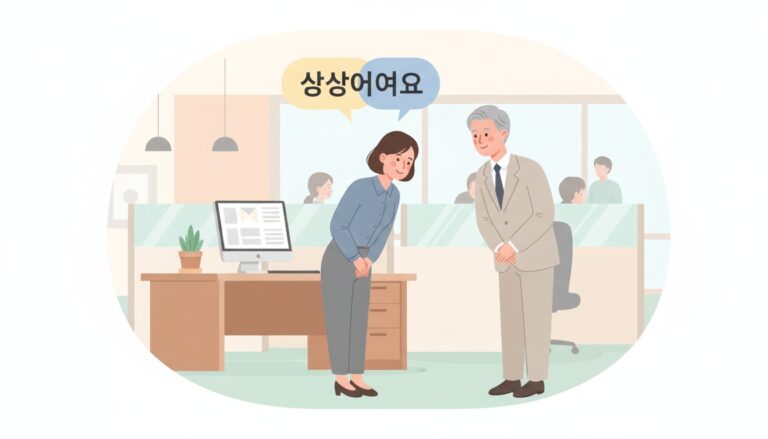
- In Korea, a greeting is not just verbal. You must include a slight bow (about 15-30 degrees). If you just say the word while looking at your phone or walking past without turning your head, it can be considered arrogant.
- Warning: Never say “Annyeong” (안녕) to a colleague unless you have explicitly agreed to drop honorifics (which rarely happens inside the office).
- Pronunciation Clinic:
- Many foreigners pronounce it as a question: “Annyeonghaseyo?” ↗️
- Try to keep the intonation relatively flat or slightly falling at the end to sound more professional: “Annyeonghaseyo.” ↘️
- Examples:
- To Boss: 부장님, 안녕하세요! [Bujangnim, annyeonghaseyo!] (Hello, Manager!)
- To Client: 안녕하세요, 매일한글입니다. [Annyeonghaseyo, Maeil Hangeul-imnida.] (Hello, this is Daily Hangul.)
- Morning: 좋은 아침입니다, 안녕하세요. [Joeun achimimnida, annyeonghaseyo.] (Good morning, hello.)
- Alternatives:
- More Formal: 안녕하십니까? [Annyeonghasimnikka?] (Used in very stiff environments, military, or broadcasting).
- Mini Quiz:
- You see the CEO in the hallway. You should say: “___haseyo!” (Check answer at bottom)
2. 식사하셨어요? (Siksa hasyeosseoyo?)
- Meaning: Have you had a meal? (Actual meaning: How are you?)
- Usage & Register:
- To whom: Colleagues and seniors.
- Tone: Polite and caring.
- Tutor’s Secret Note:
- This is the ultimate Korean ice-breaker. Foreigners often panic and think, “Are they asking me to lunch? Do I need to report what I ate?” No! It is just a greeting like “How are you doing?”
- The correct answer is almost always “Yes, I did” or “Not yet,” followed by asking them back.
- Pronunciation Clinic:
- Focus on the ‘S’ sound. It’s ‘Siksa’, not ‘Shiksa’.
- Examples:
- Lunchtime: 김 대리님, 식사하셨어요? [Kim daerinim, siksa hasyeosseoyo?] (Manager Kim, did you eat?)
- Passing in hallway (1 PM): 식사는 하셨습니까? [Siksaneun hasyeotsumnikka?] (Did you have a meal? – Formal)
- Response: 네, 먹었습니다. [Ne, meogeotsumnida.] (Yes, I ate.)
- Alternatives:
- Casual (Friends): 밥 먹었어? [Bap meogeosseo?]
3. 먼저 들어가 보겠습니다 (Meonjeo deureoga bogetseumnida)
- Meaning: I will go in [home] first. (Actual meaning: I am leaving the office for the day.)
- Usage & Register:
- To whom: When you leave work before your boss or colleagues.
- Tone: Apologetic but firm (Hapsyo-che/하십시오체).
- Tutor’s Secret Note:
- You cannot just say “Bye!” or “Annyeonghi gyeseyo” (Stay in peace) in a corporate setting. It sounds too detached.
- “Meonjeo” (First) acknowledges that others are still working, showing humility.
- Examples:
- Leaving at 6 PM: 오늘 고생하셨습니다. 먼저 들어가 보겠습니다. [Oneul gosaenghasyeotsumnida. Meonjeo deureoga bogetseumnida.] (Good work today. I’m heading out first.)
- To Team: 저 먼저 가볼게요. 내일 봬요! [Jeo meonjeo gabolgeyo. Naeil bwaeyo!] (I’m going first. See you tomorrow! – Slightly softer, for peers.)
- Mini Quiz:
- Leaving the office: “Meonjeo ___ bogetseumnida.” (Check answer at bottom)
Textbook vs. Real Korean
| Situation | Textbook (Book Korean) | Real Office (Real Korean) | Usage Tip |
|---|---|---|---|
| Leaving Work | 안녕히 계세요. (Annyeonghi gyeseyo.) | 먼저 들어가 보겠습니다. (Meonjeo deureoga bogetseumnida.) | The real version shows respect for those still working. |
| Meeting Boss | 안녕하십니까? (Annyeonghasimnikka?) | 안녕하세요! (Annyeonghaseyo!) | ‘Annyeonghaseyo’ is friendly enough for most modern offices. |
| Greeting | 잘 지냈어요? (Jal jinaesseoyo?) | 식사하셨어요? (Siksa hasyeosseoyo?) | Asking about food is the most natural way to show care. |
Analysis: The Politeness Thermometer
In a Korean office, the ending of your sentence determines the distance between you and the listener.
- 100°C (Hot/Formal): ~습니까? / ~습니다. (~sumnikka? / ~sumnida.)
- Used for: Reports, presentations, talking to the CEO, or apologizing.
- Feeling: Rigid, professional, respectful.
- 60°C (Warm/Polite): ~요. (~yo.)
- Used for: Daily work chat, emails to peers, lunch talk.
- Feeling: Friendly but polite. Safe for 90% of office life.
- 0°C (Cold/Too Close): 반말 (Banmal – No ending)
- Used for: NEVER in the office unless you are alone with a same-age friend.
- Feeling: If used wrongly, it feels disrespectful or aggressive.
Real-Life Scenario: Role Play
Setting: 9:00 AM, Office Pantry (Coffee Machine).
Characters:
* Alex (Employee): Foreigner, recently joined.
* Manager Park (Senior): Korean supervisor.
(Alex enters the pantry and sees Manager Park.)
Alex: (Bows slightly) 부장님, 안녕하세요!
[Bujangnim, annyeonghaseyo!]
(Hello, Manager!)
Manager Park: 어, 알렉스 씨, 안녕하세요. 좋은 아침이에요.
[Eo, Alex-ssi, annyeonghaseyo. Joeun achimieyo.]
(Oh, Alex, hello. Good morning.)
Alex: 네, 날씨가 참 좋네요. 식사하셨어요?
[Ne, nalssiga cham jonneyo. Siksa hasyeosseoyo?]
(Yes, the weather is nice. Have you eaten breakfast?)
Manager Park: 아직 안 먹었어요. 커피 마시는 중이에요.
[Ajik an meogeosseoyo. Keopi masineun jungieyo.]
(Not yet. I’m just drinking coffee.)
Manager Park: 오늘 회의 준비는 다 됐나요?
[Oneul hoeui junbineun da ddoennayo?]
(Is the preparation for today’s meeting done?)
Alex: 네, 준비 다 했습니다.
[Ne, junbi da haetseumnida.]
(Yes, it is all ready.)
Culture Tip: Notice how Alex switches between ~yo (casual polite) for small talk and ~sumnida (formal) when talking about work tasks. This mix is very natural!
Shadowing & Speaking Challenge
Let’s practice the “Leaving Work” phrase. It’s long, but essential.
Script:
먼저 들어가 보겠습니다. 내일 뵙겠습니다.
[Meonjeo deureoga bogetseumnida. Naeil boepgetseumnida.]
(I’m heading out first. I will see you tomorrow.)
Action Plan:
1. [ ] Listen to the pronunciation (imagine the sound).
2. [ ] Say it slowly (break it down: Meon-jeo / deu-reo-ga / bo-get-sum-ni-da).
3. [ ] Say it at normal speed while bowing slightly.
Pronunciation Point:
* In 뵙겠습니다 (boepgetseumnida), the ㅂ(p) sound in ‘boep’ flows into the ㄱ(g), making a strong K sound. It sounds like [Boep-kket-sum-ni-da].
FAQ (Frequently Asked Questions)
Q1: Can I just say “Hi” or “Hello” in English to my Korean boss?
* A: It depends on the company culture. In global companies, maybe. But in 95% of Korean companies, saying “Annyeonghaseyo” is safer and shows you respect the local culture. Sticking to English might make you look like you aren’t trying to adapt.
Q2: What if I arrive after my boss? Do I apologize?
* A: If you are not late (it’s before 9 AM), just say “안녕하세요” (Annyeonghaseyo). If you are late, you must say “늦어서 죄송합니다” [Neujeoseo joesonghamnida] (I apologize for being late).
Conclusion
To survive in a Korean office, remember: Bowing + Eye Contact + Polite Ending (~yo/~nida) is the golden formula.
Today’s Mission:
Next time you finish work, do not just slip away silently. Walk up to a colleague and practice: “Meonjeo deureoga bogetseumnida!”
Have you ever made a mistake with Korean titles at work? Share your story in the comments!
Final Quiz
1. Which greeting is inappropriate for a boss?
a) Annyeonghaseyo
b) Annyeonghasimnikka
c) Annyeong
2. What is the “Real Korean” way to say goodbye when leaving the office first?
a) Jal ga (Bye)
b) Meonjeo deureoga bogetseumnida
c) Annyeonghi gyeseyo
3. Fill in the blank: “Have you eaten?” = “_____ hasyeosseoyo?”
Click to see answers
1. c (Annyeong is banmal/casual)
2. b (Meonjeo deureoga bogetseumnida)
3. Siksa (식사)
Frequently Asked Questions (FAQ)
Q: What does "안녕하세요 (Annyeonghaseyo)" mean in Korean and how do you pronounce it?
A: In Korean, "안녕하세요 (Annyeonghaseyo)" is pronounced [see lesson guide] and means: Hello / Good morning / Good afternoon
Q: What does "식사하셨어요? (Siksa hasyeosseoyo?)" mean in Korean and how do you pronounce it?
A: In Korean, "식사하셨어요? (Siksa hasyeosseoyo?)" is pronounced [see lesson guide] and means: Have you had a meal? (Actual meaning: How are you?)
Q: What does "먼저 들어가 보겠습니다 (Meonjeo deureoga bogetseumnida)" mean in Korean and how do you pronounce it?
A: In Korean, "먼저 들어가 보겠습니다 (Meonjeo deureoga bogetseumnida)" is pronounced [see lesson guide] and means: I will go in [home] first. (Actual meaning: I am leaving the office for the day.)







