

Emergency! How to Ask “Where is the Bathroom?” in Korean
Hello, this is Daily Hangul!
Today, we are diving into the most critical survival phrase in any language. Whether you are exploring the bustling streets of Myeongdong or hiking Seoraksan, nature calls when you least expect it.
📖 Episode: The “Locked Door” Panic (Synthetic Case)
(Note: This is a synthetic case study combining common experiences from several beginner learners.)
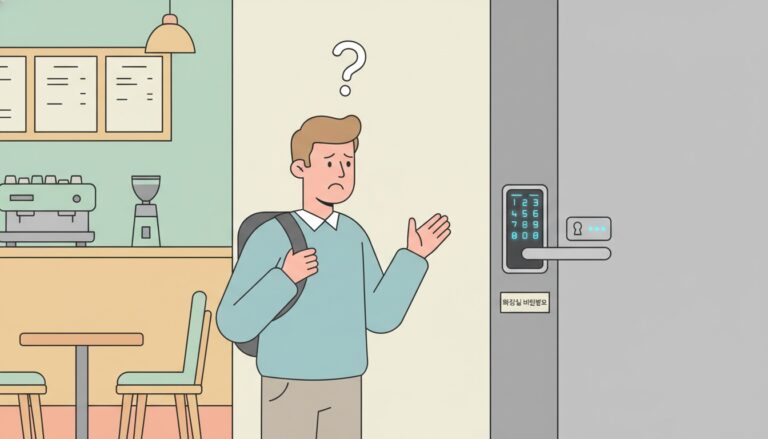
Many of my students report a similar panic moment. “Student A” was at a cafe in Seoul. After drinking a large Iced Americano, they finally found the bathroom door, but it was locked with a digital keypad. They knew how to ask “Where is it?” but didn’t know how to ask for the code. They stood there awkwardly until another customer came along.
In Korea, simply asking for location isn’t always enough. You often need to ask for permission or a password (bimil-beonho). Textbook Korean is often too stiff or misses these practical details. Let’s fix that today.
📋 Summary: Survival Kit
- Key Phrases: Asking location, asking for the password, asking for tissue.
- Safety Level: Safe for strangers, cafe staff, and people on the street.
- Difficulty: A1 (Beginner) – Vital because Korean bathrooms often have digital locks!
📑 Table of Contents
- Deep Dive: 3 Essential Expressions
- Textbook vs. Real Korean
- Korean Analysis: The Tone Thermometer
- Role Play: At a Cafe
- Shadowing Challenge
- FAQ
- Final Quiz
💡 Deep Dive: Today’s Core Expressions
1. 화장실 어디예요? (Where is the restroom?)
- Pronunciation: [Hwa-jang-sil eo-di-ye-yo?]
- Meaning: Where is the bathroom/restroom/toilet?
- Usage & Register:
- Who: To anyone (staff, strangers).
- Tone: Polite informal (해요체 – Haeyo-che). Standard and safe.
- Tutor’s Secret Note:
- Unlike some Western countries where asking for the “toilet” sounds crude, in Korea, 화장실 (Hwajangsil) is the standard word used everywhere. It literally means “makeup room.”
- Pronunciation Clinic:
- Linking: It sounds smoother if you link the syllables: Hwajang-shir-eodi-yeyo.
- Examples:
- 저기요, 화장실 어디예요? (Jeogiyo, hwajangsil eodi-yeyo?) – Excuse me, where is the restroom?
- 지하철역 화장실 어디예요? (Jihacheol-yeok hwajangsil eodi-yeyo?) – Where is the subway station restroom?
- 남자 화장실 어디예요? (Namja hwajangsil eodi-yeyo?) – Where is the men’s room?
- Alternatives:
- Polite: 화장실이 어디에 있습니까? (Hwajangsil-i eodi-e isseumnikka?)
- Casual: 화장실 어디야? (Hwajangsil eodi-ya?)
- Mini Quiz:
- Q: Fill in the blank. “Excuse me, where is the [ ]?” -> 저기요, [ ] 어디예요?
-
Click for Answer
화장실 (Hwajangsil)
2. 비밀번호 있어요? (Is there a password?)
- Pronunciation: [Bi-mil-beon-ho i-sseo-yo?]
- Meaning: Is there a password/code?
- Usage & Register:
- Who: To cafe or restaurant staff.
- Tone: Polite informal.
- Tutor’s Secret Note:
- Culture Alert! Many bathrooms in commercial buildings in Korea are locked to prevent random public use. The code is usually on the receipt or taped to the counter. If you don’t see it, you must ask this.
- Pronunciation Clinic:
- Nasal Sound: ‘비밀번호’ can sound like Bimil-beon-no due to nasal assimilation, but pronouncing each syllable clearly is fine too.
- Examples:
- 화장실 비밀번호 있어요? (Hwajangsil bimil-beonho isseoyo?) – Is there a restroom password?
- 비밀번호 뭐예요? (Bimil-beonho mwo-yeyo?) – What is the password?
- 영수증에 비밀번호 있어요. (Yeongsujeung-e bimil-beonho isseoyo.) – The password is on the receipt.
- Alternatives:
- Casual: 비번 뭐야? (Bibeon mwo-ya?) Note: ‘Bibeon’ is slang for password.
3. 휴지 있어요? (Do you have toilet paper?)
- Pronunciation: [Hyu-ji i-sseo-yo?]
- Meaning: Is there tissue/toilet paper?
- Usage & Register:
- Who: To staff or friends.
- Tone: Polite informal.
- Tutor’s Secret Note:
- Warning: In older buildings or public parks, toilet paper is often located at the entrance of the bathroom, not inside the stall. Or, you might need to grab some from the restaurant table before you go.
- Examples:
- 화장실에 휴지 있어요? (Hwajangsil-e hyuji isseoyo?) – Is there tissue in the bathroom?
- 휴지 좀 주세요. (Hyuji jom juseyo.) – Please give me some tissue.
- 저기, 휴지가 없어요. (Jeogi, hyuji-ga eopseoyo.) – Excuse me, there is no tissue.
🆚 Textbook vs. Real Korean
| Context | Textbook Korean (Books) | Real Korean (Street/Survival) |
|---|---|---|
| Asking Location | 화장실이 어디에 있습니까? (Hwajangsil-i eodi-e isseumnikka?) Very formal, slightly robotic. |
저기요, 화장실… (Jeogiyo, hwajangsil…) Stopping mid-sentence often implies “Where is it?” and sounds natural. |
| Usage Permission | 화장실을 사용해도 됩니까? (Hwajangsil-eul sayong-haedo doemnikka?) Grammatically perfect but long. |
화장실 좀 써도 돼요? (Hwajangsil jom sseodo dwaeyo?) More common in daily life. |
Checklist:
* Hotel/Airport: Use Textbook or Polite forms.
* Busy Restaurant/Bar: Use Real Korean phrases.
🌡️ Analysis: Tone Thermometer
How does the “distance” change with your ending?
- Level 1 (Cold/Rude to Strangers): “화장실 어디야?” (Hwajangsil eodi-ya?)
- Only for close friends. If you say this to a staff member, they will be offended.
- Level 3 (Warm/Standard): “화장실 어디예요?” (Hwajangsil eodi-yeyo?)
- The Gold Standard. Friendly yet respectful.
- Level 5 (Too Hot/Overly Formal): “실례지만, 화장실이 어디에 위치해 있는지 여쭈어봐도 되겠습니까?”
- Too long! By the time you finish this sentence, you might have an accident! Keep it simple.
🎭 Real Role Play: At a Cafe in Hongdae
Situation: You are at a crowded cafe. You ordered coffee, but now you need to use the restroom.
- You: 저기요, 화장실 어디예요?
- (Jeogiyo, hwajangsil eodi-yeyo?) – Excuse me, where is the restroom?
- Staff: 나가서 오른쪽 건물 2층이에요.
- (Nagaseo oreunjjok geonmul i-cheung-iyeyo.) – Go out, it’s on the 2nd floor of the building on the right.
- You: 아, 혹시 비밀번호 있어요?
- (Ah, hoksi bimil-beonho isseoyo?) – Ah, by any chance, is there a password?
- Staff: 네, 1234 별표(*)예요.
- (Ne, il-i-sam-sa byeol-pyo-yeyo.) – Yes, it’s 1234 star(*).
- You: 감사합니다!
- (Gamsahamnida!) – Thank you!
💡 Culture Tip: “Star” is 별표 (byeol-pyo) or simply 별 (byeol). The “Hash/Pound” key (#) is 우물정 (umul-jeong) or 샵 (shap).
🗣️ Shadowing Challenge
Don’t just read, speak! Repeat this 3 times.
“저기요, 화장실 비밀번호 뭐예요?”
(Jeogiyo, hwajangsil bimil-beonho mwo-yeyo?)
- [ ] Attempt 1 (Slowly check pronunciation)
- [ ] Attempt 2 (Natural speed)
- [ ] Attempt 3 (Imagine you are in a rush!)
Point: Emphasize “Mwo-yeyo” (What is it) with a rising intonation at the end.
❓ FAQ (Frequently Asked Questions)
Q1: Can I just say “Toilet”?
A: Most young Koreans understand “Toilet,” but older generations might not catch it instantly due to pronunciation differences. Hwajangsil is always safer.
Q2: Are public restrooms free in Korea?
A: Yes! Subway stations, parks, and department stores have free, clean restrooms. But small cafes usually lock theirs for customers only.
🎁 Wrap-up & Mission
Today’s Summary: Use “Hwajangsil eodi-yeyo?” for location, and don’t forget to ask for the “Bimil-beonho” (Password) in cafes!
Today’s Mission:
Next time you watch a K-Drama or Youtube vlog, look for a scene in a cafe. See if you can spot a small sign on the counter that says “WIFI” or “PW”. That’s the password culture!
Tell me in the comments:
Have you ever been stuck outside a locked bathroom in another country? How did you solve it?
📝 Final Quiz
1. Which word means “Restroom”?
A) Hwajangsil (화장실)
B) Hosil (호실)
C) Hwajang (화장)
2. If the door is locked, what should you ask for?
A) Hyuji (Tissue)
B) Bimil-beonho (Password)
C) Mul (Water)
3. Fill in the blank: “_______ eodi-yeyo?” (Where is the bathroom?)
A) Hwajangsil
Click to see answers
- A (Hwajangsil)
- B (Bimil-beonho)
- Hwajangsil
Frequently Asked Questions (FAQ)
Q: What does "화장실 어디예요? (Where is the restroom?)" mean in Korean and how do you pronounce it?
A: In Korean, "화장실 어디예요? (Where is the restroom?)" is pronounced [Hwa-jang-sil eo-di-ye-yo?] and means: Where is the bathroom/restroom/toilet?
Q: What does "비밀번호 있어요? (Is there a password?)" mean in Korean and how do you pronounce it?
A: In Korean, "비밀번호 있어요? (Is there a password?)" is pronounced [Bi-mil-beon-ho i-sseo-yo?] and means: Is there a password/code?
Q: What does "휴지 있어요? (Do you have toilet paper?)" mean in Korean and how do you pronounce it?
A: In Korean, "휴지 있어요? (Do you have toilet paper?)" is pronounced [Hyu-ji i-sseo-yo?] and means: Is there tissue/toilet paper?







