

Why Do Koreans Say “I’m Frying My Body” on the Floor?
Introduction
Hello, this is Daily Hangul! 👋
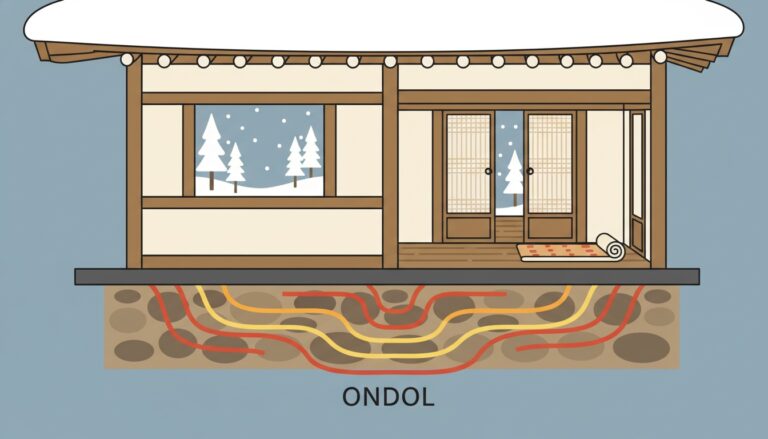
Have you ever walked into a traditional Korean house (Hanok) in the middle of a freezing winter? The air might feel crisp, but the moment your feet touch the floor, a wave of warmth travels up your legs. This is the magic of Ondol (온돌), Korea’s scientific floor heating system.
Here is a composite example based on stories from several students who visited the Jeonju Hanok Village in winter:
Many travelers are confused at first. They look for a radiator or a heater on the wall, but find nothing. Then, they sit on the floor and suddenly don’t want to get up. One student described it as “being hugged by the floor.”
However, simply saying “It is warm” doesn’t capture the full Korean experience. You need to know the specific verbs and adjectives that describe this deep, bone-melting heat. Today, we bridge the gap between textbook Korean and the real feeling of Ondol.
Summary at a Glance
- Key Expressions: Ondol, Tteu-kkeun-ha-da, Jiji-da
- Safe Zone: Perfect for Hanok stays, saunas (Jjimjilbang), or visiting a Korean friend’s home in winter.
- Level (C1): These words go beyond basic temperature descriptions to express physical relief and cultural nuance.
Table of Contents
- Today’s Deep Dive Expressions
- Textbook vs. Real Korean
- The Nuance Thermometer
- Real Life Scenario: Hanok Stay
- Shadowing Challenge
- FAQ & Wrap Up
Today’s Deep Dive Expressions
1. 온돌 (Ondol)
- Meaning: Traditional Korean floor heating system (literally: ‘warm stone’)
- Usage & Register: Neutral noun. Used in all situations.
- Tutor’s Secret Note: 🤫
- Ondol is not just a heater; it’s the reason Koreans don’t wear shoes inside and sit on the floor. In modern Korea, we use hot water pipes under the floor (Boiler), but we still call the concept “Ondol bang” (Ondol room).
- Pronunciation Clinic:
- Don’t say “On-doll.” The ‘l’ (ㄹ) at the end is soft, like the ‘l’ in “leaf,” not the ‘l’ in “ball.”
- [On-dol]
- Examples:
- (Check-in) 이 방은 온돌방인가요?
- I bang-eun ondol-bang-in-ga-yo?
- Is this room an Ondol (floor heating) room?
- (Construction) 한국 아파트는 대부분 온돌 시스템이에요.
- Hanguk apateu-neun dae-bu-bun ondol siseutem-i-e-yo.
- Most Korean apartments use the Ondol system.
- (History) 온돌은 과학적인 난방 방식입니다.
- Ondol-eun gwahak-jeog-in nanbang bangsik-im-ni-da.
- Ondol is a scientific heating method.
- (Check-in) 이 방은 온돌방인가요?
2. 뜨끈하다 (Tteu-kkeun-ha-da)
- Meaning: To be pleasantly hot; to be warm and soothing (often used for soup or floors).
- Usage & Register: Casual to Polite. Often used to express satisfaction.
- Tutor’s Secret Note: 🤫
- Unlike tteu-geop-da (hot/burning), tteu-kkeun-ha-da implies a positive feeling. It feels good for your body. If you say this while lying on the floor, Koreans will think you are a local!
- Pronunciation Clinic:
- Double consonant ‘Tt’ (ㄸ) and ‘Kk’ (ㄲ). Tense up your tongue/throat. It sounds impactful.
- [Tteu-kkeun-ha-da]
- Examples:
- (Hanok Stay) 바닥이 뜨끈해서 잠이 잘 왔어요.
- Badag-i tteu-kkeun-hae-seo jam-i jal wass-eo-yo.
- The floor was pleasantly hot, so I slept well.
- (Food) 국물이 뜨끈하네요.
- Gungmul-i tteu-kkeun-ha-ne-yo.
- The soup is hot and soothing.
- (Friend) 방 좀 뜨끈하게 해 줘.
- Bang jom tteu-kkeun-ha-ge hae jwo.
- Please make the room nice and toasty.
- (Hanok Stay) 바닥이 뜨끈해서 잠이 잘 왔어요.
3. 지지다 (Jiji-da)
- Meaning: To sear/fry (cooking); To warm one’s body on a hot floor (figurative).
- Usage & Register: Casual/Intimate. Used with close friends or when talking to yourself.
- Tutor’s Secret Note: 🤫
- Warning: If you use this in a formal business meeting (
Frequently Asked Questions (FAQ)
Q: What does "온돌 (Ondol)" mean in Korean and how do you pronounce it?
A: In Korean, "온돌 (Ondol)" is pronounced [see lesson guide] and means: Traditional Korean floor heating system (literally: 'warm stone')
Q: What does "뜨끈하다 (Tteu-kkeun-ha-da)" mean in Korean and how do you pronounce it?
A: In Korean, "뜨끈하다 (Tteu-kkeun-ha-da)" is pronounced [see lesson guide] and means: To be pleasantly hot; to be warm and soothing (often used for soup or floors).
Q: What does "지지다 (Jiji-da)" mean in Korean and how do you pronounce it?
A: In Korean, "지지다 (Jiji-da)" is pronounced [see lesson guide] and means: To sear/fry (cooking); To warm one's body on a hot floor (figurative).







