

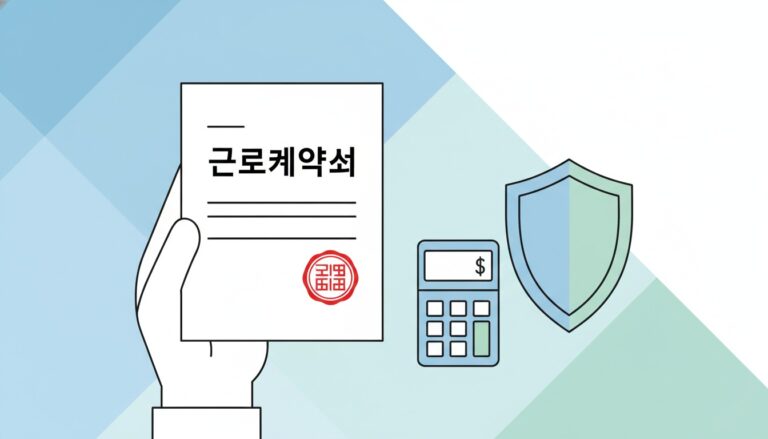
Help! My Boss Won’t Sign the Contract: Protecting Your Rights in Korea
Introduction
Hello, this is Daily Hangul!
Today, we are tackling a serious but essential topic for anyone working a part-time job (Arbaiteu) in Korea. Have you started working but haven’t signed any papers yet? You are not alone.
📝 Synthesized Case Study
(This is a synthesized case combining patterns frequently reported by foreign students in Korea.)
“I started working at a convenience store two weeks ago. When I asked the owner about the contract, he just said, ‘We are like family here, don’t worry about it.’ Now he is late paying my first week’s wages. Can I report this? What do I say in Korean without sounding rude but being firm?”
In Korea, “We are family” (가족 같은 분위기) can sometimes be a red flag for skipping legal procedures. Writing a Labor Contract (근로계약서) is mandatory by law, even for part-time jobs. Let’s learn how to demand your rights smartly and safely.
Summary at a Glance
- Today’s Expressions: Asking for a contract, mentioning reporting, discussing fines.
- Safe Zone: Use these when your rights are being ignored. Start polite, then get firm.
- Level (C2/Advanced): This involves legal terms and negotiation. Even if your grammar isn’t perfect, knowing these specific nouns gives you power.
Table of Contents
- Today’s Key Expressions Deep Dive
- Textbook vs. Real Korean
- Tutor’s Analysis: The Temperature of Speech
- Real-Life Scenario: The Confrontation
- Shadowing Challenge
- FAQ
- Wrap-up & Quiz
Today’s Key Expressions Deep Dive
1. 근로계약서 (Geunlo-gyeyakseo)
- Meaning: Labor Contract / Employment Contract
- Usage & Register:
- To Boss: Use polite formal style (Haeyo-che/Hapnida-che).
- Context: Essential vocabulary. You must mention this specifically, not just “paper.”
- Tutor’s Secret Note:
- Some bosses act vague. If you say this word clearly, they realize you know Korean labor law. It signals, “I am not an easy target.”
- Pronunciation Clinic:
- [글로계약써] (Geullo-gyeyaksseo): Note that ‘ㄴ’ + ‘ㄹ’ becomes ‘ㄹㄹ’ (Assimilation), and ‘서’ sounds like ‘써’ (Tensing).
- Examples:
- 사장님, 우리 근로계약서 언제 써요? (Sajangnim, uri geunlo-gyeyakseo eonje sseoyo?) – Boss, when do we write the labor contract?
- 근로계약서 사본을 주세요. (Geunlo-gyeyakseo saboneul juseyo.) – Please give me a copy of the labor contract.
- 근로계약서 미작성은 불법이에요. (Geunlo-gyeyakseo mijakseong-eun bulbeobi-eyo.) – Not writing a labor contract is illegal.
- Alternatives:
- Polite: 계약서 작성 부탁드립니다. (Please write the contract.)
- Casual (To friends): 계약서 안 썼어. (I didn’t write the contract.)
- Mini Quiz:
- The law requires you to receive a ___ of the contract. (Hint: Copy)
Click to see answer
사본 (Sabon)
- The law requires you to receive a ___ of the contract. (Hint: Copy)
2. 신고하다 (Singohada)
- Meaning: To report (to authorities) / To file a complaint
- Usage & Register:
- To Boss: Use carefully. This is a threat or a final warning.
- To Friends/Consultants: Use to explain your plan.
- Tutor’s Secret Note:
- In Korea, we usually report labor issues to the Ministry of Employment and Labor (고용노동부). The verb is always
신고하다. - Warning: Do not say this smiling. It requires a serious face.
- In Korea, we usually report labor issues to the Ministry of Employment and Labor (고용노동부). The verb is always
- Pronunciation Clinic:
- Pronounce clearly as [신고하다]. No major sound changes, but stress the ‘Sin’.
- Examples:
- 노동부에 신고할 수밖에 없어요. (Nodongbu-e singohal subakke eopseoyo.) – I have no choice but to report this to the Labor Ministry.
- 임금 체불로 신고했어요. (Imgeum chebullo singohaesseoyo.) – I reported (the owner) for unpaid wages.
- 신고 절차가 어떻게 돼요? (Singo jeolchaga eotteoke dwaeyo?) – What is the procedure for reporting?
- Alternatives:
- Softer: 진정을 넣다 (To file a petition – specific legal term)
- Stronger: 고발하다 (To accuse/prosecute)
- Mini Quiz:
- Where do you report labor issues? _____ (Hint: MOEL in Korean)
Click to see answer
고용노동부 (Goyong-nodongbu) or 노동부
- Where do you report labor issues? _____ (Hint: MOEL in Korean)
3. 벌금 (Beolgeum)
- Meaning: Fine / Penalty money
- Usage & Register:
- Used when explaining the consequences of breaking the law.
- Tutor’s Secret Note:
- Not writing a contract can result in a fine of up to 5 million KRW. Mentioning “fine” usually scares bad employers into compliance.
- Pronunciation Clinic:
- [벌금]: The ‘ㄱ’ becomes a tensed sound ‘ㄲ’ -> [Beolkkqeum].
- Examples:
- 계약서 안 쓰면 벌금 내셔야 해요. (Gyeyakseo an sseumyeon beolgeum naesyeoya haeyo.) – You have to pay a fine if we don’t write the contract.
- 벌금이 최대 500만 원이에요. (Beolgeum-i choedae obaek-man woniyeyo.) – The fine is up to 5 million won.
- 벌금형을 받을 수 있어요. (Beolgeum-hyeong-eul badeul su isseoyo.) – You could receive a fine sentence.
- Alternatives:
- Formal: 과태료 (Administrative fine/penalty)
- Casual: 돈 물어내다 (To pay up money)
- Mini Quiz:
- If you break the law, you pay this: ___.
Click to see answer
벌금 (Beolgeum)
- If you break the law, you pay this: ___.
Textbook vs. Real Korean
Context: Negotiating with a boss who is delaying the paperwork.
| Type | Expression (Korean/Romanization) | Meaning | Situation Checklist |
|---|---|---|---|
| Book Korean | 근로계약서 작성을 부탁드립니다. (Geunlo-gyeyakseo jakseong-eul butak-deuripnida.) |
I request the writing of the labor contract. | Too formal. Sounds like reading a script. Use in emails only. |
| Book Korean | 이것은 위법 행위입니다. (Igeoseun wibeop haengwi-ipnida.) |
This is an illegal act. | Very stiff. Sounds like a lawyer drama. |
| Real Korean | 사장님, 계약서 오늘 쓸 수 있을까요? (Sajangnim, gyeyakseo oneul sseul su isseulkkayo?) |
Boss, can we write the contract today? | Natural & polite pressure. Use this first! |
| Real Korean | 나중에 문제 생기면 사장님이 힘들어져요. (Najung-e munje saenggimyeon sajangnim-i himdeureojyeoyo.) |
If problems arise later, it gets hard for you, Boss. | Passive-aggressive Master. implying “I will report you, and you will get fined.” |
Tutor’s Analysis: The “Temperature of Speech” (말투 온도계)
In Korea, hierarchy is strong, but legal rights are stronger. However, jumping straight to threats is bad strategy. See how the “temperature” rises:
- Level 1 (Soft & Polite): “사장님, 저 아직 계약서 안 썼는데 언제 쓸까요?” (Boss, I haven’t written the contract yet, when shall we do it?) -> Give them a chance to remember.
- Level 2 (Firm Reminder): “알바하려면 계약서 꼭 있어야 한다고 들었어요.” (I heard that to do part-time work, a contract is a must.) -> Blame “others” or “the rules”.
- Level 3 (Warning): “계약서 없으면 나중에 벌금 나오지 않나요? 걱정돼서요.” (Doesn’t it lead to a fine if there’s no contract? I’m worried.) -> Pretend to worry about the BOSS, but actually warning them.
- Level 4 (Declaration of War): “계속 미루시면 노동부에 신고하겠습니다.” (If you keep delaying, I will report to the Labor Ministry.) -> Last resort.
Real-Life Scenario: Role Play
Setting: A small restaurant (Kimbap place). It’s been 3 days since you started. The boss is busy counting money.
You: 사장님, 바쁘신데 죄송해요. 말씀드릴 게 있어요.
(Sajangnim, bappeusinde joesonghaeyo. Malseumdeuril ge isseoyo.)
(Boss, sorry to interrupt while you’re busy. I have something to tell you.)
Boss: 어, 그래. 무슨 일이야?
(Eo, geurae. Museun iriya?)
(Oh, sure. What’s up?)
You: 저 일한 지 3일 됐는데, 근로계약서 아직 안 써서요.
(Jeo ilhan ji sam-il dwaenneunde, geunlo-gyeyakseo ajik an sseoseoyo.)
(It’s been 3 days since I worked, but we haven’t written the labor contract yet.)
Boss: 아, 그거? 나중에 천천히 써도 돼. 우린 서로 믿잖아.
(Ah, geugeo? Najung-e cheoncheonhi sseodo dwae. Urin seoro mitjana.)
(Ah, that? We can write it slowly later. We trust each other.)
You: 그래도 확실한 게 좋으니까요. 미작성하면 벌금도 세다고 들었어요.
(Geuraedo hwaksilhan ge joeunikkayo. Mijakseong-hamyeon beolgeum-do sedago deureosseoyo.)
(Still, it’s better to be certain. I heard the fine for not writing it is strong, too.)
Boss: (Slightly annoyed but realizes you know the law) 알았어. 오늘 마감하고 바로 쓰자.
(Arasseo. Oneul magamhago baro sseuja.)
(Okay. Let’s write it right after closing today.)
💡 Culture Tip:
Notice how the student says “I heard the fine is strong” instead of “You will get fined.” This indirect speech protects the Boss’s face (Chemyon) while delivering a clear warning.
Shadowing & Speaking Challenge
Let’s practice the sentence that protects you. Repeat this 3 times aggressively but politely.
Script:
“법적으로 근로계약서는 일 시작하기 전에 써야 해요.”
(Beopjeog-euro geunlo-gyeyakseo-neun il sijakhagi jeon-e sseoya haeyo.)
(Legally, the labor contract must be written before starting work.)
- [ ] Attempt 1 (Read slowly)
- [ ] Attempt 2 (Focus on ‘Jeon-e’ / Before)
- [ ] Attempt 3 (Natural speed, look confident)
🗣️ Pronunciation Point:
* 법적으로 (Beopjeog-euro): Pronounce as [법쩌그로] (Beop-jjeo-geu-ro) due to tensing.
FAQ (Frequently Asked Questions)
Q1: Can I report them even if I already quit?
Yes! You can report unpaid wages or missing contracts to the MOEL (Ministry of Employment and Labor) even after you leave. You can call 1350 (with interpretation service).
Q2: I am an international student (D-2 visa). Do I need a permit?
Yes! Before signing a contract, you must get Time-part Employment Permission (시간제 취업 허가) from Immigration. If you work illegally without this, reporting a bad boss might also get you in trouble (fines/deportation).
* Expression: “출입국사무소 허가 받아야 해요.” (I need to get permission from the Immigration Office.)
Wrap-up & Action Item
One Sentence Summary:
Always ask for the 근로계약서 (Labor Contract) on day one, and politely remind the boss of the 벌금 (Fine) if they refuse.
Today’s Mission:
If you are currently working, check if you have your contract copy. If not, practice the “Level 3” sentence from the ‘Temperature of Speech’ section in front of a mirror!
Question for You:
Have you ever had a boss who said “We are family”? How did it end? Tell me in the comments!
Final Quiz
- Which word means “Labor Contract”?
A) 이력서 (Iryeokseo)
B) 근로계약서 (Geunlo-gyeyakseo)
C) 사직서 (Sajikseo) -
What implies “You must pay money as a punishment”?
A) 월급 (Wolgeup)
B) 보너스 (Boneoseu)
C) 벌금 (Beolgeum) -
Fill in the blank: To report a problem to the authorities is called ___하다.
Answers: 1. (B), 2. (C), 3. 신고 (Singo)
Frequently Asked Questions (FAQ)
Q: What does "근로계약서 (Geunlo-gyeyakseo)" mean in Korean and how do you pronounce it?
A: In Korean, "근로계약서 (Geunlo-gyeyakseo)" is pronounced [see lesson guide] and means: Labor Contract / Employment Contract
Q: What does "신고하다 (Singohada)" mean in Korean and how do you pronounce it?
A: In Korean, "신고하다 (Singohada)" is pronounced [see lesson guide] and means: To report (to authorities) / To file a complaint
Q: What does "벌금 (Beolgeum)" mean in Korean and how do you pronounce it?
A: In Korean, "벌금 (Beolgeum)" is pronounced [see lesson guide] and means: Fine / Penalty money







