

Stop Pointing Fingers! How to Ask “What is this?” in Korean Naturally
Introduction
Hello, this is Daily Hangul!
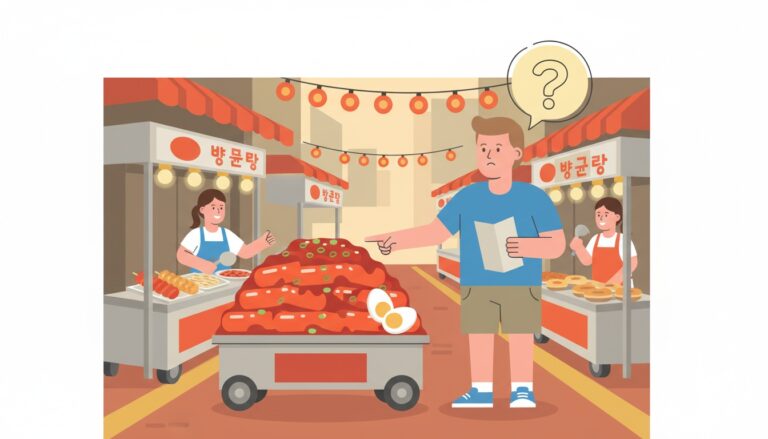
Imagine you are at the bustling Gwangjang Market in Seoul. You see a delicious-looking red snack, but you have no idea what it is or how spicy it might be. You want to ask the lady behind the counter, but you freeze. You just point and smile awkwardly. Sound familiar?
Note: The following is a synthetic example based on common patterns observed among beginner learners.
Many beginners, like “Alex,” a composite character of my A1 students, often just say “This?” in English or remain silent while pointing. The result? Alex once ended up buying extremely spicy chicken feet (Dakbal) thinking it was mild BBQ chicken! If he had known just one simple phrase, his taste buds would have been saved.
Textbooks often teach you distinct grammar rules, but in the noisy reality of a Korean street market, you need short, punchy, and polite phrases. Today, we will learn how to point at things and ask about them like a pro.
At a Glance
Here is your survival kit for today:
- Igeo mwoyeyo? (What is this?)
- Jeogeo juseyo. (Please give me that over there.)
- Hangugeoro mworago haeyo? (What do you call this in Korean?)
- Safe Zone: These phrases are polite (Haeyo-che) and safe to use with shopkeepers, strangers, and tutors.
- Level A1 (Beginner): Essential for survival. You don’t need complex grammar—just these chunks will help you navigate shopping and dining.
Table of Contents
- Today’s Core Expressions: Deep Dive
- Textbook vs. Real Korean
- The “Pointing” Thermometer (This vs. That)
- Real-Life Scenario: Street Food Market
- Shadowing Challenge
- FAQ
- Final Quiz
Today’s Core Expressions: Deep Dive
1. 이거 뭐예요? (Igeo mwoyeyo?)
- Meaning: What is this?
- Usage & Register: Use this when asking about an object close to you (the speaker). The ending -yo makes it polite enough for shop owners or strangers.
- Tutor’s Secret Note: Korean listeners focus heavily on context. While “Igeo” technically means “this thing,” you can often drop the “Igeo” and just say “Mwoyeyo?” (What is it?) if you are holding the object. However, keeping “Igeo” is safer for beginners to ensure clarity.
- Pronunciation Clinic:
- Linking: It sounds like [이거 머예요] (Igeo meo-ye-yo). Don’t pronounce it robotically as “Mwo-Ye-Yo.” The ‘w’ sound often blends softly.
- Examples:
- (At a restaurant) 이거 뭐예요? (Igeo mwoyeyo?) – What is this (dish)?
- (Finding a strange object) 이거 뭐예요? (Igeo mwoyeyo?) – What is this?
- (Pointing at a souvenir) 이거 뭐예요? (Igeo mwoyeyo?) – What is this?
- Alternatives:
- Polite: 이것은 무엇입니까? (Igeoseun mueosimnikka?) – Too formal, sounds like a news anchor.
- Casual: 이거 뭐야? (Igeo mwoya?) – Only for close friends.
- Mini Quiz:
- Q: You are holding a fruit. You ask: “_____ mwoyeyo?”
-
Click to see answer
Answer: 이거 (Igeo)
2. 저거 주세요 (Jeogeo juseyo)
- Meaning: Please give me that (over there).
- Usage & Register: Use this when the object is far from both you and the listener (e.g., on a shelf behind the cashier).
- Tutor’s Secret Note: This is the magic phrase for shopping without knowing the name of the item. Just point and say “Jeogeo juseyo.”
- Pronunciation Clinic:
- Jeogeo: The ‘J’ is soft, like ‘J’ in ‘Juice’, not ‘Z’.
- Examples:
- (At a cafe) 저거 주세요. (Jeogeo juseyo.) – I’ll have that one.
- (At a clothing store) 저거 주세요. (Jeogeo juseyo.) – Please give me that one.
- (Buying tickets) 저거 주세요. (Jeogeo juseyo.) – I want that one.
- Alternatives:
- Formal: 저것을 주십시오. (Jeogeoseul jusipsio.) – Very stiff.
- Casual: 저거 줘. (Jeogeo jwo.) – Only for friends.
- Mini Quiz:
- Q: You want the bag on the top shelf. You say: “_____ juseyo.”
-
Click to see answer
Answer: 저거 (Jeogeo)
3. 한국어로 뭐라고 해요? (Hangugeoro mworago haeyo?)
- Meaning: What is it called in Korean? / How do you say (this) in Korean?
- Usage & Register: This is your “learning tool.” Use it when you want to know the name of the object, not just what the object is.
- Tutor’s Secret Note: Koreans love it when foreigners try to learn the language. Asking this won’t annoy them; it will usually make them smile and teach you the word.
- Pronunciation Clinic:
- Hangugeoro: The ‘R’ in ‘Ro’ is a soft flap, between an R and an L.
- Examples:
- (Pointing at water) 이거 한국어로 뭐라고 해요? (Igeo Hangugeoro mworago haeyo?) – What do you call this in Korean?
- (Showing a picture) 한국어로 뭐라고 해요? (Hangugeoro mworago haeyo?) – How do you say it in Korean?
- (Hearing a word) 그게 한국어로 뭐라고 해요? (Geuge Hangugeoro mworago haeyo?) – What is that called in Korean?
- Alternatives:
- Simpler: 한국말… 이름이 뭐예요? (Hangukmal… ireumi mwoyeyo?) – Korean name… what is it?
- Mini Quiz:
- Q: Fill in the blank: “_______ mworago haeyo?”
-
Click to see answer
Answer: Hangugeoro (In Korean)
Textbook vs. Reality
Here is why you might sound like a robot if you rely only on old textbooks.
| Context | Textbook Korean (Book) | Real Korean (Reality) |
|---|---|---|
| Asking about an item | 이것은 무엇입니까? (Igeoseun mueosimnikka?) |
이거 뭐예요? (Igeo mwoyeyo?) |
| Pointing at something | 저것을 보십시오. (Jeogeoseul bosipsio.) |
저거 봐요. (Jeogeo bwayo.) |
Tutor’s Checklist:
* Situation: Are you in a military briefing? -> Use Textbook version.
* Situation: Are you buying socks or asking about food? -> Use Real Korean version.
Analysis: The “Pointing” Thermometer
Confused between Igeo, Geugeo, and Jeogeo? Think of it as physical distance.
| Word | Romanization | Meaning | Distance / Concept |
|---|---|---|---|
| 이거 | Igeo | This | Close to ME (Speaker). I am holding it. |
| 그거 | Geugeo | That | Close to YOU (Listener). You are holding it. OR we just talked about it. |
| 저거 | Jeogeo | That (over there) | Far from BOTH of us. It’s over on the wall or shelf. |
Common Mistake Scenario:
* You see a bag in your friend’s hand.
* Wrong: “Igeo mwoyeyo?” (You are using “this,” but it’s near them.)
* Right: “Geugeo mwoyeyo?” (What is that thing you have?)
Real-Life Scenario: Role Play
Setting: A street food stall in Myeongdong, evening. Delicious smells everywhere.
- Tourist: (Pointing to a red stick) 안녕하세요. 이거 뭐예요?
- (Annyeonghaseyo. Igeo mwoyeyo?)
- (Hello. What is this?)
- Owner: 아, 이거 닭꼬치예요. 매운맛.
- (Ah, igeo dakkkochi-yeyo. Maeun-mat.)
- (Ah, this is a chicken skewer. Spicy flavor.)
- Tourist: 아… (Thinking it might be too spicy) 음… 그럼 저거는 뭐예요?
- (Ah… Eum… Geureom jeogeoneun mwoyeyo?)
- (Ah… Hmm… Then what is that over there?)
- Owner: 저거는 오뎅이에요. 안 매워요.
- (Jeogeoneun odeng-ieyo. An maewoyo.)
- (That is fish cake. Not spicy.)
- Tourist: 저거 주세요.
- (Jeogeo juseyo.)
- (Please give me that.)
Culture Tip: In street markets, pointing is perfectly acceptable. If you don’t like spicy food, listening for the word “Maewoyo” (Spicy) is crucial!
Shadowing Challenge
Let’s train your mouth muscles. Read this out loud 3 times. Focus on the flow, not just individual words.
Script:
“이거 뭐예요? 저거 주세요.”
(Igeo mwoyeyo? Jeogeo juseyo.)
- [ ] slow speed (Articulate clearly)
- [ ] Normal speed (Imagine you are hungry)
- [ ] Fast speed (Like a busy local)
Pronunciation Point:
When saying 이거 (Igeo), don’t stress the ‘I’ too hard. It flows smoothly into ‘geo’.
FAQ
Q1: Can I use these phrases with my boss?
* A: It is better to add “Yo” (polite ending). “Igeo mwoyeyo?” is polite, but for a boss, you might want to be slightly more formal, but generally, “mwoyeyo” is acceptable in most daily business interactions unless it is a very formal presentation.
Q2: What if I forget “Igeo” or “Jeogeo”?
* A: Just point! Non-verbal communication is 50% of the conversation. Point and say “Mwoyeyo?” (What is it?) and you will be understood perfectly.
Q3: Can I say “This please” instead of “Give me this”?
* A: You can say “Igeo-yo” (This one), but adding “Juseyo” (Please give) makes you sound much more educated and polite. Try to stick to “Igeo juseyo.”
Wrap-up & Action Item
Summary:
Today we learned how to identify objects using Igeo (This), Geugeo (That), and Jeogeo (That over there), and how to ask “Mwoyeyo?” (What is it?).
Today’s Mission:
Look around your room right now. Point to 3 objects and ask out loud (even if you are alone):
1. Touch something near you: “Igeo mwoyeyo?”
2. Point to something far away: “Jeogeo mwoyeyo?”
Question for you:
What is the one Korean food you want to point at and order right now? Let me know in the comments!
Final Quiz
1. You are at a store. You want to ask about the price of a shirt hanging high on the wall behind the clerk. Which word do you use?
* A) Igeo
* B) Geugeo
* C) Jeogeo
2. How do you politely ask “What is this?”
* A) Igeo mwoya?
* B) Igeo mwoyeyo?
* C) Igeo mwo?
3. Fill in the blank: “_______ juseyo.” (Please give me that one over there.)
* Answer: ____________
Answers:
1. C (Jeogeo)
2. B (Igeo mwoyeyo?)
3. Jeogeo (저거)
Frequently Asked Questions (FAQ)
Q: What does "이거 뭐예요? (Igeo mwoyeyo?)" mean in Korean and how do you pronounce it?
A: In Korean, "이거 뭐예요? (Igeo mwoyeyo?)" is pronounced [Clinic:] and means: What is this?
Q: What does "저거 주세요 (Jeogeo juseyo)" mean in Korean and how do you pronounce it?
A: In Korean, "저거 주세요 (Jeogeo juseyo)" is pronounced [Clinic:] and means: Please give me that (over there).
Q: What does "한국어로 뭐라고 해요? (Hangugeoro mworago haeyo?)" mean in Korean and how do you pronounce it?
A: In Korean, "한국어로 뭐라고 해요? (Hangugeoro mworago haeyo?)" is pronounced [Clinic:] and means: What is it called in Korean? / How do you say (this) in Korean?







