

Running Late? How to Ask “Has the Movie Started?” in Korean Like a Pro
🎬 Introduction
Hello, this is Daily Hangul!
We’ve all been there. You bought a ticket for the latest blockbuster, but getting popcorn took longer than expected, or you got lost in the vast shopping mall where the cinema is located. Now you are standing in front of the theater door, breathless, wondering: “Did I miss the opening scene?”
Composite Case Study (Synthesized Example):
Many of our learners share a similar panic moment. One student mentioned rushing into a theater in Seoul, thinking they were 5 minutes late. They stood awkwardly in the dark, unsure if the movie had actually started or if it was still the trailers. They wanted to ask the staff, but the textbook phrase “Yeonghwa-ga sang-yeong jung-imnikka?” (Is the movie currently screening?) felt too long and formal for a dark, quiet hallway.
Today, we will learn the real, natural phrases to check your timing, ask for permission to enter, and understand the unique “10-minute rule” in Korean cinemas. Let’s make sure you never miss the opening scene again!
📝 At a Glance: Key Expressions
Here are the 3 survival phrases you need today:
- Yeonghwa sijak-haesseoyo? (Has the movie started?)
- Gwanggo jung-ieyo? (Is it just commercials right now?)
- Jigeum deureogado dwaeyo? (Can I go in now?)
- When to use: When you arrive at the cinema lobby or the entrance of the specific theater hall slightly late.
- Difficulty: A1 (Beginner). These are short, high-frequency phrases perfect for beginners.
📑 Table of Contents
- Today’s Core Expressions: Deep Dive
- Textbook vs. Real Korean
- Cultural Insight: The 10-Minute Rule
- Real-Life Role Play
- Shadowing Challenge
- FAQ
🔍 Today’s Core Expressions: Deep Dive
1. 영화 시작했어요? (Yeonghwa sijak-haesseoyo?)
- Meaning: Has the movie started?
- Usage & Register:
- To whom: Cinema staff or ticket collectors.
- Tone: Polite informal (Haeyo-che). Safe to use with strangers.
- Tutor’s Secret Note:
- Korean staff are very quick. You don’t need a full sentence like “Excuse me, I would like to ask if…” Just making eye contact and saying this phrase is sufficient.
- Warning: Don’t drop the “yo” (Yeonghwa sijak-haesseo?) unless the staff appears to be your close friend (which they are not!). It can sound rude.
- Pronunciation Clinic:
- Sijak (Start): The ‘k’ sound at the bottom of ‘jak’ flows into the ‘h’ of ‘haesseoyo’, often sounding like
Sija-kaesseoyo.
- Sijak (Start): The ‘k’ sound at the bottom of ‘jak’ flows into the ‘h’ of ‘haesseoyo’, often sounding like
- Examples:
- Travel: 죄송해요, 영화 시작했어요? (Joesong-haeyo, yeonghwa sijak-haesseoyo?) – Sorry, has the movie started?
- Date: 우리 영화 시작했어요? (Uri yeonghwa sijak-haesseoyo?) – Did our movie start?
- Casual: 벌써 시작했어요? (Beolsseo sijak-haesseoyo?) – Did it start already?
- Alternative:
- More Formal: 상영 시작했나요? (Sang-yeong sijak-haennayo?) – Has the screening started?
Mini Quiz: Fill in the blank
Q: “Excuse me, has it started?” -> “Jeogi-yo, ______ sijak-haesseoyo?”
A: yeonghwa (영화)
2. 광고 중이에요? (Gwanggo jung-ieyo?)
- Meaning: Is it (still) playing commercials?
- Gwanggo = Advertisement/Commercial
- Jung = In the middle of / During
- Usage & Register:
- To whom: Staff, to check if the actual movie is playing.
- Tutor’s Secret Note:
- This is a pro-level question. If you ask this, the staff will think, “Ah, this person knows Korean cinema culture.”
- Pronunciation Clinic:
- Gwang-go: Make sure to pronounce the ‘Gwang’ clearly. It’s not ‘Gango’.
- Examples:
- Situation: 지금 광고 중이에요? (Jigeum gwanggo jung-ieyo?) – Is it commercials right now?
- Response: 네, 아직 광고 중이에요. (Ne, ajik gwanggo jung-ieyo.) – Yes, it’s still commercials.
- Reasoning: 광고 끝나면 들어갈게요. (Gwanggo kkeut-namyeon deureogal-geyo.) – I’ll go in when the ads finish.
3. 지금 들어가도 돼요? (Jigeum deureogado dwaeyo?)
- Meaning: Can I go in now?
- Usage & Register:
- Used when the door is closed, or the staff is checking tickets.
- Pronunciation Clinic:
- Dwaeyo: It sounds like
Day-yobut with a slight ‘w’ sound at the start.
- Dwaeyo: It sounds like
- Examples:
- Late arrival: 늦었는데, 지금 들어가도 돼요? (Neujeon-neunde, jigeum deureogado dwaeyo?) – I’m late, can I go in now?
- Cleaning time: 청소 끝났어요? 들어가도 돼요? (Cheongso kkeut-nasseoyo? Deureogado dwaeyo?) – Is cleaning finished? Can I go in?
- Checking seat: 친구가 안에 있어요. 들어가도 돼요? (Chingu-ga ane isseoyo. Deureogado dwaeyo?) – My friend is inside. Can I enter?
🆚 Textbook vs. Real Korean
| Context | Textbook Korean (Book) | Real Korean (Street) |
|---|---|---|
| Asking about start time | 영화 상영이 시작되었습니까? (Yeonghwa sang-yeongi sijak-doeeot-seumnikka?) |
시작했어요? (Sijak-haesseoyo?) |
| Asking about seat | 제 좌석은 어디입니까? (Je jwaseogeun eodi-imnikka?) |
자리 어디예요? (Jari eodi-yeyo?) |
Situation Checklist:
* Formal Business/News: Use Textbook version.
* Talking to Cinema Staff/Friends: ALWAYS use Real Korean version. The textbook version sounds like a robot or a news anchor.
💡 Cultural Insight: The “10-Minute Rule”
Did you know?
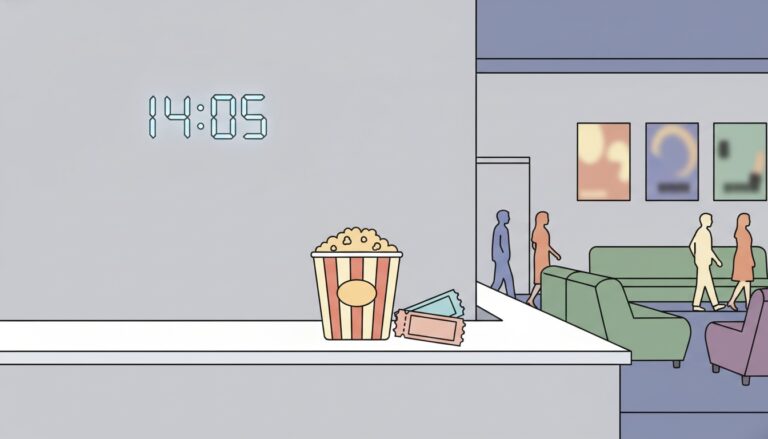
In Korea, the time printed on your ticket is NOT the exact time the movie starts. It is the time the advertisements start.
- Ticket Time: 14:00
- Ads & Trailers: 14:00 ~ 14:10 (Usually 10 minutes)
- Actual Movie Start: Around 14:10
So, if you arrive at 14:05, you are actually on time! This is legally mandated to allow latecomers to settle in without disturbing others during the movie intro. You can relax and buy your popcorn.
🎭 Real-Life Role Play
Scenario: You (Guest) arrived 5 minutes past the ticket time at a CGV Cinema in Seoul. You are rushing to the ticket check counter.
Guest: (Breathless) 저기요, 혹시 영화 시작했어요?
(Jeogi-yo, hoksi yeonghwa sijak-haesseoyo?)
Excuse me, strictly speaking, has the movie started?
Staff: 티켓 보여주시겠어요? 아, 2시 영화요?
(Tiket boyeojusi-gesseoyo? Ah, dusi yeonghwa-yo?)
May I see your ticket? Ah, the 2 o’clock movie?
Guest: 네 맞아요. 지금 들어가도 돼요?
(Ne majayo. Jigeum deureogado dwaeyo?)
Yes, correct. Can I go in now?
Staff: 네, 지금 광고 중이라서 괜찮아요. 바로 입장해 주세요.
(Ne, jigeum gwanggo jung-iraseo gwaenchana-yo. Baro ipjang-hae juseyo.)
Yes, it’s just commercials right now, so it’s okay. Please enter right away.
Guest: 휴, 다행이다. 감사합니다!
(Hyu, dahaeng-ida. Gamsahamnida!)
Phew, that’s a relief. Thank you!
Cultural Tip:
* Ipjang (입장): This word means “entrance” or “admission.” You will see it written above the theater doors.
🗣️ Shadowing Challenge
Let’s practice speaking naturally. Listen to the rhythm and repeat 3 times.
Script:
“Joesong-handeyo, gwanggo jung-ieyo?”
(Excuse me, is it playing commercials?)
- [ ] Slow: Joesong… handeyo… gwanggo… jung-ieyo?
- [ ] Normal: Joesong-handeyo, gwanggo jung-ieyo?
- [ ] Fast (Native Speed): Joesonghandeyo, gwanggojung-ieyo?
Focus Point: Raise your intonation at the very end (yo?) to make it a polite question.
❓ FAQ (Frequently Asked Questions)
Q1: Can I ask “Sijak-haesseoyo?” to my friend?
A: Yes, but drop the “yo”. Say “Sijak-haesseo?” (시작했어?) to close friends.
Q2: What if I need to find the bathroom before entering?
A: Ask: “Hwajangsil eodi-yeyo?” (화장실 어디예요? – Where is the bathroom?). Korean cinemas usually have restrooms inside the ticket zone, but sometimes they are outside.
Q3: Can I bring outside food into Korean cinemas?
A: Generally, yes! Unlike many other countries, major Korean cinema chains (CGV, Lotte, Megabox) allow outside food as long as it doesn’t have a strong smell (no Tteokbokki or Ramen!). Coffee or snacks from a convenience store are fine.
🎁 Wrap-up & Mission
Today’s Summary:
Don’t panic if you are 5 minutes late! Use “Gwanggo jung-ieyo?” to check if it’s just ads, and “Deureogado dwaeyo?” to ask permission to enter.
Today’s Mission:
Next time you watch a Korean drama or YouTube vlog about daily life, listen for the word “Sijak” (Start). It’s used everywhere, not just for movies!
Question for you:
Have you ever been late to a movie in another country? How did you handle it? Tell me in the comments!
🧩 Final Quiz
1. How do you ask “Has the movie started?” politely?
a) Yeonghwa sijak-hae!
b) Yeonghwa sijak-haesseoyo?
c) Yeonghwa sijak-imnikka?
2. Usually, how long are the commercials (ads) in Korean cinemas?
a) 0 minutes (Starts immediately)
b) About 10 minutes
c) 30 minutes
3. Fill in the blank: “Can I enter now?”
-> Jigeum _________ dwaeyo?
Click to see answers
1. b) Yeonghwa sijak-haesseoyo?
2. b) About 10 minutes
3. deureogado (들어가도)
Frequently Asked Questions (FAQ)
Q: What does "영화 시작했어요? (Yeonghwa sijak-haesseoyo?)" mean in Korean and how do you pronounce it?
A: In Korean, "영화 시작했어요? (Yeonghwa sijak-haesseoyo?)" is pronounced [see lesson guide] and means: Has the movie started?
Q: What does "광고 중이에요? (Gwanggo jung-ieyo?)" mean in Korean and how do you pronounce it?
A: In Korean, "광고 중이에요? (Gwanggo jung-ieyo?)" is pronounced [see lesson guide] and means: Is it (still) playing commercials?
Q: What does "지금 들어가도 돼요? (Jigeum deureogado dwaeyo?)" mean in Korean and how do you pronounce it?
A: In Korean, "지금 들어가도 돼요? (Jigeum deureogado dwaeyo?)" is pronounced [see lesson guide] and means: Can I go in now?






