

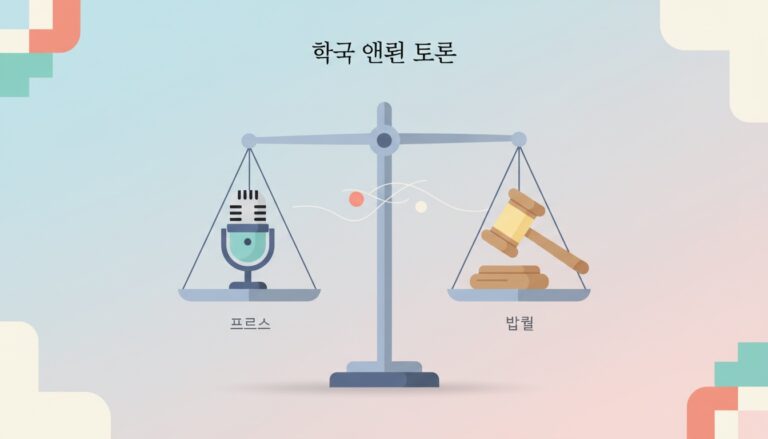
Fake News vs. Free Speech: How to Debate Like a Korean Intellectual 📰
1. Introduction: Why “Good” and “Bad” Aren’t Enough
Hello, this is Daily Hangul! 👋
Have you ever watched a Korean news clip on YouTube or read a controversial headline and wanted to discuss it with your Korean friends, but found yourself stuck using simple words like “이거 나빠요” (This is bad) or “거짓말이에요” (It’s a lie)?
Synthetic Case (Based on Learner Patterns):
Many advanced learners tell me they feel frustrated when the conversation turns to social issues. For instance, “Mark” (a synthetic persona based on multiple students) mentioned that when his Korean colleagues started discussing a recent “Fake News” controversy involving a celebrity and a lawsuit, he could only nod. He knew the concept of “Freedom of Speech” in English but didn’t know the specific Korean legal terms or the nuance required to debate without sounding aggressive.
Today, we are tackling a C2 (Advanced) topic: The tension between Freedom of the Press and Punitive Damages (Responsibility). This isn’t just about law; it’s about expressing opinion, agreement, and skepticism in a sophisticated way.
2. Summary: At a Glance
- Today’s Key Expressions:
- 언론의 자유 (Freedom of the press)
- 징벌적 손해배상 (Punitive damages)
- 알 권리 (The right to know)
- 가짜 뉴스 (Fake news)
- Safe Zone: These are formal/intellectual terms. Use them in serious discussions, debates, or when commenting on news articles.
- Level (C2): These words elevate your Korean from “daily survival” to “intellectual fluency.”
3. Table of Contents
- Today’s Key Expressions Deep Dive
- Textbook vs. Real Korean
- Nuance Analysis: The Debate Thermometer
- Real-Life Role Play: Discussing a Scandal
- Shadowing Challenge
- FAQ
- Wrap-up & Quiz
4. Today’s Key Expressions Deep Dive 💡
1) 언론의 자유 (Eollon-ui jayu)
- Meaning: Freedom of the press
- Context: Used when defending journalists or arguing against censorship.
- Tutor’s Secret Note: Koreans value this highly, but it’s often pitted against privacy rights. If you overemphasize this when someone is hurt by a rumor, you might seem insensitive.
- Pronunciation Clinic: Be careful with [ㄹ] in ‘언론’ and ‘권리’. It often undergoes nasalization or liquidization depending on the surrounding consonants. Here, pronounce it clearly as Eollon.
Ex 1 (Debate): 언론의 자유는 보장되어야 합니다.
(Eollon-ui jayuneun bojangdoeeoya hamnida.)
Freedom of the press must be guaranteed.Ex 2 (News): 이것은 언론의 자유를 침해하는 행위입니다.
(Igeoseun eollon-ui jayureul chimhaehaneun haengwiimnida.)
This is an act that infringes on the freedom of the press.Ex 3 (Casual): 아무리 언론의 자유가 중요해도 선은 지켜야죠.
(Amuri eollon-ui jayuga jungyohaedo seoneun jikyeoyajyo.)
No matter how important press freedom is, they should draw the line.
2) 징벌적 손해배상 (Jingbeoljeok sonhaebaesang)
- Meaning: Punitive damages (Compensation meant to punish the wrongdoer, not just cover costs).
- Context: Used in legal contexts or when discussing laws to punish “Fake News” severely.
- Tutor’s Secret Note: This is a hot topic in Korea regarding YouTubers or media outlets spreading malicious rumors. Using this full phrase makes you sound extremely knowledgeable.
- Pronunciation Clinic: ‘징벌적’ becomes [징벌쩍] due to tensing (tensification).
Ex 1 (Opinion): 가짜 뉴스에 대해서는 징벌적 손해배상제를 도입해야 해요.
(Gajja nyuseue daehaeseoneun jingbeoljeok sonhaebaesangjereul doiphaeya haeyo.)
We need to introduce punitive damages for fake news.Ex 2 (Skepticism): 징벌적 손해배상이 언론을 위축시킬 수도 있어요.
(Jingbeoljeok sonhaebaesangi eolloneul wichuksikil sudo isseoyo.)
Punitive damages could potentially shrink (chill) the press.Ex 3 (Legal): 법원은 피해자에게 징벌적 손해배상을 판결했습니다.
(Beobwoneun pihaeja-ege jingbeoljeok sonhaebaesangeul pangyeolhaetseumnida.)
The court ruled for punitive damages to the victim.
3) 악의적 보도 (Aguijeok bodo)
- Meaning: Malicious reporting
- Context: When a news outlet intentionally twists facts to hurt someone.
- Tutor’s Secret Note: This is stronger than just “incorrect report” (오보 – obo). It implies bad intent.
Ex 1 (Complaint): 이건 명백한 악의적 보도예요.
(Igeon myeongbaekhan aguijeok bodoeyo.)
This is clearly malicious reporting.Ex 2 (Defense): 단순한 실수가 아니라, 악의적 보도였습니다.
(Dan-sunhan silsuga anira, aguijeok bodoyeotseumnida.)
It wasn’t a simple mistake; it was malicious reporting.Ex 3 (Social): 악의적 보도로 피해자가 너무 많아요.
(Aguijeok bodoro pihaejaga neomu manayo.)
There are too many victims of malicious reporting.
Alternative Expressions:
* Better (Casual): 가짜 뉴스 (Gajja nyuseu) – Fake news.
* Better (Formal): 허위 사실 유포 (Heowi sasil yupo) – Spreading false facts.
👉 Mini Quiz: Fill in the blank (Click to see)
Q. “If the news was intentional and bad, it is called ______ .”
(뉴스가 고의적이고 나빴다면, 그것은 ______입니다.)
Answer: 악의적 보도 (Aguijeok bodo)
5. Textbook vs. Real Korean 🇰🇷
| Situation | Textbook / Formal 📘 | Real Life / News Comments 🗣️ |
|---|---|---|
| Reporting errors | 정정 보도를 요청합니다. (Jeongjeong bodoreul yocheonghamnida.) I request a correction report. |
팩트 체크 좀 하세요. (Paekteu chekeu jom haseyo.) Please do some fact-checking. |
| Criticizing Journalists | 언론의 책임감이 부족합니다. (Eollon-ui chaegimgami bujokhamnida.) The press lacks responsibility. |
기레기들이 또 소설 쓰네. (Giregideuri tto soseol sseune.) Trash journalists are writing fiction again. |
⚠️ Danger Alert: “기레기 (Giregi)” is a combination of 기자 (Reporter) + 쓰레기 (Trash). It is extremely common in internet comments but very rude. Never say this to a journalist or in a formal setting. Only use it when venting with close friends about bad media.
6. Analysis: The “Debate Thermometer” 🌡️
When discussing sensitive topics like politics or media law, the ending of your sentence changes the “temperature” of the debate.
| Level | Expression Pattern | Vibe | Context |
|---|---|---|---|
| 1 (Cool/Safe) | ~라고 생각해요. (-rago saenggakaeyo) |
“I think that…” | Safest. Expressing personal opinion without forcing it. |
| 2 (Warm/Logic) | ~는 점을 고려해야죠. (-neun jeomeul goryeohaeyajyo) |
“We should consider the point that…” | Intellectual disagreement. Very polite. |
| 3 (Hot/Strong) | ~는 말이 안 돼요. (-neun mari an doeyo) |
“That makes no sense.” | Strong disagreement. Can be offensive if used with seniors. |
| 4 (Boiling) | 절대 반대합니다! (Jeoldae bandaehamnida!) |
“I absolutely oppose!” | Protest or very heated argument. |
Tutor’s Tip: In a friendly debate, stay between Level 1 and 2. If you jump to Level 3, the atmosphere might get awkward (싸해지다 – ssahaejida).
7. Real-Life Role Play 🎬
Situation: Two friends, Minji and Jason, are at a cafe looking at a smartphone news alert about a YouTuber being sued.
Jason: 와, 이 유튜버 결국 고소당했네? 징벌적 손해배상 청구한대.
(Wa, i yutyubeo gyeolguk gosodanghaenne? Jingbeoljeok sonhaebaesang cheongguhandae.)
Wow, this YouTuber finally got sued? They say they are claiming punitive damages.
Minji: 잘됐네. 그동안 가짜 뉴스를 너무 많이 퍼뜨렸잖아.
(Jaldwaenne. Geudong-an gajja nyuseureul neomu mani peotteuryeotjana.)
Good. He’s been spreading too much fake news all this time.
Jason: 그런데 배상액이 너무 크면 언론의 자유가 위축되지 않을까?
(Geureonde baesang-aegi neomu keumyeon eollon-ui jayuga wichukdoeji aneulkka?)
But if the compensation amount is too high, wouldn’t it shrink freedom of the press?
Minji: 글쎄, 알 권리도 중요하지만 개인의 삶을 망치는 건 범죄라고 생각해.
(Geulsse, al gwollido jungyohajiman gaein-ui sarmeul mangchineun geon beomjoerago saenggakae.)
Well, the right to know is important, but I think ruining an individual’s life is a crime.
Jason: 일리가 있네. 책임 없는 자유는 방종이니까.
(Illiga inne. Chaegim eomneun jayuneun bangjonginikka.)
That makes sense. Freedom without responsibility is just self-indulgence.
8. Shadowing Challenge 🗣️
Step 1: Read aloud slowly.
Step 2: Read at normal speed.
Step 3: Record yourself and compare.
“언론은 사실을 보도할 의무가 있습니다. 하지만 확인되지 않은 정보로 누군가에게 피해를 준다면, 그에 대한 엄중한 법적 책임을 져야 합니다.”
(Eolloneun sasireul bodohal uimuga itseumnida. Hajiman hwagindoeji aneun jeongboro nugun-ga-ege pihaereul jundamyeon, geue daehan eomjunghan beopjeok chaegimeul jyeoya hamnida.)
“The media has a duty to report facts. However, if they harm someone with unverified information, they must bear strict legal responsibility for it.”
Checklist:
* [ ] Did you pronounce ‘법적’ as [법쩍]?
* [ ] Did you pause after ‘하지만’ (However)?
* [ ] Did you say it 3 times?
9. FAQ (Frequently Asked Questions) ❓
Q1: Is ‘찌라시 (Jjirasi)’ the same as Fake News?
A: Similar, but slightly different. 찌라시 refers to information sheets/rumors circulating privately (often in stock markets or politics) that aren’t verified. Fake news (가짜 뉴스) often mimics legitimate news formats.
Ex: 그거 찌라시에서 봤어. (Geugeo jjirasi-eseo bwasseo.) – I saw that in a rumor sheet.
Q2: Can I use “악플 (Akple)” in this context?
A: Yes! 악플 (Malicious comment) is different from a news report, but often Fake News encourages 악플. It stands for 악성 리플 (Malicious Reply).
10. Wrap-up & Action Item 🎁
Summary: Today we learned how to balance 언론의 자유 (Freedom of Press) with 책임 (Responsibility) using advanced terms like 징벌적 손해배상.
Today’s Mission:
Find a Korean news title on YouTube related to a celebrity or politician. Check the comments section. Can you find the word “기레기” or “가짜 뉴스”? Try to read one sentence aloud!
Discussion:
Do you think strict laws against Fake News help society or hurt free speech? Leave a comment in Korean using “~라고 생각해요”!
11. Final Quiz 📝
1. What is the Korean term for “Punitive Damages”?
a) 손해배상 (Sonhaebaesang)
b) 징벌적 손해배상 (Jingbeoljeok sonhaebaesang)
c) 벌금 (Beolgeum)
2. Which expression is rude to say to a journalist’s face?
a) 기자님 (Gija-nim)
b) 기레기 (Giregi)
c) 취재진 (Chwijaejin)
3. Fill in the blank:
“Citizens have the ______ to know the truth.” (시민들은 진실을 ______가 있습니다.)
a) 알 권리 (Al gwolli)
b) 잊혀질 권리 (Ichyeojil gwolli)
Click to see answers
1. b) 징벌적 손해배상
2. b) 기레기
3. a) 알 권리
Frequently Asked Questions (FAQ)
Q: What does "징벌적 손해배상 (Jingbeoljeok sonhaebaesang)" mean in Korean and how do you pronounce it?
A: In Korean, "징벌적 손해배상 (Jingbeoljeok sonhaebaesang)" is pronounced [Clinic: '징벌적' becomes [징벌쩍] and means: Punitive damages (Compensation meant to punish the wrongdoer, not just cover costs).
Q: What does "악의적 보도 (Aguijeok bodo)" mean in Korean and how do you pronounce it?
A: In Korean, "악의적 보도 (Aguijeok bodo)" is pronounced [see lesson guide] and means: Malicious reporting







