

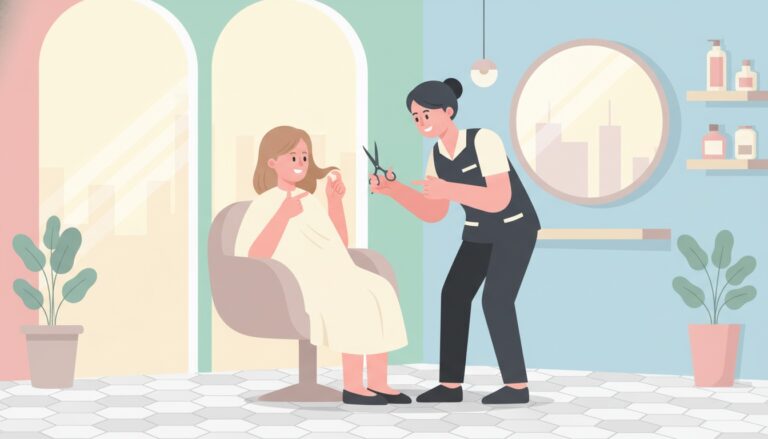
Don’t Cry at the Salon! How to Ask for “Just a Trim” in Korean
Introduction
Hello, this is Daily Hangul!
Have you ever walked into a hair salon in a foreign country, asked for a “little cut,” and walked out looking like you joined the military? It’s a common nightmare.
Since I haven’t been with you in the salon personally, I’ll share a synthetic example based on stories from many of my students. A student once told a stylist, “머리 잘라 주세요 (Meori jalla juseyo – Please cut my hair),” thinking it meant “trim.” The stylist, hearing “cut,” chopped off 10cm instead of the intended 1cm. The student was too polite to scream, but they wore a hat for a month.
Textbooks often teach “Jareuda (to cut)” but rarely explain the subtle art of “Dadeumda (to trim).” In Korea, beauty standards are high, and specific words matter. Today, let’s learn how to keep your length and style intact.
Summary: Survival Korean at the Salon
Here is your safety kit for today:
- 다듬어 주세요 (Dadeumeo juseyo): Please trim it.
- 기장은 그대로 (Gijang-eun geudaero): Keep the length as is.
- 숱 치지 마세요 (Sut chiji maseyo): Don’t thin it out.
When to use: Whenever you visit a Miyongsil (Hair Salon).
Level: A2 (Essential for daily life). Knowing the difference between “Cut” and “Trim” saves tears.
Table of Contents
- Today’s Core Expressions: Deep Dive
- Textbook vs. Real Korean
- Nuance Thermometer: Rude vs. Polite
- Real Life Scenario: Hongdae Salon
- Shadowing Challenge
- FAQ: Tipping & Perms
- Final Quiz
Today’s Core Expressions Deep Dive
1. 다듬어 주세요 (Dadeumeo juseyo)
- Meaning: Please trim it / Tidy it up.
- Usage & Register:
- To whom: The hair stylist (designer).
- Tone: Polite request (Haeyo-che / 해요체).
- Tutor’s Secret Note:
- If you say “Cut” (잘라 주세요), they focus on removing length. If you say “Trim” (다듬어 주세요), they focus on organizing the ends. Use this when you want to look neat but keep the style.
- Warning: If you just say “Yes” to everything the stylist asks after this, they might add a perm or treatment. Listen carefully!
- Pronunciation Clinic:
- Link the sound: [Da-deu-meo] (다드머).
- Full: Da-deu-meo ju-se-yo.
- Examples:
- 길이만 살짝 다듬어 주세요. (Giliman saljjak dadeumeo juseyo.)
- Please just trim the length slightly.
- 상한 것만 다듬어 주세요. (Sanghan geomman dadeumeo juseyo.)
- Please just trim the damaged ends (split ends).
- 앞머리 좀 다듬어 주세요. (Apmmeori jom dadeumeo juseyo.)
- Please trim my bangs a little.
- 길이만 살짝 다듬어 주세요. (Giliman saljjak dadeumeo juseyo.)
- Alternatives:
- 정리해 주세요 (Jeongrihae juseyo): Please tidy it up (similar nuance).
- 조금만 잘라 주세요 (Jogeumman jalla juseyo): Please cut just a little bit.
- Mini Quiz:
- Q: How do you say “Please trim the bangs”?
-
Click to see answer
앞머리 다듬어 주세요 (Apmmeori dadeumeo juseyo)
2. 기장은 유지해 주세요 (Gijang-eun yujihae juseyo)
- Meaning: Please keep the length (don’t make it shorter).
- Usage & Register:
- Use this before the scissors touch your hair. It’s a strong preference statement.
- Tutor’s Secret Note:
- “Gijang” (기장) is a slightly more professional word for “Length” than “Giri” (길이), though both are used. Using “Gijang” makes you sound like you know hair terminology.
- Pronunciation Clinic:
- Gi-jang-eun yu-ji-hae ju-se-yo.
- Examples:
- 기장은 건드리지 마세요. (Gijang-eun geondeuriji maseyo.)
- Please don’t touch the length.
- 기장은 유지하면서 층만 내 주세요. (Gijang-eun yujihamyeonseo cheungman nae juseyo.)
- Please keep the length but add some layers.
- 전체 기장은 그대로 해 주세요. (Jeonche gijang-eun geudaero hae juseyo.)
- Please leave the overall length as it is.
- 기장은 건드리지 마세요. (Gijang-eun geondeuriji maseyo.)
3. 숱 (안) 쳐 주세요 (Sut (an) chyeo juseyo)
- Meaning: Please (don’t) thin it out.
- Usage & Register:
- 숱 치다 (Sut chida): To thin out hair (remove bulk/volume).
- Tutor’s Secret Note:
- Korean stylists are experts at “thinning” to make hair feel lighter. If you have thin hair, you MUST say “숱 치지 마세요 (Don’t thin it).” If you have very thick hair, you might want to say “숱 좀 쳐 주세요 (Please thin it out).”
- Pronunciation Clinic:
- “Sut” sounds like Soot. “Chyeo” is a strong sound.
- Sut chi-ji ma-se-yo.
- Examples:
- 숱은 치지 말아 주세요. (Suteun chiji mara juseyo.)
- Please do not thin it out.
- 너무 무거워요. 숱 좀 쳐 주세요. (Neomu mugeowoyo. Sut jom chyeo juseyo.)
- It’s too heavy. Please thin it out a bit.
- 길이는 놔두고 숱만 쳐 주세요. (Girineun nwadugo summan chyeo juseyo.)
- Leave the length, just thin it out.
- 숱은 치지 말아 주세요. (Suteun chiji mara juseyo.)
Textbook vs. Real Korean
| Feature | Book Korean (Textbook) | Real Korean (Street/Salon) |
|---|---|---|
| Expression | 머리를 자르고 싶어요. (Meorireul jareugo sipeoyo) |
커트만 하려고요. (Keoteuman haryeogoyo) |
| Nuance | Grammatically correct, but sounds like a stiff sentence translation. “I desire to cut hair.” | “I’m just planning to do a cut.” (Casual, natural flow). |
| Precision | 조금만 잘라 주세요. (Jogeumman jalla juseyo) |
1센티만 다듬어 주세요. (Il-senti-man dadeumeo juseyo) |
| Why? | “A little” is subjective. | Using specific measurements (cm) or “trim” avoids accidents. |
Situation Checklist:
* Making an appointment: “커트 예약하고 싶어요.” (I want to book a haircut.)
* Sitting in the chair: “다듬어 주세요.” (Trim, please.)
Analysis: The ‘Command’ Thermometer
How you end your sentence changes the “politeness temperature” in a service setting.
| Level | Expression | Feel/Nuance |
|---|---|---|
| 1 (Rude) | 잘라. (Jalla) | “Cut it.” (You are starting a fight). |
| 2 (Casual) | 잘라 줘. (Jalla jwo) | “Cut it for me.” (Only for close friends). |
| 3 (Standard) | 잘라 주세요. (Jalla juseyo) | “Please cut it.” (Standard, safe). |
| 4 (Polite) | 다듬어 주시겠어요? (Dadeumeo jusigesseoyo?) | “Would you mind trimming it?” (Very gentle). |
| 5 (Specific) | 이 사진처럼 해 주세요. (I sajin-cheoreom hae juseyo) | “Please do it like this photo.” (The safest method!). |
Real Life Scenario: Role Play
Setting: A trendy hair salon in Gangnam, 2:00 PM.
Characters: Stylist (S) and Guest (G).
S: 어서 오세요! 예약하셨나요?
(Eoseo oseyo! Yeyak-hasyeonnayo?)
Welcome! Did you make a reservation?
G: 네, 2시에 예약했어요.
(Ne, dusi-e yeyak-haesseoyo.)
Yes, I booked for 2 o’clock.
S: 오늘 어떻게 해 드릴까요?
(Oneul eotteoke hae deurilkkayo?)
How should we do your hair today?
G: 길이는 많이 자르지 말고, 끝만 살짝 다듬어 주세요.
(Girineun mani jareuji malgo, kkeunman saljjak dadeumeo juseyo.)
Don’t cut much off the length, just trim the ends slightly.
S: 네, 알겠습니다. 샴푸 먼저 도와드릴게요.
(Ne, algesseumnida. Syampu meonjeo dowadeurilgeyo.)
Okay, understood. I’ll help you with the shampoo first.
💡 Culture Tip:
In Korea, “Cut” usually includes a shampoo service and styling (blow-dry) afterwards. The cost is all-inclusive. Don’t be surprised if they lead you to the shampoo chair immediately!
Shadowing Challenge
Let’s practice the magic phrase to save your hair. Repeat this 3 times!
“Please keep the length, just trim the split ends.”
기장은 유지하고, 상한 것만 다듬어 주세요.
(Gi-jang-eun yu-ji-ha-go, sang-han geom-man da-deu-meo ju-se-yo)
- [ ] Attempt 1 (Slow)
- [ ] Attempt 2 (Natural Speed)
- [ ] Attempt 3 (Confident Tone)
Key Pronunciation: Make sure to pronounce “Sang-han” (Damaged) clearly so they know what to remove!
FAQ (Frequently Asked Questions)
Q1: Do I need to tip the hair stylist in Korea?
* A: No. Tipping is not part of Korean culture, even in high-end salons. The price listed is the final price. A sincere “Gamsahamnida” (Thank you) is enough.
Q2: How do I say “Dye” and “Perm”?
* A: Simple! Konglish is often used.
* Dye: 염색 (Yeom-saek)
* Perm: 파마 (Pa-ma) – Note: It’s Pama, not Perm.
* Ex: “파마 하고 싶어요.” (I want to get a perm.)
Q3: Can I show a picture from Instagram?
* A: Absolutely. It is the most recommended way to communicate. Say “이 사진이랑 똑같이 해 주세요” (I sajin-irang ttokkachi hae juseyo – Please do it exactly like this photo).
Wrap-up & Mission
Today’s Summary: If you want a small change, say “다듬어 주세요” (Trim), not “잘라 주세요” (Cut).
Today’s Mission:
Next time you look in the mirror, practice pointing to your hair and saying: “Gi-jang-eun geu-dae-ro!” (Length stays as is!).
Comment Question:
Have you ever had a funny or scary haircut experience in Korea? Tell me in the comments!
Final Quiz
1. Which phrase should you use if you want to keep your current length?
a) 삭발해 주세요 (Sakbalhae juseyo)
b) 기장은 유지해 주세요 (Gijang-eun yujihae juseyo)
c) 짧게 잘라 주세요 (Jjalge jalla juseyo)
2. What does “숱 치다 (Sut chida)” mean?
a) To dye hair
b) To shampoo
c) To thin out hair
3. Fill in the blank: “Please trim just the ends.”
끝만 살짝 [ _______ ] 주세요.
Click to reveal answers
1. b) 기장은 유지해 주세요
2. c) To thin out hair
3. 다듬어 (Dadeumeo)
Frequently Asked Questions (FAQ)
Q: What does "다듬어 주세요 (Dadeumeo juseyo)" mean in Korean and how do you pronounce it?
A: In Korean, "다듬어 주세요 (Dadeumeo juseyo)" is pronounced [see lesson guide] and means: Please trim it / Tidy it up.
Q: What does "기장은 유지해 주세요 (Gijang-eun yujihae juseyo)" mean in Korean and how do you pronounce it?
A: In Korean, "기장은 유지해 주세요 (Gijang-eun yujihae juseyo)" is pronounced [see lesson guide] and means: Please keep the length (don't make it shorter).
Q: What does "숱 (안) 쳐 주세요 (Sut (an) chyeo juseyo)" mean in Korean and how do you pronounce it?
A: In Korean, "숱 (안) 쳐 주세요 (Sut (an) chyeo juseyo)" is pronounced [see lesson guide] and means: Please (don't) thin it out.







