

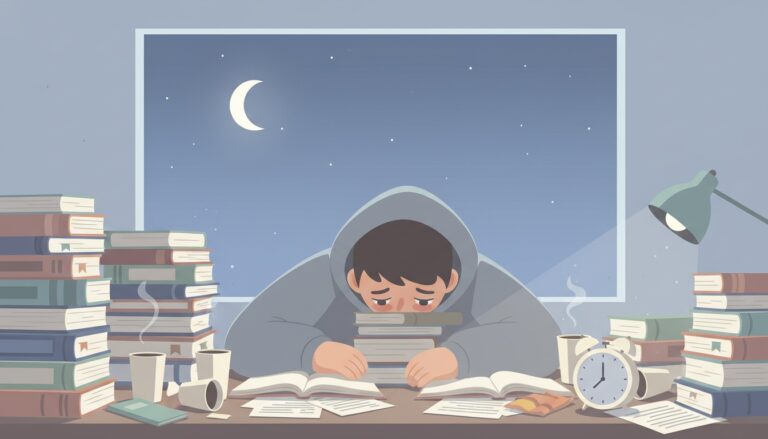
Surviving Exam Week in Korea: “My Blood Type is Americano” ☕
Introduction
“Hello, this is Daily Hangul!”
Are your eyes red? Is there an empty coffee cup on your desk? If you are studying in Korea, you will inevitably face the dreaded “Exam Week” (sihyeom gigwan / 시험 기간).
I often receive questions from international students about how to express their exhaustion. Today, I’ll share a Composite Case based on stories from several students (let’s call them “Alex” and “Sarah”) attending universities in Seoul. They all said the same thing:
“I wanted to tell my Korean friend that I stayed up all night studying, but I accidentally said I ‘stood up the night’ and they looked confused. Also, everyone keeps talking about ‘lightning’ (thunder) before exams. What does that mean?”
In Korean university culture, exam week is a battlefield. Textbooks don’t teach you the desperate slang students use at 3 AM in the library. Today, let’s learn the real survival Korean for when you are running on caffeine.
Summary: Survival Korean for Exams
Here are the 3 expressions we will master today.
- 밤새우다 (Bam-sae-u-da): To pull an all-nighter.
- 벼락치기 (Byeo-rak-chi-gi): Cramming (studying at the last minute).
- 카페인 수혈 (Ka-pe-in Su-hyeol): Caffeine transfusion (drinking coffee desperately).
- Safe to use: Friends, classmates, and close colleagues.
- Level B1 (Intermediate): You can describe your physical condition and study habits beyond just saying “I am tired.”
Table of Contents
- Today’s Deep Dive Expressions
- Textbook vs. Real Korean
- Unique Analysis: The Tiredness Thermometer
- Real Role Play: The 24-Hour Cafe
- Shadowing Challenge
- FAQ
- Final Quiz
Today’s Core Expressions Deep Dive
1. 밤새우다 (Bam-sae-u-da)
- Meaning: To stay up all night (Literally: To make the night stand up white)
- Usage & Register:
- Friends: 밤샜어 (Bam-saess-eo)
- Polite: 밤새웠어요 (Bam-sae-woss-eo-yo)
- Tutor’s Secret Note:
- Koreans often shorten
밤새우다to밤새다. While밤새우다is the transitive verb (I stayed up), in casual speech, almost everyone says “나 어제 밤샜어” (I stayed up yesterday). - Warning: Don’t confuse it with
밤 (Chestnut)+새 (Bird). Context is key!
- Koreans often shorten
- Pronunciation Clinic:
- It is not “Bam-sae-woo-da”. The
우 (u)is often swallowed or shortened in fast speech to sound like [Bam-saet-seo] (for past tense).
- It is not “Bam-sae-woo-da”. The
- Examples:
- [Friend] 어제 시험 공부하느라 밤샜어.
- (Eo-je si-hyeom gong-bu-ha-neu-ra bam-saess-eo.)
- “I stayed up all night studying for the exam yesterday.”
- [Office] 프로젝트 때문에 며칠째 밤새우고 있어요.
- (Peu-ro-jek-teu ttae-mun-e mye-chil-jjae bam-sae-u-go iss-eo-yo.)
- “I’ve been pulling all-nighters for days because of the project.”
- [General] 밤새우지 마세요. 건강에 나빠요.
- (Bam-sae-u-ji ma-se-yo. Geon-gang-e na-ppa-yo.)
- “Don’t stay up all night. It’s bad for your health.”
- [Friend] 어제 시험 공부하느라 밤샜어.
- Alternatives:
- Casual: 날 밤 깠어 (Nal bam kkass-eo) – Slang, very informal.
- Polite: 철야했어요 (Cheol-ya-haess-eo-yo) – Used in formal/work contexts.
- Mini Quiz:
-
Click to see the answer
Q: I didn’t sleep at all. -> 나 어제 ____.
A: 밤샜어 (Bam-saess-eo)
-
2. 벼락치기 (Byeo-rak-chi-gi)
- Meaning: Cramming (Literally: Lightning striking)
- Usage & Register:
- Mostly used among students or when talking about urgent preparation.
- Tutor’s Secret Note:
- This implies you were lazy until the last moment and are now rushing like lightning (
벼락). It’s a very common, slightly self-deprecating humor in Korea.
- This implies you were lazy until the last moment and are now rushing like lightning (
- Pronunciation Clinic:
- Link the sounds:
[Byeo-rak-cchi-gi]. Thek(ㄱ) at the bottom of 락 meetsch(ㅊ), making the sound stronger.
- Link the sounds:
- Examples:
- [Friend] 나 이번 시험 완전 벼락치기야.
- (Na i-beon si-hyeom wan-jeon byeo-rak-chi-gi-ya.)
- “I am totally cramming for this exam.”
- [Advice] 벼락치기는 기억에 오래 안 남아요.
- (Byeo-rak-chi-gi-neun gi-eok-e o-rae an nam-a-yo.)
- “Cramming doesn’t stay in your memory for long.”
- [Result] 벼락치기로 공부했는데 A받았어!
- (Byeo-rak-chi-gi-ro gong-bu-haess-neun-de A bad-ass-eo!)
- “I crammed, but I got an A!”
- [Friend] 나 이번 시험 완전 벼락치기야.
3. 카페인 수혈 (Ka-pe-in Su-hyeol)
- Meaning: Caffeine transfusion (Drinking coffee as if it were a medical emergency)
- Usage & Register:
- Humorous slang. Use it with peers or on social media.
- Tutor’s Secret Note:
- Koreans love Iced Americano (Ah-Ah). When we are extremely tired, we don’t say “I’m drinking coffee.” We say “I am receiving a transfusion” (
수혈) because it feels like life-saving medicine.
- Koreans love Iced Americano (Ah-Ah). When we are extremely tired, we don’t say “I’m drinking coffee.” We say “I am receiving a transfusion” (
- Examples:
- [Cafe] 지금 당장 카페인 수혈이 필요해.
- (Ji-geum dang-jang ka-pe-in su-hyeol-i pil-yo-hae.)
- “I need a caffeine transfusion right now.”
- [Friend] 아아(아이스 아메리카노)로 수혈하러 가자.
- (Ah-Ah-ro su-hyeol-ha-reo ga-ja.)
- “Let’s go get a transfusion with Iced Americano.”
- [Cafe] 지금 당장 카페인 수혈이 필요해.
Textbook vs. Real Korean
| Situation | Textbook Korean (Book Korean) | Real Korean (Spoken/Slang) |
|---|---|---|
| Staying up | 밤을 꼬박 새웠습니다. (Bam-eul kko-bak sae-woss-seup-ni-da.) “I stayed up the whole night.” |
나 어제 밤샜어. (Na eo-je bam-saess-eo.) “I pulled an all-nighter.” |
| Studying fast | 급하게 시험 공부를 준비했어요. (Geup-ha-ge si-hyeom gong-bu-reul jun-bi-haess-eo-yo.) “I prepared for the exam hurriedly.” |
완전 벼락치기 중이야. (Wan-jeon byeo-rak-chi-gi jung-i-ya.) “I’m totally cramming right now.” |
✅ Checklist:
* Use Textbook Korean when talking to a professor or doctor.
* Use Real Korean when complaining to friends or posting on Instagram stories.
Unique Analysis: The ‘Tiredness’ Thermometer
How tired are you really? Choose the right word to express your fatigue level.
| Level | Expression (Korean/Romanization) | Meaning | Nuance |
|---|---|---|---|
| Lv. 1 | 피곤해요 (Pi-gon-hae-yo) | I’m tired. | Standard. Just normal fatigue. |
| Lv. 3 | 졸려요 (Jol-ryeo-yo) | I’m sleepy. | Your eyes are closing. |
| Lv. 5 | 녹초가 됐어요 (Nok-cho-ga dwaess-eo-yo) | I’m exhausted. | Literally “became a melted candle.” |
| Lv. 10 | 좀비 같아요 (Jom-bi gat-a-yo) | I’m like a zombie. | Brain is dead, only body is moving. |
| MAX | 기절할 것 같아요 (Gi-jeol-hal geot gat-a-yo) | I feel like fainting. | You need a bed immediately. |
Real Scenario Role Play
Situation: A 24-hour cafe near a university in Seoul. 2:00 AM. Two students are studying.
Characters:
* Mina: Hasn’t slept for 24 hours.
* Jason: International student, trying to focus.
Jason: 미나야, 너 괜찮아? 눈이 좀비 같아.
(Mina-ya, neo gwaen-chan-a? Nun-i jom-bi gat-a.)
“Mina, are you okay? Your eyes look like a zombie.”
Mina: 어제 밤새우고 지금 또 공부하는 거야. 죽겠어.
(Eo-je bam-sae-u-go ji-geum tto gong-bu-ha-neun geo-ya. Juk-gess-eo.)
“I pulled an all-nighter yesterday and I’m studying again. I feel like dying.”
Jason: 나도 이번 시험 완전 벼락치기야. 진도가 너무 많아.
(Na-do i-beon si-hyeom wan-jeon byeo-rak-chi-gi-ya. Jin-do-ga neo-mu man-a.)
“I’m also totally cramming for this exam. There’s too much material.”
Mina: 야, 안 되겠다. 나랑 편의점 갈래?
(Ya, an doe-gess-da. Na-rang pyeon-ui-jeom gal-lae?)
“Hey, I can’t take it. Wanna go to the convenience store with me?”
Jason: 왜? 배고파?
(Wae? Bae-go-pa?)
“Why? Are you hungry?”
Mina: 아니, 카페인 수혈하러. 커피 우유라도 마셔야겠어.
(A-ni, ka-pe-in su-hyeol-ha-reo. Keo-pi u-yu-ra-do ma-syeo-ya-gess-eo.)
“No, to get a caffeine transfusion. I need to drink coffee milk or something.”
💡 Culture Tip: Korean university areas have many 24-hour cafes (Study Cafes). It is common to see students sleeping on tables there. Don’t be surprised!
Shadowing & Speaking Challenge
Let’s practice the most useful phrase for students. Repeat this 3 times!
“오늘 밤새워야 해서 커피 마셔야 해요.”
(O-neul bam-sae-wo-ya hae-seo keo-pi ma-syeo-ya hae-yo.)
(I have to stay up all night today, so I need to drink coffee.)
- [ ] Attempt 1 (Slow)
- [ ] Attempt 2 (Normal Speed)
- [ ] Attempt 3 (Emotion: Desperate)
🗣️ Pronunciation Point:
When saying 해-서 (hae-seo), don’t chop it. Connect it smoothly like “haeseo”.
FAQ (Frequently Asked Questions)
Q1: Can I say “One night two days” (1박 2일) instead of “밤새우다”?
A: No! 1박 2일 (Il-bak i-il) is strictly for travel/trips. If you say “I did 1박 2일 studying,” it sounds like you went on a study trip. Use 밤새우다 for staying awake.
Q2: Is “벼락치기” a bad word?
A: Not at all. It’s informal, but not a swear word. Teachers know students do it, and students admit it freely.
Q3: How do I say “Good luck on your exam”?
A: Say “시험 잘 봐!” (Si-hyeom jal bwa! – Lit: Watch the exam well). Don’t say “Good luck” (Hang-un-eul bil-eo) directly; it sounds translated.
Conclusion & Action Item
Today’s Summary: We learned how to express the pain of exam week: Bam-sae-u-da (All-nighter), Byeo-rak-chi-gi (Cramming), and Caffeine Su-hyeol (Caffeine transfusion).
Mission:
Next time you drink coffee to stay awake, post a photo on social media with the caption: “오늘 카페인 수혈 중!” (Getting a caffeine transfusion today!)
Question for you:
Do you prefer 벼락치기 (Cramming) or studying in advance? Tell me in the comments!
Final Quiz
1. Which word fits in the blank?
“I didn’t study until today. I have to do _______.”
a) 카페인 (Caffeine)
b) 벼락치기 (Cramming)
c) 수혈 (Transfusion)
2. How do you say “I stayed up all night” naturally to a friend?
a) 나 어제 1박 2일 했어.
b) 나 어제 밤샜어.
c) 나 어제 밤 일어났어.
3. Fill in the blank:
To drink coffee desperately is called “Caffeine ______”.
(Answer in Korean or English)
⬇️ Click to check answers
1. b) 벼락치기
2. b) 나 어제 밤샜어.
3. 수혈 (Transfusion)
Frequently Asked Questions (FAQ)
Q: What does "밤새우다 (Bam-sae-u-da)" mean in Korean and how do you pronounce it?
A: In Korean, "밤새우다 (Bam-sae-u-da)" is pronounced [see lesson guide] and means: To stay up all night (Literally: To make the night stand up white)
Q: What does "벼락치기 (Byeo-rak-chi-gi)" mean in Korean and how do you pronounce it?
A: In Korean, "벼락치기 (Byeo-rak-chi-gi)" is pronounced [see lesson guide] and means: Cramming (Literally: Lightning striking)
Q: What does "카페인 수혈 (Ka-pe-in Su-hyeol)" mean in Korean and how do you pronounce it?
A: In Korean, "카페인 수혈 (Ka-pe-in Su-hyeol)" is pronounced [see lesson guide] and means: Caffeine transfusion (Drinking coffee as if it were a medical emergency)







