

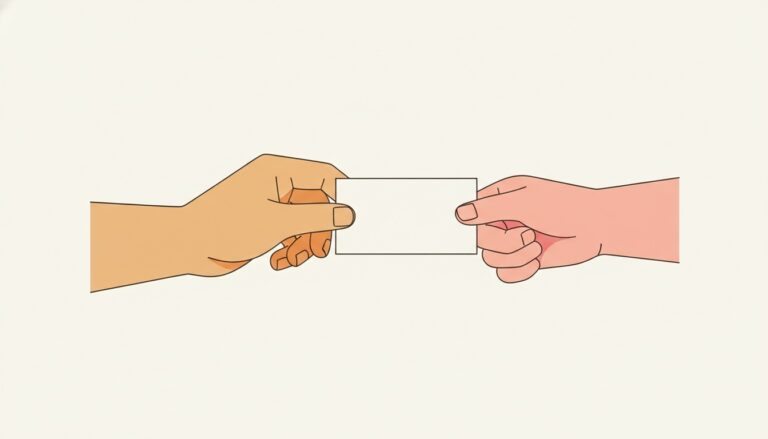
Stop Being Rude by Accident! The Magic of “Two Hands” in Korea 🤲
Introduction
Hello, this is Daily Hangul!
Have you ever handed a credit card to a cashier in Seoul, only to feel a slightly cold or awkward vibe in return? You smiled, you said “Thank you,” but something felt off.
Composite Case (Synthesized from multiple learner experiences):
We frequently hear stories from students like “Alex” (a pseudonym for a common pattern). Alex visited a Korean convenience store, bought a bottle of water, and casually handed his credit card to the clerk with one hand while checking his phone with the other. The clerk took it stiffly and didn’t make eye contact. Alex asked us, “Was it my pronunciation?”
Actually, it wasn’t what he said, but what he did. In Korea, your hands speak as loudly as your mouth. Even if your grammar is perfect A2 level, using one hand can unintentionally signal, “I don’t respect you.”
Today, we will fix this instantly so you can be the most polite foreigner in the room!
At a Glance
- Today’s Focus: The “Two-Hand Rule” (Giving & Receiving).
- Safe Zone: Use this with elders, bosses, shop staff, and strangers.
- Level: Essential Culture (A0~A2). This is critical because language without culture can lead to misunderstandings.
Table of Contents
- Deep Dive: The Art of Giving
- Textbook vs. Real Life
- Analysis: Politeness Thermometer
- Role Play: Convenience Store
- Shadowing Challenge
- FAQ
Today’s Core Expressions: Deep Dive
1. 두 손으로 드리기 (Du soneuro deurigi)
- Meaning: Giving with two hands
- Usage & Register:
- Who: To anyone older, higher in rank, or providing a service (customer to staff).
- Style: Respectful body language.
- Tutor’s Secret Note:
Using two hands isn’t just about “rules.” It signifies Jeong (정 – affection/connection) and that you are giving your full attention to the other person.- Warning: Handing something (especially money or cards) with one hand while looking away is considered very rude, almost like tossing trash.
- Pronunciation Clinic:
- 드리기 (Deurigi): The ‘r’ in ‘ri’ is a soft flap, like the ‘dd’ in ‘ladder’, not the harsh English ‘R’.
- Examples:
- (Cafe) 여기 카드 있어요. (Yeogi kadeu isseoyo.) – Here is my card. (Handing it with two hands)
- (Gift) 이거 선물이에요. (Igeo seonmurieyo.) – This is a gift.
- (Office) 서류 드립니다. (Seoryu deurimnida.) – Here are the documents.
- Alternative:
- More Casual: Right hand gives, left hand touches the right elbow (The “Elbow Support”).
- More Formal: Full bow while extending both arms fully.
- Mini Quiz:
When giving a business card to a CEO, which hand gesture is best?Click to see answer
Holding the card with both hands at the corners, facing the recipient.
2. 잘 부탁드립니다 (Jal butakdeurimnida)
- Meaning: Please take good care of me / I look forward to working with you.
-
Usage & Register:
- Who: Business meetings, first introductions.
- Style: Formal (Haeyo-che or Hamnida-che).
- Tutor’s Secret Note:
This phrase often accompanies the “Two-Hand” gesture when exchanging business cards. It is the magic phrase that seals the deal on your politeness. -
Pronunciation Clinic:
- 부탁 (Butak): The ‘k’ (ㄱ) at the end stops abruptly. It’s not “Butak-eu,” just “Butak.”
- Examples:
- (Meeting) 제 명함입니다. 잘 부탁드립니다. (Je myeonghamimnida. Jal butakdeurimnida.) – Here is my business card. Please take care of me.
- (New Job) 열심히 하겠습니다. 잘 부탁드립니다! (Yeolsimhi hagesseumnida. Jal butakdeurimnida!) – I will work hard. I look forward to your guidance!
- (Request) 이거 좀 잘 부탁드려요. (Igeo jom jal butakdeuryeoyo.) – Please handle this well for me.
Textbook vs. Real Korean
Context Comparison: How much physical effort is really needed?
| Type | Expression/Action | Nuance |
|---|---|---|
| Book Korean | Always hold the object with both hands tightly. | Very formal, traditional. Can feel stiff in a busy cafe. |
| Real Korean | Right hand gives, left hand lightly touches the right forearm or elbow. | “The Elbow Support.” Fast, efficient, but still very polite. |
Situation Checklist:
* Giving a gift to elders: Use Book Korean (Full two hands).
* Paying at Starbucks: Use Real Korean (Elbow support).
* Passing salt to a friend: One hand is fine (Casual).
Unique Analysis: The Politeness Thermometer
Let’s measure the “Respect Temperature” of your hand gestures.
| Level | Gesture | Meaning | Target Audience |
|---|---|---|---|
| Lv 1 (Cold) | One hand (Left hand often perceived worse if used alone). | “We are close friends” OR “I don’t care.” | Best friends, Children. |
| Lv 2 (Warm) | Right hand extends, left hand supports right elbow. | “I respect you, but let’s be quick.” | Cashiers, Taxi drivers, Acquaintances. |
| Lv 3 (Hot) | Right hand extends, left hand supports right wrist. | “I respect you a lot.” | Senior colleagues, older relatives. |
| Lv 4 (Boiling) | Both hands holding the object. | “Highest Honor.” | Bosses, Grandparents, Important Guests. |
Common Mistake Scenario:
* Situation: You hand money to a taxi driver with one hand.
* Result: He might not say “Thank you” or might throw the change back.
* Fix: Just touching your elbow with your other hand changes the temperature from Lv 1 to Lv 2 immediately.
Real Life Scenario: Role Play
Setting: A busy convenience store (Pyeonuijeom) in Hongdae. Saturday night.
Characters: Foreigner (Customer), Clerk (Part-timer).
Dialog:
Clerk: 봉투 필요하세요?
(Bongtu piryohaseyo?)
Do you need a bag?
Customer: 아니요, 괜찮아요. 여기 계산해 주세요.
(Aniyo, gwaenchanayo. Yeogi gyesanhae juseyo.)
No, I’m okay. Please calculate (check out) this.
(Action: Hands over the product using the Elbow Support technique)
Clerk: 4,500원입니다.
(Sacheon-obaekwon-imnida.)
It is 4,500 won.
Customer: 여기 카드요.
(Yeogi kadeuyo.)
Here is the card.
(Action: Gives card with two hands or right hand + left hand on wrist)
Clerk: (Takes it with two hands) 네, 감사합니다.
(Ne, gamsahamnida.)
Yes, thank you.
Culture Tip:
Did you notice? The clerk also receives your card with two hands. Politeness is often mirrored in Korea. If you are polite, they will be polite back.
Shadowing & Speaking Challenge
Let’s practice the “Elbow Support” gesture while speaking.
Script (Repeat 3 times):
“여기 있어요.” (Yeogi isseoyo.)
[Here it is.]
- [ ] Say it while touching your right elbow with your left hand.
- [ ] Say it while making eye contact and smiling slightly.
- [ ] Say it imagining you are handing a credit card to a cashier.
Pronunciation Point:
Link the sounds: Yeogi-isseoyo -> Yeogisseoyo (Smooth connection).
FAQ
Q1: Can I use my left hand to give things if I am left-handed?
* Answer: In Korea, the right hand is the dominant “polite” hand. Even if you are left-handed, it is safer to use your right hand (or both hands) for giving money or business cards to avoid misunderstanding.
Q2: Do I have to do this for my friends too?
* Answer: No! If you use two hands with a close friend of the same age, they might ask, “Why are you being so distant?” or “Did you do something wrong?” Keep it casual with friends.
Conclusion & Action Item
Summary:
In Korea, how you give something is just as important as what you give. Remember: One hand for friends, two hands (or elbow support) for everyone else.
Today’s Mission:
Next time you hand anything (even a pen or a phone) to someone today, try touching your elbow with your other hand. Notice if it changes your mindset!
Comment Question:
Have you ever had an awkward moment handing something over in a foreign country? Tell us your story below!
Final Quiz
- Which gesture is considered RUDE to a boss?
A) Giving with both hands
B) Giving with right hand supported by left hand
C) Tossing the object with one hand -
Where is the most casual place to put your supporting hand?
A) Your heart
B) Your elbow
C) Your head -
Complete the sentence: “Here is my card.” -> 제 ______입니다.
(Hint: M_ _ _ _ _ _ _)
Answers:
1. C
2. B
3. 명함 (Myeongham)
Frequently Asked Questions (FAQ)
Q: What does "두 손으로 드리기 (Du soneuro deurigi)" mean in Korean and how do you pronounce it?
A: In Korean, "두 손으로 드리기 (Du soneuro deurigi)" is pronounced [see lesson guide] and means: Giving with two hands
Q: What does "잘 부탁드립니다 (Jal butakdeurimnida)" mean in Korean and how do you pronounce it?
A: In Korean, "잘 부탁드립니다 (Jal butakdeurimnida)" is pronounced [see lesson guide] and means: Please take good care of me / I look forward to working with you.







