

Don’t Panic! How to Find Emergency Exits in Korea
Introduction
Hello, this is Daily Hangul!
Imagine you are exploring a massive underground shopping mall in Korea, like COEX in Seoul or the endless地下상가 (Jihasangga – underground shopping center) in Gangnam. Suddenly, the fire alarm rings, or the lights flicker out. Do you know how to ask for the nearest exit instantly?
Based on a composite case from several learners, many foreigners feel confident ordering coffee but freeze when they need to ask for safety directions because they fear being misunderstood in a high-pressure situation. They often rely on English “Exit,” but in a panicked crowd, distinct Korean phrases cut through the noise better.
Textbooks often teach rigid, formal sentences that are too long to say when your heart is racing. Today, we will learn the short, punchy, and survival-essential phrases to find your way out.
At a Glance: Today’s Summary
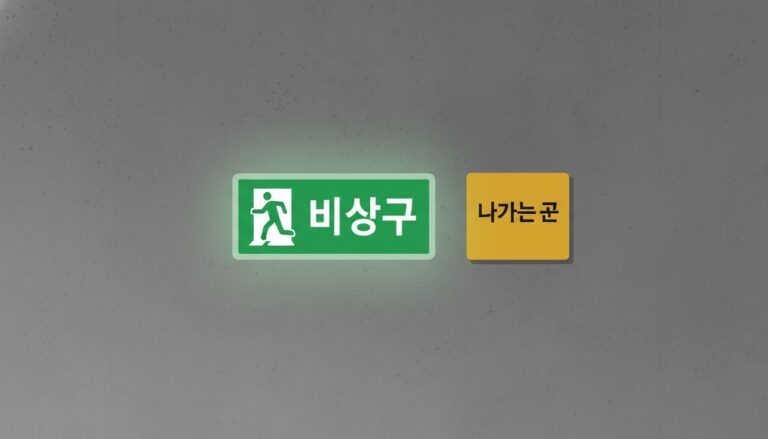
- Key Expressions: 비상구 (Emergency Exit), 나가는 곳 (Way Out), 도와주세요 (Help me).
- Safe Zone: These phrases are critical for emergencies but also useful for navigating complex subway stations.
- Level (A1): Even absolute beginners must know this because safety vocabulary takes priority over grammar.
Table of Contents
- Today’s Key Expressions: Deep Dive
- Textbook vs. Real Korean
- Unique Analysis: The “Urgency” Thermometer
- Real-Life Scenario: Role Play
- Shadowing Challenge
- FAQ
- Wrap-up & Quiz
Today’s Key Expressions: Deep Dive
1. 비상구 (Bisanggu / Emergency Exit)
- Meaning: Emergency Exit (Literal: Emergency Mouth/Opening)
- Usage & Register:
- To whom: Anyone (security guards, passersby).
- Tone: Use the polite ending -예요? (-yeyo?) quickly.
- Tutor’s Secret Note:
- Koreans distinguish between just “going out” and a “safety exit.” If you say this word, people immediately understand there is a safety issue.
- Warning: Don’t confuse this with Chulgu (출구 – regular exit). In a fire, you want a Bisanggu.
- Pronunciation Clinic:
- Bi-sang-gu [비상구]. Be careful with the ‘ng’ sound in sang.
- Examples:
- 비상구 어디예요? (Bisanggu eodiyeyo?) – Where is the emergency exit?
- 비상구 확인하세요. (Bisanggu hwaginhaseyo.) – Please check the emergency exit.
- 비상구가 잠겼어요. (Bisangguga jamgyeosseoyo.) – The emergency exit is locked.
- Alternatives:
- More Formal: 비상구는 어디에 있습니까? (Bisangguneun eodie isseumnikka?)
- More Urgent: 비상구! (Bisanggu! – Just shouting the noun)
2. 나가는 곳 (Naganeun got / Way out)
- Meaning: The place to go out (The way out)
- Usage & Register:
- To whom: General navigation (Subway staff, shop owners).
- Tone: Standard polite.
- Tutor’s Secret Note:
- This is the most common phrase you will see on yellow signs in subway stations. It’s softer than “Emergency Exit.”
- Pronunciation Clinic:
- Na-ga-neun got. The ‘t’ in got is a stopper (unreleased sound).
- Examples:
- 나가는 곳이 안 보여요. (Naganeun gosi an boyeoyo.) – I can’t see the way out.
- 나가는 곳 어디로 가요? (Naganeun got eodiro gayo?) – Which way is the exit?
- 저기가 나가는 곳이에요. (Jeogiga naganeun gosieyo.) – That is the way out over there.
3. 도와주세요 (Dowajuseyo / Please help me)
- Meaning: Help me (Polite request)
- Usage & Register:
- To whom: Anyone in an emergency.
- Tutor’s Secret Note:
- In a real disaster, scream this loud. Koreans will stop to look.
- Pronunciation Clinic:
- Do-wa-ju-se-yo. Stress the “Do” and “Ju”.
- Examples:
- 여기요! 도와주세요! (Yeogiyo! Dowajuseyo!) – Over here! Help me!
- 빨리 도와주세요. (Ppalli dowajuseyo.) – Please help me quickly.
- 다쳤어요, 도와주세요. (Dachyeosseoyo, dowajuseyo.) – I’m hurt, please help.
Mini Quiz (Click to check answer)
Q. Which word means “Emergency Exit”?
( ) 나가는 곳
( ) 비상구
Answer: 비상구 (Bisanggu)
Textbook vs. Real Korean
| Context | Textbook Korean (Book) | Real Korean (Reality) |
|---|---|---|
| Asking for location | 비상구는 어디에 있습니까? (Bisangguneun eodie isseumnikka?) |
비상구 어디예요? (Bisanggu eodiyeyo?) |
| Signage | 출구 (Exit) | 나가는 곳 (Way out) (Found on most overhead signs) |
Situation Check: use the Real Korean version. In an emergency, nobody uses the long formal sentence ending “-imnikka?” Speed is key.
Unique Analysis: The “Urgency Thermometer”
How you speak changes the reaction of people around you. Let’s look at how the tone shifts.
| Level | Expression (Korean/Romanization) | Feeling/Vibe |
|---|---|---|
| 1. Calm (Information) | 출구는 어디예요? (Chulguneun eodiyeyo?) | “I’m just finished shopping and want to leave.” |
| 3. Nervous (Lost) | 나가는 곳 좀 알려주세요. (Naganeun got jom allyeojuseyo.) | “I’m lost and a bit anxious. Can you guide me?” |
| 5. Emergency (Danger) | 비상구!! 도와주세요!! (Bisanggu!! Dowajuseyo!!) | “I am in danger! I need to escape NOW!” |
Real-Life Scenario: Role Play
Setting: Inside a crowded movie theater hallway. The fire alarm starts ringing. There is a bit of smoke.
Characters:
* Alex: Foreigner (You)
* Staff: Korean Safety Staff
Alex: (Coughing) 불이 났어요! 비상구 어디예요?
(Buri nasseoyo! Bisanggu eodiyeyo?)
There’s a fire! Where is the emergency exit?
Staff: 침착하세요! 저쪽입니다.
(Chimchakhaseyo! Jeojjogimnida.)
Stay calm! It is over there.
Alex: 문이 잠겼어요! 도와주세요!
(Muni jamgyeosseoyo! Dowajuseyo!)
The door is locked! Please help!
Staff: 이쪽으로 오세요. 나가는 곳은 반대편이에요.
(Ijjogeuro oseyo. Naganeun goseun bandaepyeonieyo.)
Come this way. The way out is on the opposite side.
Cultural Tip: In Korea, green signs with a “running man” indicate the 비상구 (Bisanggu). Follow the green lights on the floor or ceiling.
Shadowing & Speaking Challenge
Let’s practice for survival. Repeat this loop 3 times until it feels automatic.
Script:
“Where is the exit? Please help!”
비상구 어디예요? 도와주세요!
(Bisanggu eodiyeyo? Dowajuseyo!)
- [ ] Attempt 1 (Slowly check pronunciation)
- [ ] Attempt 2 (Normal speed)
- [ ] Attempt 3 (Urgent speed – imagine the alarm!)
Pronunciation Point: Don’t pause too long between “Bisanggu” and “Eodiyeyo.” Link them: Bisanggu-weodiyeyo.
FAQ (Frequently Asked Questions)
Q1: Can I just say “Exit” in English?
A: Most younger Koreans will understand “Exit.” However, older generations or in a loud environment, 비상구 (Bisanggu) is much safer and clearer.
Q2: What is the difference between 출구 (Chulgu) and 비상구 (Bisanggu)?
A: 출구 (Chulgu) is a general exit (like Subway Exit 1). 비상구 (Bisanggu) is specifically for emergencies (Fire Exit).
Wrap-up & Action Item
Safety comes first! Today we learned how to identify and ask for the emergency exit using the word 비상구 (Bisanggu).
Today’s Mission:
Next time you visit a public building (mall, cinema, subway), look for the green “running man” sign. Point to it and whisper “저기가 비상구예요” (That is the emergency exit).
Comment Question: Have you ever gotten lost in a Korean subway station? How did you find your way out?
Final Quiz
- Which word should you shout if you are in danger?
a) 안녕하세요 (Annyeonghaseyo)
b) 도와주세요 (Dowajuseyo)
c) 얼마예요 (Eolmayeyo) -
What does the green sign with a running man represent?
a) 화장실 (Restroom)
b) 매표소 (Ticket Office)
c) 비상구 (Emergency Exit) -
Fill in the blank: “Where is the way out?” -> _________ 어디예요?
(Hint: naga-neun got)
Click to see answers
1. b) 도와주세요
2. c) 비상구
3. 나가는 곳 (Naganeun got)
Frequently Asked Questions (FAQ)
Q: What does "비상구 (Bisanggu / Emergency Exit)" mean in Korean and how do you pronounce it?
A: In Korean, "비상구 (Bisanggu / Emergency Exit)" is pronounced [see lesson guide] and means: Emergency Exit (Literal: Emergency Mouth/Opening)
Q: What does "나가는 곳 (Naganeun got / Way out)" mean in Korean and how do you pronounce it?
A: In Korean, "나가는 곳 (Naganeun got / Way out)" is pronounced [see lesson guide] and means: The place to go out (The way out)
Q: What does "도와주세요 (Dowajuseyo / Please help me)" mean in Korean and how do you pronounce it?
A: In Korean, "도와주세요 (Dowajuseyo / Please help me)" is pronounced [see lesson guide] and means: Help me (Polite request)







