

Introduction
Hello, this is Daily Hangul!
Have you ever felt frozen when talking to a CEO about your direct manager? You want to be polite to your manager, but the CEO is much higher in rank. Who do you honor? Both? Neither?
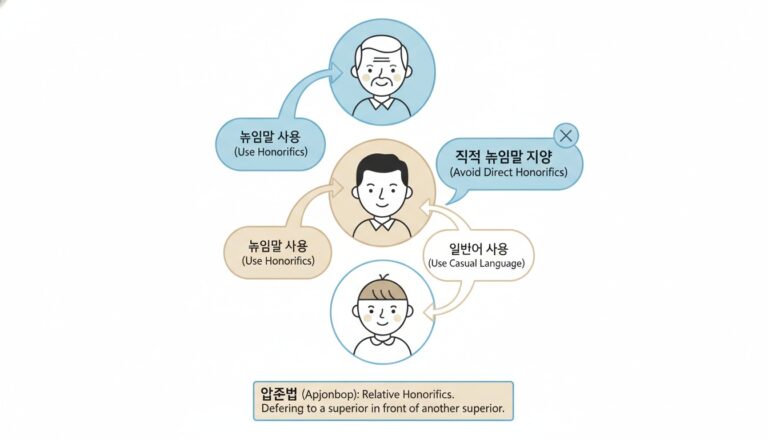
This is a classic dilemma even for native Koreans, known as Apjonbeop (압존법) or “Relative Honorifics.”
[Synthetic Case: The “Over-Polite” Mistake]
Since we don’t have a specific user submission today, let’s look at a composite case based on frequent questions from our intermediate learners.
“I am Mark, working at a Korean trading company. One day, the CEO asked me where my team manager (Mr. Kim) was. I wanted to be super polite, so I said, ‘Manager Kim honorably went (가셨습니다) to the bank.’ The CEO looked at me strangely. Later, a colleague told me I shouldn’t elevate the Manager in front of the CEO. But isn’t the Manager still my boss? I’m so confused!”
This situation is tricky because textbook rules and modern reality are slightly different. Let’s clear up this confusion so you can speak confidently without worrying about “honorific hierarchy.”
Summary: At a Glance
- Topic: Apjonbeop (Relative Honorifics) – Deciding politeness based on the listener’s rank.
- Safe Zone: Family (Use it) vs. Workplace (Don’t stress about it – rules have changed!).
- Level: B2 (Upper Intermediate). This is crucial for navigating complex social hierarchies without offending anyone.
Table of Contents
- What is Apjonbeop? (Family vs. Business)
- Core Expression Deep Dive
- Textbook vs. Real Korean (The 2011 Change)
- Tone Thermometer: How Strict is Your Office?
- Role Play: The CEO and the Manager
- Shadowing Challenge
- FAQ & Final Quiz
Today’s Core Expressions Deep Dive
1. The Traditional Rule (Family)
할아버지, 아빠가 왔어요.
(Harabeoji, appaga wasseoyo.)
- Meaning (Kor/Eng): 할아버지, 아버지가 (집에) 왔습니다. / Grandfather, Dad is here (came).
- Usage & Register: Used within the family when speaking to an elder (Grandfather) about someone lower than them (Father), even if that person is higher than you.
- Tutor’s Secret Note:
- Normally, you would say your father “honorably came” (오셨어요 / osyeosseoyo).
- However, in front of his father (your grandfather), elevating your dad is traditionally considered rude to the grandfather.
- Warning: If you say “아빠가 오셨어요” to your strict grandfather, he might think, “Who are you trying to elevate in front of me?”
- Pronunciation Clinic:
- Double Consonant: ‘빠’ in 아빠 (Appa) needs a tense, sharp sound (Pp), not a soft ‘b’.
- Examples:
- 할머니, 엄마 장보러 갔어요. (Halmeoni, eomma jangboreo gasseoyo.) – Grandma, Mom went grocery shopping. (Not gasyeosseoyo)
- 어머니, 형 지금 자요. (Eomeoni, hyeong jigeum jayo.) – Mother, my older brother is sleeping now. (Not jumuseyo)
- 아버님, 그 아이는 아직 안 들어왔어요. (Abeonim, geu aineun ajik an deureowasseoyo.) – Father-in-law, that child (my husband) hasn’t come in yet.
- Alternatives:
- Standard Honorific: 아빠가 오셨어요 (Appaga osyeosseoyo) – Accepted in modern, less strict families.
- Mini Quiz:
- To your Grandmother: “Mom is eating.” -> 엄마가 [ ??? ] 있어요.
-
Click to see answer
먹고 (meokgo) – Not 드시고 (deusigo)
2. The Modern Business Standard
사장님, 김 부장님 자리에 안 계십니다.
(Sajangnim, Kim Bujangnim jarie an gyesimnida.)
- Meaning (Kor/Eng): 사장님, 김 부장님은 지금 자리에 없습니다. / CEO, Manager Kim is not at his desk (honorific form).
- Usage & Register: Business settings. This is the current recommended standard.
- Tutor’s Secret Note:
- Crucial Update: In the past, you had to lower the Manager in front of the CEO (e.g., “김 부장은 자리에 없습니다”).
- HOWEVER, the National Institute of Korean Language changed the guideline in 2011. Now, recognizing mutual respect in the workplace is preferred. You can use honorifics (~시~, 님) for your manager even in front of the CEO.
- Pronunciation Clinic:
- Nasalization: ‘입니다/없습니다’ sounds like [im-ni-da/eop-sum-ni-da]. The ‘ㅂ’ becomes an ‘m’ sound.
- Examples:
- 팀장님, 이 대리님 외근 나가셨습니다. (Timjangnim, I Daerinim oegeun nagasyeotsseumnida.) – Team Leader, Assistant Manager Lee went out for external duty.
- 전무님, 박 과장님은 회의 중이십니다. (Jeonmunim, Park Kwajangnimeun hoe-ui jung-isimnida.) – Executive Director, Section Chief Park is in a meeting.
- 부장님, 최 대리님이 작성하셨습니다. (Bujangnim, Choe Daerinimi jakseonghasyeotsseumnida.) – Manager, Assistant Manager Choi wrote this.
- Mini Quiz:
- Modern Office: Talking to the Director about the Manager. “Manager Kim called.” -> 김 부장님이 [ ??? ].
-
Click to see answer
전화하셨습니다 (jeonhwahasyeotsseumnida)
Textbook vs. Reality: The Confusion Points
| Feature | Textbook / Traditional Rules (Old School) | Reality / Modern Guideline (New School) |
|---|---|---|
| Concept | Absolute Hierarchy. Never praise a superior if a higher superior is listening. | Mutual Respect. Rank matters, but everyone deserves basic honorifics. |
| Calling a Manager | “사장님, 김 부장은 외근 나갔습니다.” (Dropping ‘Nim’ and honorific verb) | “사장님, 김 부장님은 외근 나가셨습니다.” (Keeping ‘Nim’ and honorific verb) |
| Family Setting | Still somewhat strictly observed (Grandpa > Dad). | Getting looser, but safer to follow tradition with very old elders. |
| Workplace Setting | Only used in very conservative conglomerates or military. | Recommended standard for most companies today. |
When to use what?
* Family: Stick to Tradition (No honorifics for Dad in front of Grandpa).
* Business: Stick to Modern (Use honorifics for everyone), unless your boss explicitly corrects you.
Unique Analysis: The Tone Thermometer
How do you measure the “stiffness” of your workplace regarding Apjonbeop?
| Level | Atmosphere | How to Speak (To CEO about Manager) |
|---|---|---|
| 5 (Freezing) | Military / Very Conservative Conglomerate | “김 부장, 외근 나갔습니다.” (Remove ‘Nim’, Remove honorifics) |
| 4 (Cold) | Traditional Office | “김 부장님, 외근 나갔습니다.” (Keep ‘Nim’, Remove honorifics) |
| 3 (Warm) | Most Modern Companies (Safe Zone) | “김 부장님, 외근 나가셨습니다.” (Keep ‘Nim’, Keep honorifics) |
| 2 (Hot) | Startups / English Name Culture | “Mark가 나갔어요.” or “Mark님 나갔어요.” |
Tutor’s Tip: If you are unsure, start with Level 3. It is better to be “too polite” than “rude.” If the CEO says, “You don’t need to honor him,” then switch to Level 4 or 5.
Real Scenario Role Play
Setting: A meeting room in a generic Korean company. Junior employee Minji is talking to the Director (Isanim) about her direct boss, Manager Park (Bujangnim).
Director: (Looking around) 박 부장은 아직 안 왔나?
(Park Bujangeun ajik an wanna?)
Hasn’t Manager Park arrived yet?
Minji: 아, 이사님. 박 부장님은 지금 클라이언트와 통화 중이십니다.
(Ah, Isanim. Park Bujangnimeun jigeum keullaieonteuwa tonghwa jung-isimnida.)
Ah, Director. Manager Park is currently on a call with a client.
(Note: Minji uses modern standard – keeping ‘Nim’ and ‘Si’)
Director: 그래? 통화 끝나면 내 방으로 좀 오라고 해.
(Geurae? Tonghwa kkeunnamyeon nae bangeuro jom orago hae.)
Really? When the call ends, tell him to come to my office.
Minji: 네, 알겠습니다. 오시면 바로 말씀드리겠습니다.
(Ne, algesseumnida. Osimyeon baro malsseumdeurigesseumnida.)
Yes, understood. I will tell him as soon as he comes.
Manager Park: (Enters later) 이사님이 나 찾으셨어?
(Isanimi na chajeusyeosseo?)
Did the Director look for me?
Minji: 네, 부장님. 방금 오라고 하셨습니다.
(Ne, Bujangnim. Banggeum orago hasyeotsseumnida.)
Yes, Manager. He just said to come (to his office).
[Culture Tip]
Did you notice? Minji used “말씀드리다” (to tell – humble form) instead of “말하다”. When conveying a message to a superior, always use humble verbs!
Shadowing & Speaking Challenge
Let’s practice the “Safe Business Standard.” Repeat this 3 times.
Sentence: “Director, the Manager is in a meeting right now.”
Korean: 이사님, 부장님은 지금 회의 중이십니다.
Romanization: Isanim, Bujangnimeun jigeum hoe-ui jung-isimnida.
- [ ] Attempt 1 (Slowly, checking pronunciation)
- [ ] Attempt 2 (Natural speed)
- [ ] Attempt 3 (Confident eye contact, business tone)
Pronunciation Point:
* 회의 (Meeting): Pronounced as [hwe-i] or even [he-i] in fast speech. Don’t stress the ‘ui’ sound too much.
FAQ: Frequently Asked Questions
Q1: My boss scolded me for using ‘Nim’ for him in front of the CEO. Why?
A: Your boss is likely from the “Old School” generation or your company is very conservative (Level 5). In this specific case, follow your company culture. Say: “사장님, 김 부장은…” (Sajangnim, Kim Bujang-eun…).
Q2: Can I use Apjonbeop with friends?
A: No! With friends, we don’t use honorific hierarchy like this. You just use polite speech (Jondaemal) or casual speech (Banmal) depending on your closeness. Apjonbeop is strictly for Hierarchical Organizations (Family/Work).
Conclusion & Action Item
Summary:
Apjonbeop (lowering a superior in front of a higher superior) is still alive in families but is disappearing in workplaces. When in doubt at work, use honorifics for everyone!
Today’s Mission:
Imagine you are explaining where your boss is to the company President. Write down one sentence using the Modern Business Standard (using ~nim and ~si).
- Example: 사장님, 팀장님은 화장실 가셨습니다. (CEO, the Team Leader went to the restroom.)
Tell me in the comments: Does your language have a system for talking to bosses vs. super bosses? I’m curious!
Final Quiz
1. You are talking to your Grandfather about your Father. Which is correct (Traditional)?
A) 할아버지, 아버지가 주무세요. (Sleeping – Honorific)
B) 할아버지, 아빠 자요. (Sleeping – Plain form)
C) 할아버지, 아버님께서 취침하십니다. (Sleeping – Super Honorific)
2. You are in a modern, standard Korean company. You talk to the CEO about Manager Kim. Which is the safest choice?
A) 김 부장은 자리에 없어.
B) 김 부장은 자리에 없습니다.
C) 김 부장님은 자리에 안 계십니다.
3. [Fill in the blank]
The rule where you lower a superior’s status because the listener is even higher is called [ _______ ].
Answers:
1. B (In traditional family rules, you suppress honorifics for the “lower” superior)
2. C (Modern guidelines allow honorifics for mutual respect)
3. Apjonbeop (압존법)
Frequently Asked Questions (FAQ)
Q: What does ""말씀드리다"" mean in Korean and how do you pronounce it?
A: In Korean, ""말씀드리다"" is pronounced [to tell - humble form] and means: instead of "말하다". When conveying a message to a superior, always use humble verbs!
Q: What does "회의" mean in Korean and how do you pronounce it?
A: In Korean, "회의" is pronounced [Meeting] and means: Pronounced as [hwe-i] or even [he-i] in fast speech. Don't stress the 'ui' sound too much.







