

Don’t Wear Shoes Inside! 🚫 Essential Korean Phrases for Visiting a Friend’s Home
Introduction
Hello, this is Daily Hangul! 👋
Have you ever been invited to a Korean friend’s house? It’s a moment of excitement but also high anxiety for many learners.
Let me share a Composite Case (based on recurring learner experiences): A student named “Alex” once visited a Korean colleague’s home. Nervous about making a good impression, he walked straight into the living room wearing his sneakers because that was normal in his culture. The room went silent. The host’s mother looked at the floor in horror. Alex had to awkwardly backtrack to the entrance, remove his shoes, and wipe the floor.
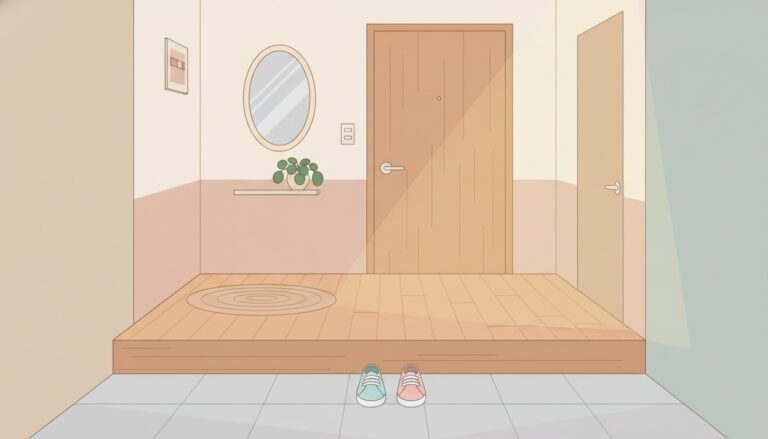
Today, we will prevent this “Alex moment.” In Korea, the Hyeon-gwan (Entryway) is a sacred border between the dirty outside world and the clean inside space. Textbooks teach you how to say hello, but they often miss the timing and the specific motions that go with the words. Let’s learn the real survival phrases for that critical first minute at the door.
Summary at a Glance
- Today’s Expressions:
- Entering politely: 실례하겠습니다 (Excuse me for interrupting/entering)
- Gratitude: 초대해 줘서 고마워요 (Thank you for inviting me)
- Logistics: 신발은 어디에 놓아요? (Where should I put my shoes?)
- Safety Level: Polite/Friendly (Safe for colleagues and friends)
- Difficulty: ⭐⭐ (B1) – Crucial for cultural adaptation beyond just grammar.
Table of Contents
- Deep Dive: Key Expressions
- Textbook vs. Real Korean
- Tutor’s Secret: The “Sock” Etiquette
- Real-Life Role Play
- Shadowing Challenge
- FAQ
- Final Quiz
Deep Dive: Key Expressions
1. 실례하겠습니다
- Pronunciation: [Sil-lye-ha-get-seum-ni-da]
- Meaning: Excuse me / Pardon me (literally: “I am about to commit a rudeness”)
Usage & Register:
* To whom: Elders, superiors, or when entering someone’s personal space for the first time.
* Style: Hapnida-che (Formal polite).
Tutor’s Secret Note 🤫:
Koreans use this even when they are invited! It shows humility. It implies, “I am disrupting the peace of your home by entering.”
* Warning: Do not shout this like a military command. Say it softly as you step in.
Pronunciation Clinic 👄:
* Liquidization (ㄹ+ㄹ): The ‘l’ sound is doubled. It is not Sil-rye, but Sil-lye.
Examples:
1. (Entering a boss’s office) 실례하겠습니다. (Sil-lye-ha-get-seum-ni-da) – Excuse me.
2. (Entering a friend’s house for the first time) 늦은 시간에 실례하겠습니다. (Neu-jeun si-ga-ne sil-lye-ha-get-seum-ni-da) – Excuse me for visiting at this late hour.
3. (Passing through a crowd) 잠시만 실례하겠습니다. (Jam-si-man sil-lye-ha-get-seum-ni-da) – Excuse me for a moment.
Alternatives:
* Polite: 실례합니다 (Sil-lye-ham-ni-da) – Slightly more present tense.
* Casual: 들어갈게 (Deu-reo-gal-ge) – I’m coming in (Only for close friends).
Mini Quiz:
When stepping over the threshold, you say: “_____하겠습니다!”
Click to see answer
실례 (Sil-lye)
2. 초대해 줘서 고마워요
- Pronunciation: [Cho-dae-hae jwo-seo go-ma-wo-yo]
- Meaning: Thank you for inviting me.
Usage & Register:
* To whom: Friends, colleagues, acquaintances.
* Style: Haeyo-che (Polite informal).
Tutor’s Secret Note 🤫:
It is polite to say this after you have taken off your shoes and are facing the host properly. Don’t say it while your back is turned and you are struggling with your shoelaces!
Pronunciation Clinic 👄:
* Linking: Jwo-seo flows together. Cho-dae-hae should be said smoothly, not choppy.
Examples:
1. 집에 초대해 줘서 고마워요. (Ji-be cho-dae-hae jwo-seo go-ma-wo-yo) – Thanks for inviting me to your home.
2. 맛있는 저녁 초대해 줘서 고마워요. (Ma-sin-neun jeo-nyeok cho-dae-hae jwo-seo go-ma-wo-yo) – Thanks for inviting me to a delicious dinner.
3. 바쁘실 텐데 초대해 줘서 감사합니다. (Ba-ppeu-sil ten-de cho-dae-hae jwo-seo gam-sa-ham-ni-da) – Thank you for inviting me even though you must be busy (Formal).
3. 신발은 어디에 놓아요?
- Pronunciation: [Sin-ba-reun eo-di-e no-a-yo?]
- Meaning: Where should I put my shoes?
Usage & Register:
* To whom: The host.
* Style: Haeyo-che (Polite informal).
Tutor’s Secret Note 🤫:
Even if you see other shoes, asking this question shows you are considerate and don’t want to clutter their entryway. It’s a “manners” question, not just a logistical one.
Pronunciation Clinic 👄:
* Liaison: Sin-bal-eun sounds like [Sin-ba-reun].
* Silent H: No-a-yo (The ‘h’ in 놓 is weakly pronounced or silent between vowels).
Examples:
1. 신발은 어디에 놓아요? (Sin-ba-reun eo-di-e no-a-yo?) – Where do I put my shoes?
2. 신발은 그냥 여기에 두면 돼요? (Sin-ba-reun geu-nyang yeo-gi-e du-myeon dwae-yo?) – Can I just leave my shoes here?
3. 신발장 안에 넣을까요? (Sin-bal-jang a-ne neo-eul-kka-yo?) – Shall I put them inside the shoe cabinet?
Textbook vs. Real Korean
| Context | Book Korean 📘 | Real Korean 🗣️ |
|---|---|---|
| Host greeting guest | 어서 오십시오. (Eoseo osipsio) Very formal, sounds like a hotel. |
어서 와요! / 들어와요! (Eoseo wayo / Deureo wayo) Come on in! (Standard polite) |
| Guest entering | 방문을 허락해 주셔서 감사합니다. I thank you for allowing the visit. (Robot style 🤖) |
초대해 줘서 고마워요. (Cho-dae-hae jwo-seo go-ma-wo-yo) Thanks for the invite. |
Situation Checklist:
* Professor’s house: Use Book Korean style (ending in -simnida).
* Co-worker/Friend’s house: Use Real Korean style (ending in -yo).
Tutor’s Analysis: The “Barefoot” Risk 🦶
Topic: The unspoken rule of socks.
In Western culture, taking off shoes might mean going barefoot. In Korea, going barefoot in someone else’s house is often considered rude, especially with elders. It looks too “raw” or intimate.
| Condition | Perception | Verdict |
|---|---|---|
| Socks | Clean, prepared, respectful. | ✅ Best |
| Stockings | Acceptable for formal visits. | ✅ Good |
| Barefoot | Too casual, potentially unhygienic? | ⚠️ Risky (Okay for close friends in summer) |
Survival Tip: If you are visiting a Korean home in summer and wearing sandals, bring a pair of clean socks in your bag. Put them on before you ring the doorbell. The host will be impressed by your manners!
Real-Life Role Play 🎬
Scenario: You (Guest) arrive at your Korean friend Min-ji’s apartment for a housewarming party. Min-ji opens the door.
Min-ji: 어서 와! 찾느라 힘들지 않았어? (Welcome! Was it hard to find?)
You: 아니에요, 금방 찾았어요. 초대해 줘서 고마워요.
(An-i-e-yo, geum-bang cha-ja-sseo-yo. Cho-dae-hae jwo-seo go-ma-wo-yo.)
No, I found it quickly. Thanks for inviting me.
Min-ji: 들어와. (Come in.)
You: (Stepping inside) 실례하겠습니다. 아, 신발은 어디에 놓아요?
(Sil-lye-ha-get-seum-ni-da. Ah, Sin-ba-reun eo-di-e no-a-yo?)
Excuse me. Ah, where should I put my shoes?
Min-ji: 그냥 거기 두면 돼. 내가 정리할게.
(Just leave them there. I’ll organize them.)
You: (Taking off shoes and turning them to face the door) 아니에요, 제가 할게요.
(A-ni-e-yo, je-ga hal-ge-yo.)
No, I’ll do it. (Shows good manners!)
Cultural Tip 💡: After taking off your shoes, it is polite to turn them around so the toes face the door (pointing out). This makes it easier to leave later and looks tidy.
Shadowing Challenge 🗣️
Instructions: Read this out loud 3 times. Focus on the flow of the conversation.
- 초대해 줘서 고마워요. (Cho-dae-hae jwo-seo go-ma-wo-yo)
- 실례하겠습니다. (Sil-lye-ha-get-seum-ni-da)
- 신발은 어디에 둘까요? (Sin-ba-reun eo-di-e dul-kka-yo?)
Checklist:
* [ ] Did you pronounce ‘Sil-lye’ with a double ‘L’?
* [ ] Did you use a soft, polite tone?
* [ ] Did you smile while saying ‘Gomawoyo’?
FAQ (Frequently Asked Questions)
Q1: Do I really have to take off my shoes? Even if the floor looks dirty?
A: Yes, absolutely. 100%. Even if the house is under renovation, you ask before keeping them on. Walking in with shoes is a major culture shock to Koreans.
Q2: What if I have a hole in my sock?
A: This is a classic embarrassing moment in K-dramas! 🧦 Always check your socks before visiting. If it happens, try to curl your toes… or just apologize with a laugh: 양말에 구멍이 났네요! (Yang-ma-re gu-meong-i nan-ne-yo! – Oops, there is a hole in my sock!).
Q3: Can I say “Silryehapnida” to a close friend?
A: To a “best friend” (BFF), it might sound too stiff. Just say “나 왔어!” (Na wa-sseo! – I’m here!) or “들어간다!” (Deu-reo-gan-da! – I’m coming in!). Use the formal version for colleagues or parents.
Wrap-up & Mission
One Sentence Summary:
When visiting a Korean home, always wear socks, say “Sil-lye-ha-get-seum-ni-da” when entering, and ask where to place your shoes.
Today’s Mission:
Next time you enter your own home, pretend you are a guest. Take off your shoes, turn them around to face the door, and say aloud: “실례하겠습니다!” Do this for 3 days to build muscle memory.
Question for you:
Have you ever experienced the “shoes off” culture in another country? How was it? Tell me in the comments!
Final Quiz 📝
1. Which phrase is best used immediately upon entering a superior’s home?
a) 안녕? (An-nyeong?)
b) 실례하겠습니다. (Sil-lye-ha-get-seum-ni-da)
c) 신발 벗어! (Sin-bal beo-seo!)
2. What is the most polite thing to wear when visiting a Korean home?
a) Bare feet
b) Muddy boots
c) Clean socks
3. Fill in the blank:
“Thanks for inviting me” = ________해 줘서 고마워요.
⬇️ Click to check answers
1. b) 실례하겠습니다.
2. c) Clean socks
3. 초대 (Cho-dae)
Frequently Asked Questions (FAQ)
Q: What does "실례하겠습니다" mean in Korean and how do you pronounce it?
A: In Korean, "실례하겠습니다" is pronounced [Sil-lye-ha-get-seum-ni-da] and means: Excuse me / Pardon me (literally: "I am about to commit a rudeness")
Q: What does "초대해 줘서 고마워요" mean in Korean and how do you pronounce it?
A: In Korean, "초대해 줘서 고마워요" is pronounced [Cho-dae-hae jwo-seo go-ma-wo-yo] and means: Thank you for inviting me.
Q: What does "신발은 어디에 놓아요?" mean in Korean and how do you pronounce it?
A: In Korean, "신발은 어디에 놓아요?" is pronounced [Sin-ba-reun eo-di-e no-a-yo?] and means: Where should I put my shoes?







