

Hello, this is Daily Hangul!
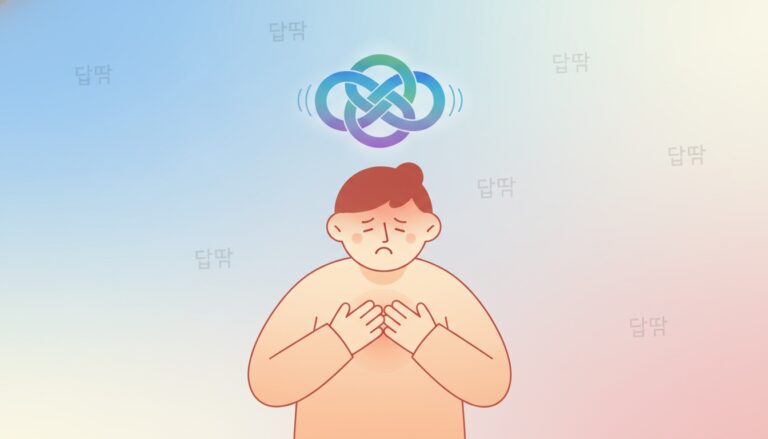
Have you ever felt a situation where things aren’t moving forward, or you just can’t explain yourself clearly, and your chest literally feels tight? In English, you might just say “I’m frustrated” or “I’m stressed.” But in Korea, we have very specific words for that physical sensation of blockage.
📖 The Story: “It’s not just anger!”
(Note: This is a synthesized case based on common struggles shared by intermediate learners.)
Meet Alex. He was trying to set up online banking in Korea. He installed five security programs, but the site kept crashing. When his Korean friend asked, “Are you angry? (화났어?)”, Alex felt that wasn’t quite right. He wasn’t just “mad”—he felt blocked, stifled, and stuck.
If Alex knew the word “답답하다 (dap-dap-ha-da),” his friend would have understood his pain immediately. Today, let’s learn how to express these complex feelings like a true local.
📝 At a Glance
- Topic: Expressing frustration, annoyance, and stress.
- Safe Zone: We will distinguish between words safe for work and words only for close friends.
- Level (B2): Beyond simple emotions like “Happy/Sad,” these words describe situations and nuances essential for adult life in Korea.
Table of Contents
- Deep Dive: 3 Key Expressions
- Textbook vs. Real Korean
- Unique Analysis: The Anger Thermometer
- Role Play: The Slow Internet Cafe
- Shadowing Challenge
- FAQ & Quiz
💡 Deep Dive: Today’s Core Expressions
1. 답답하다 (Dap-dap-ha-da)
- Meaning: Frustrated, stifled, stuffy, feeling “blocked.”
- Usage & Register:
- Very common in all situations.
- Safe to use with: Everyone (if describing a situation, not a person).
- Polite: 답답해요 (Dap-dap-hae-yo) / Casual: 답답해 (Dap-dap-hae).
- Tutor’s Secret Note:
This word is unique. It describes both physical stuffiness (like a room with no windows) and psychological frustration (like when communication fails). Koreans often hit their chest with their fist when saying this!- ⚠️ Warning: Never say “You are dap-dap-hae” to your boss. It means they are slow-witted or inflexible.
- Pronunciation Clinic:
- Written: [답답하다]
- Pronounced: [답따파다] (dap-tta-pa-da)
- Key: The second ‘ㄷ’ sounds like ‘tt’ (tensification), and the ‘ㅂ’ + ‘ㅎ’ merges into a ‘p’ sound.
- Examples:
- (Situation) 인터넷이 너무 느려서 답답해요.
- In-teo-ne-si neo-mu neu-ryeo-seo dap-dap-hae-yo.
- (The internet is so slow, it’s frustrating.)
- (Physical) 마스크를 오래 써서 답답해.
- Ma-seu-keu-reul o-rae sseo-seo dap-dap-hae.
- (It feels stuffy because I’ve been wearing a mask for a long time.)
- (Feeling) 말이 안 통해서 답답했어요.
- Ma-ri an tong-hae-seo dap-dap-hae-sseo-yo.
- (I was frustrated because we couldn’t understand each other.)
- (Situation) 인터넷이 너무 느려서 답답해요.
- Mini Quiz:
Click to see the answer
Q: Which situation is NOT “dap-dap-ha-da”?
A) Wearing a tight turtleneck sweater.
B) Winning the lottery.
Answer: B
2. 짜증 나다 (Jja-jeung na-da)
- Meaning: Annoyed, irritated (Not furious, just peevish).
- Usage & Register:
- Expressing a sudden burst of annoyance.
- Polite: 짜증 나요 (Jja-jeung na-yo) / Casual: 짜증 나 (Jja-jeung na).
- Tutor’s Secret Note:
This is the #1 word for “bad hair days,” “raining when you have no umbrella,” or “someone chewing loudly.” It’s lighter than “hate” or “fury.” -
Pronunciation Clinic:
- Written: [짜증 나다]
- Pronounced: [짜증나다] (jja-jeung-na-da)
- Key: Emphasize the double ‘jj’ (짜) strongly to sound authentic.
- Examples:
- (Situation) 차가 막혀서 진짜 짜증 나요.
- Cha-ga ma-kyeo-seo jin-jja jja-jeung na-yo.
- (I’m so annoyed because the traffic is blocked.)
- (Reaction) 아, 비 오네. 짜증 나!
- Ah, bi o-ne. Jja-jeung na!
- (Ah, it’s raining. So annoying!)
- (Work – careful!) 일이 계획대로 안 돼서 좀 짜증이 났어요.
- I-ri gye-hoek-dae-ro an dwae-seo jom jja-jeung-i na-sseo-yo.
- (I got a bit irritated because work didn’t go as planned.)
- (Situation) 차가 막혀서 진짜 짜증 나요.
3. 스트레스(를) 받다 / 풀다 (Seu-teu-re-seu-reul bat-da / pul-da)
- Meaning: To get stressed / To relieve stress.
- Usage & Register:
- Safe everywhere. Korean uses the English word “Stress,” but combines it with verbs “receive” (get) and “untie” (relieve).
- Tutor’s Secret Note:
In Korea, “How do you relieve stress?” is a common small talk question. You must know the verb 풀다 (pul-da). -
Examples:
- (Getting stressed) 요즘 회사 일 때문에 스트레스 받아요.
- Yo-jeum hoe-sa il ttae-mu-ne seu-teu-re-seu ba-da-yo.
- (I’m getting stressed because of work these days.)
- (Relieving) 저는 매운 음식을 먹으면서 스트레스를 풀어요.
- Jeo-neun mae-un eum-si-geul meo-geu-myeon-seo seu-teu-re-seu-reul pu-reo-yo.
- (I relieve stress by eating spicy food.)
- (Advice) 스트레스 받지 마세요.
- Seu-teu-re-seu bat-ji ma-se-yo.
- (Don’t get stressed out.)
- (Getting stressed) 요즘 회사 일 때문에 스트레스 받아요.
📘 Textbook vs. 🇰🇷 Reality
| Situation | 📘 Book Korean (Too Stiff) | 🗣️ Real Korean (Natural) |
|---|---|---|
| When the bus doesn’t come | 화가 납니다. (Hwa-ga nam-ni-da) “I am angry.” |
아, 진짜 답답하네. (Ah, jin-jja dap-dap-ha-ne) “Ah, this is seriously stifling/frustrating.” |
| When something is annoying | 기분이 나빠요. (Gi-bu-ni na-ppa-yo) “I feel bad.” |
아, 짜증 나. (Ah, jja-jeung na) “Ah, so annoying.” |
✅ Checkpoint:
* Use 화가 나다 (Angry) only when you are genuinely mad or furious.
* Use 짜증 나다 (Annoyed) for daily inconveniences.
* Use 답답하다 (Frustrated) when things are slow, blocked, or misunderstood.
🌡️ The “Anger Thermometer”
How intense is your feeling? Let’s check the temperature.
- 귀찮다 (Gwi-chan-ta): 🤒 36.5°C (Normal)
- “I can’t be bothered.” / “It’s a hassle.”
- 답답하다 (Dap-dap-ha-da): 🌡️ 37.5°C (Mild Fever)
- “I’m frustrated/stuck.” (Internal burn)
- 짜증 나다 (Jja-jeung na-da): 🔥 38.0°C (Hot)
- “I’m irritated/annoyed.” (Visible reaction)
- 열받다 (Yeol-bat-da): 🌋 39.0°C (Very Hot)
- “I’m pissed off/heated.” (Slangy, slightly aggressive)
- Lit: Receiving heat.
- 폭발하다 (Pok-bal-ha-da): 💥 100°C (Explosion)
- “I exploded.” / “I lost it.”
🎭 Real Life Role Play: At the Office
Situation: Sarah (Foreigner) is trying to submit a file, but the internet is extremely slow. Min-ji (Korean colleague) notices.
Sarah: (Sighs loudly) 휴…
(Hyu…)
Min-ji: 사라 씨, 무슨 일 있어요?
(Sarah-ssi, mu-seun il i-sseo-yo?)
(Sarah, is something wrong?)
Sarah: 인터넷이 너무 느려서 파일 전송이 안 돼요. 진짜 답답해요.
(In-teo-ne-si neo-mu neu-ryeo-seo pa-il jeon-song-i an dwae-yo. Jin-jja dap-dap-hae-yo.)
(The internet is so slow the file won’t send. It’s really frustrating.)
Min-ji: 아, 그거 진짜 짜증 나죠. 제가 핫스팟 켜 드릴까요?
(Ah, geu-geo jin-jja jja-jeung na-jyo. Je-ga hat-seu-pat kyeo deu-ril-kka-yo?)
(Ah, that is really annoying. Shall I turn on my hotspot for you?)
Sarah: 정말요? 고마워요. 이제 좀 살 것 같아요!
(Jeong-mal-yo? Go-ma-wo-yo. I-je jom sal geot ga-ta-yo!)
(Really? Thanks. Now I feel like I can live! [Expression for relief])
🍯 Culture Tip: Koreans often use the phrase “살 것 같다” (I feel like I can live) when a frustration (답답함) is resolved. It’s the perfect opposite of 답답하다.
🗣️ Shadowing Challenge
Let’s practice the pronunciation of “Frustrated.” Repeat this 3 times.
“Please speak a bit faster. It’s frustrating.”
좀 빨리 말해 주세요. 답답해요.
[Jom ppal-li mal-hae ju-se-yo. Dap-dap-hae-yo]
Checklist:
* [ ] Did you pronounce 답답 as [Dap-ttap]? (Tensification!)
* [ ] Did you drop your pitch at the end for a calm request?
* [ ] Did you say it 3 times?
❓ FAQ & Wrap Up
Q1: Can I say “짜증 나 (Jja-jeung na)” to my boss?
A: Absolutely NOT! That is very rude. Even with “yo” (짜증 나요), it sounds like you are complaining at them. Instead, describe the situation: “상황이 좀 답답합니다” (The situation is a bit frustrating/stagnant).
Q2: Is “Stress” (스트레스) Konglish?
A: No, it’s a loanword fully adopted into Korean. Use it freely! “스트레스 받다” is the standard phrase.
🎁 Today’s Mission
Next time you are stuck in traffic or waiting for a slow elevator in Korea, whisper to yourself: “아, 답답해!” (Ah, dap-dap-hae!) instead of just sighing.
Final Quiz
1. Which word fits best? “My computer crashed unsaved work! I am so ______!”
A) 심심해 (Bored)
B) 짜증 나 (Annoyed/Irritated)
C) 시원해 (Cool/Refreshed)
2. How do you say “to relieve stress”?
A) 스트레스를 먹다 (Eat stress)
B) 스트레스를 풀다 (Untie/Relieve stress)
C) 스트레스를 자다 (Sleep stress)
3. Fill in the blank:
“The room has no windows, so it feels ______.”
= 창문이 없어서 ______.
(Scroll down for answers)
…
Answers: 1. (B), 2. (B), 3. 답답해 (Dap-dap-hae)
Frequently Asked Questions (FAQ)
Q: What does "답답하다 (Dap-dap-ha-da)" mean in Korean and how do you pronounce it?
A: In Korean, "답답하다 (Dap-dap-ha-da)" is pronounced [see lesson guide] and means: Frustrated, stifled, stuffy, feeling "blocked."
Q: What does "짜증 나다 (Jja-jeung na-da)" mean in Korean and how do you pronounce it?
A: In Korean, "짜증 나다 (Jja-jeung na-da)" is pronounced [see lesson guide] and means: Annoyed, irritated (Not furious, just peevish).
Q: What does "스트레스(를) 받다 / 풀다 (Seu-teu-re-seu-reul bat-da / pul-da)" mean in Korean and how do you pronounce it?
A: In Korean, "스트레스(를) 받다 / 풀다 (Seu-teu-re-seu-reul bat-da / pul-da)" is pronounced [see lesson guide] and means: To get stressed / To relieve stress.







