

Hello, this is Daily Hangul! 👋
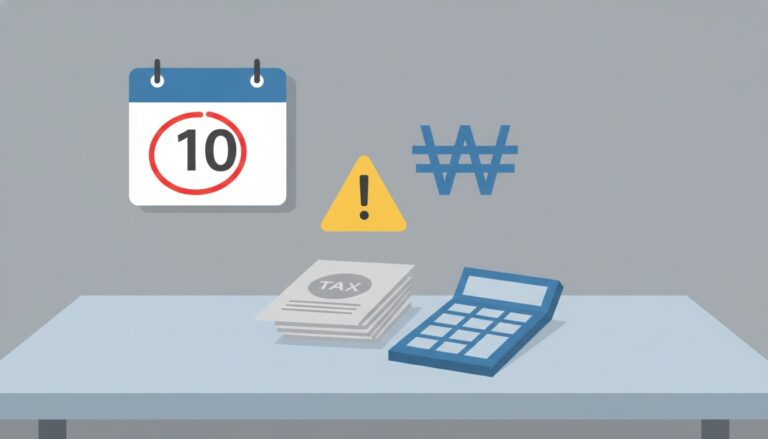
Are you running a business in Korea or working in a finance team? If so, there is one date that might haunt your dreams: the 10th of every month.
Many foreign professionals think, “I paid the salary, so I’m done!” But in Korea, the National Tax Service (NTS) waits for no one. I have seen many competent foreign managers panic when they receive a notice about unpaid taxes simply because they misunderstood the reporting cycle.
📝 Synthetic Case Study: The “10th Day” Shock
(Note: This is a synthetic example combining common mistakes made by foreign business owners in Korea.)
Meet “Alex,” a startup CEO in Seoul. He paid his employees on the 25th of last month perfectly on time. However, on the 15th of the following month, his accountant called him in a panic. Why? Alex didn’t approve the “Withholding Tax (원천세)” filing by the 10th. He thought filing taxes was an annual event, not a monthly one. The result? He had to pay a “Penalty Tax (가산세)”.
Textbooks teach you how to buy apples at the market, but they rarely teach you how to avoid tax penalties. Today, let’s learn the survival Korean for Accounting & Tax, specifically focused on Withholding Tax and Payment Statements. Let’s save your money and your reputation!
📋 Summary at a Glance
- Topic: Reporting Withholding Tax & Payment Statements
- Safe to use: Business meetings, emails to accountants, HR discussions.
- Level: C1-C2 (Advanced Business) – Essential for managers to understand obligations, even if you hire an accountant.
- Key Expressions:
- 원천세 (Withholding Tax)
- 지급명세서 (Payment Statement)
- 가산세 (Penalty Tax)
- 기한 내에 (Within the deadline)
📑 Table of Contents
- Today’s Core Expressions: Deep Dive
- Textbook vs. Real Business Korean
- Unique Analysis: The “Urgency” Thermometer
- Real Scenario Role Play: Talking to the Accountant
- Shadowing Challenge
- FAQ: Tax Mistakes
- Wrap-up & Quiz
💡 Today’s Core Expressions: Deep Dive
1. 원천세 (Woncheon-se)
- Meaning (English): Withholding Tax
- Context: Used when discussing taxes deducted from salary/income before payment.
- Register: Formal (Business/Legal).
- Tutor’s Secret Note:
- Korean employees know exactly how much
원천세is taken out. If you are an employer, saying “I forgot the Woncheon-se” makes you look very unprofessional. It implies you are not managing the company’s funds legally. - Warning: Do not confuse this with
부가세(VAT). They are totally different!
- Korean employees know exactly how much
- Pronunciation Clinic:
- [won-cheon-se]: Make sure to pronounce the ‘ch’ clearly. It’s not ‘jeon’.
- Examples:
- 원천세 신고는 매달 10일까지 해야 해요. (Woncheon-se singo-neun maedal sip-il-kkaji haeya haeyo.)
- Meaning: Withholding tax reporting must be done by the 10th of every month.
- 이번 달 원천세 납부액이 얼마인가요? (Ibeon dal woncheon-se napbu-aegi eolma-ingayo?)
- Meaning: How much is the withholding tax payment amount for this month?
- 프리랜서 소득세는 3.3% 원천징수합니다. (Peuriraenseo sodeuk-seneun sam-jeom-sam-peosenteu woncheon-jingsu-hamnida.)
- Meaning: Freelancer income tax is withheld at 3.3%.
- 원천세 신고는 매달 10일까지 해야 해요. (Woncheon-se singo-neun maedal sip-il-kkaji haeya haeyo.)
2. 지급명세서 (Jigeup-myeongse-seo)
- Meaning (English): Payment Statement / Payroll Report
- Context: The detailed report sent to the NTS stating who got paid how much.
- Register: Formal (Administrative).
- Tutor’s Secret Note:
- This is even scarier than the tax itself because the penalty for missing this is based on the total payment amount. Koreans often shorten this to
지급조서(older term) but지급명세서is the official current term.
- This is even scarier than the tax itself because the penalty for missing this is based on the total payment amount. Koreans often shorten this to
- Pronunciation Clinic:
- [ji-geup-myeong-se-seo]: The
p(ㅂ) ingeupmeetsm(ㅁ), so it sounds like[ji-geum-myeong-se-seo]due to nasalization rules.
- [ji-geup-myeong-se-seo]: The
- Examples:
- 지급명세서 제출 기한을 놓치면 안 돼요. (Jigeup-myeongse-seo jechul gihaneul nochimyeon an dwaeyo.)
- Meaning: You must not miss the deadline for submitting the payment statement.
- 일용직 지급명세서는 매달 제출해야 합니다. (Iryongjik jigeup-myeongse-seoneun maedal jechul-haeya hamnida.)
- Meaning: Daily worker payment statements must be submitted every month.
- 홈택스에서 지급명세서를 확인해 주세요. (Homtaekseu-eseo jigeup-myeongse-seoreul hwaginhae juseyo.)
- Meaning: Please check the payment statement on Hometax.
- 지급명세서 제출 기한을 놓치면 안 돼요. (Jigeup-myeongse-seo jechul gihaneul nochimyeon an dwaeyo.)
3. 가산세 (Gasan-se)
- Meaning (English): Penalty Tax / Additional Tax
- Context: Used when warning about late payments or errors.
- Register: Formal.
- Tutor’s Secret Note:
- This word creates instant tension in a meeting. If an accountant says “가산세가 나올 수 있습니다” (Penalty tax might come out), it means “Fix this NOW.”
- Examples:
- 하루만 늦어도 가산세가 부과됩니다. (Haruman neujeodo gasan-sega bugwa-doemnida.)
- Meaning: Even being one day late will incur a penalty tax.
- 가산세를 피하려면 미리 준비하세요. (Gasan-sereul piharyeomyeon miri junbi-haseyo.)
- Meaning: Prepare in advance to avoid penalty taxes.
- 불성실 신고 가산세가 꽤 커요. (Bulseongsil singo gasan-sega kkwae keoyo.)
- Meaning: The penalty tax for unfaithful (inaccurate) reporting is quite large.
- 하루만 늦어도 가산세가 부과됩니다. (Haruman neujeodo gasan-sega bugwa-doemnida.)
Alternatives
- More Casual (Internal Team): 벌금 (Beolgeum – Fine) -> Note: Not legally accurate for tax, but commonly used loosely.
- More Formal (Legal): 가산금 (Gasangeum – Surcharge for late payment).
👉 Mini Quiz: Fill in the blank (Click to see)
Q. “If we don’t file by the 10th, we have to pay _____.”
10일까지 신고 안 하면 ( )를 내야 해요.
Answer: 가산세 (Gasan-se)
⚖️ Textbook vs. Real Korean
Context: Talking about filing taxes
| Type | Expression | Nuance |
|---|---|---|
| Book Korean | 세금을 냅니다. (Segeumeul naemnida.) | Grammatically correct, but sounds like “I pay tax.” Very generic. |
| Real Korean | 신고하고 납부해요. (Singo-hago napbu-haeyo.) | Distinguishes between “filing” (reporting) and “paying.” Essential in business. |
| Book Korean | 세무서에 가요. (Semuseo-e gayo.) | “I go to the tax office.” (Nobody goes physically anymore!) |
| Real Korean | 홈택스로 처리해요. (Homtaekseu-ro cheori-haeyo.) | “I handle it via Hometax.” (The online NTS system). |
🚩 When to use what?
- Use ‘Real Korean’: When talking to your accountant, HR manager, or using the NTS website.
- Use ‘Book Korean’: When explaining general concepts to a beginner or a child.
🌡️ Unique Analysis: The “Urgency” Thermometer
In Korean business culture, how you remind someone of a deadline changes based on urgency. Here is how to push your boss or client to send documents for the tax deadline.
| Level | Expression | Translation & Nuance |
|---|---|---|
| Level 1 (D-7) | 자료 전달 부탁드립니다. (Jaryo jeondal butak-deurimnida.) | “Please send the documents.” (Polite, standard reminder.) |
| Level 2 (D-3) | 기한 엄수 부탁드립니다. (Gihan eomsu butak-deurimnida.) | “Please strictly adhere to the deadline.” (Formal pressure. “Eomsu” means strict observance.) |
| Level 3 (D-1) | 오늘까지 마감해 주셔야 합니다. (Oneul-kkaji magamhae jusyeoya hamnida.) | “You MUST finish this by today.” (Direct, urgent. No room for negotiation.) |
| Level 4 (Late) | 가산세 이슈가 발생할 수 있습니다. (Gasan-se isyu-ga balseang-hal su iss-seumnida.) | “Penalty tax issues may arise.” (The ultimate threat. Used when the deadline is at critical risk.) |
🎭 Real Scenario Role Play
Setting: A phone call between a foreign CEO (Mark) and his Korean Tax Accountant (Ms. Kim). It is the 9th of the month.
Mark: 김 세무사님, 내일이 원천세 신고 마감일이죠?
(Kim semusa-nim, naeiri woncheon-se singo magam-irijyo?)
Accountant Kim, tomorrow is the withholding tax filing deadline, right?
Ms. Kim: 네, 맞아요. 급여 대장 아직 안 보내주셨어요. 오늘 4시까지는 주셔야 해요.
(Ne, majayo. Geupyeo daejang ajik an bonae-jusyeosseoyo. Oneul ne-si-kkajineun jusyeoya haeyo.)
Yes, correct. You haven’t sent the payroll ledger yet. You must give it to me by 4 PM today.
Mark: 아, 죄송해요. 지금 바로 정리해서 홈택스에 올릴까요?
(Ah, joesong-haeyo. Jigeum baro jeongni-haeseo homtaekseu-e ollilkkayo?)
Ah, I’m sorry. Should I organize it now and upload it to Hometax?
Ms. Kim: 아니요, 저에게 보내주시면 제가 신고하고 납부서 보내드릴게요.
(Aniyo, jeo-ege bonae-jusimyeon jega singo-hago napbu-seo bonae-deuril-geyo.)
No, if you send it to me, I will file it and send you the payment slip.
Mark: 알겠습니다. 가산세 안 나오게 빨리 할게요!
(Alget-seumnida. Gasan-se an naoge ppalli hal-geyo!)
Understood. I’ll do it quickly so we don’t get a penalty tax!
💡 Cultural Tip
- 세무사님 (Semusa-nim): Always add ‘nim’ to job titles like Accountant (Semusa), Lawyer (Byeonhosa), or Doctor (Uisa) to show respect.
- 납부서 (Napbu-seo): The paper/file used to make the payment at the bank. You don’t just “pay”; you pay according to this bill.
🗣️ Shadowing Challenge
Let’s practice the most important sentence to remember the deadline. Repeat this 3 times!
“Please process the withholding tax report by the 10th of every month.”
원천세 신고는 매달 10일까지 처리해 주세요.
(Woncheon-se singo-neun maedal sip-il-kkaji cheori-hae juseyo.)
- [ ] Attempt 1 (Slow)
- [ ] Attempt 2 (Normal Speed)
- [ ] Attempt 3 (Business Professional Speed)
🔑 Pronunciation Point:
* 10일 [si-bil]: The p (ㅂ) sound in 10 (sip) moves to the next syllable. It sounds like “Si-bil”.
🙋♀️ FAQ: Korean Tax Questions
Q1: Can I just pay the tax without filing the report (Singo)?
* No! In Korea, 신고 (Filing/Reporting) and 납부 (Paying) are two steps. If you pay but don’t file the 지급명세서 or tax return, it is considered “Unfiled” (무신고) and you will pay penalties.
* Example: 신고와 납부를 둘 다 해야 해요. (You must do both filing and paying.)
Q2: Is the deadline always the 10th?
* Mostly, yes. It is the 10th of the following month. If the 10th is a weekend or holiday, the deadline moves to the next business day.
* Example: 이번 달 10일은 일요일이라서 월요일까지예요. (Since the 10th is Sunday this month, it’s until Monday.)
📝 Wrap-up & Action Item
Today we learned that in Korea, the 10th is the golden deadline for Withholding Tax (원천세), and missing it leads to the scary Penalty Tax (가산세).
🚀 Today’s Mission:
Check your work calendar right now. Set a recurring alarm for the 7th of every month labeled: “원천세 자료 준비 (Prepare Tax Docs).” Being 3 days early makes you a pro!
Have you ever panicked because of a Korean deadline? Tell me your story in the comments! 👇
🧩 Final Quiz
- What is the Korean term for the detailed report of who got paid?
A. 원천세 (Woncheon-se)
B. 지급명세서 (Jigeup-myeongse-seo)
C. 부가세 (Bugase) -
When is the usual deadline for reporting Withholding Tax?
A. The 25th
B. The last day of the month
C. The 10th of the following month -
Fill in the blank:
“신고를 늦게 하면 ( )를 내야 합니다.”
(If you file late, you must pay _____.)
Click to reveal answers
- B. 지급명세서
- C. The 10th of the following month
- 가산세 (Gasan-se)
Frequently Asked Questions (FAQ)
Q: What does "세무사님" mean in Korean and how do you pronounce it?
A: In Korean, "세무사님" is pronounced [Semusa-nim] and means: Always add 'nim' to job titles like Accountant (Semusa), Lawyer (Byeonhosa), or Doctor (Uisa) to show respect.
Q: What does "납부서" mean in Korean and how do you pronounce it?
A: In Korean, "납부서" is pronounced [Napbu-seo] and means: The paper/file used to make the payment at the bank. You don't just "pay"; you pay according to this bill.
Q: What does "납부" mean in Korean and how do you pronounce it?
A: In Korean, "납부" is pronounced [Paying] and means: are two steps. If you pay but don't file the







